
FOSTA
The component quality of deep-drawn parts is subject to uncontrollable stochastic fluctuations in series production despite extensive quality controls along the entire value chain. One way to implement a robust process …
The component quality of deep-drawn parts is subject to uncontrollable stochastic fluctuations in series production despite extensive quality controls along the entire value chain. One way to implement a robust process despite the changing input variables is to set up a control loop for process monitoring. While the indentation of the component flange is a suitable control variable for reliably determining the component quality, appropriate sensors are required to record this variable that also function in an industrial environment. In this research project, existing sensor systems for deep drawing are first analysed on the basis of various measurement methods.
Based on this, an inductive sensor system is designed, which is particularly robust against the loads acting in the process due to its structure. Two different measurement methods are tested, of which the transformer-based method is selected over the parametric method due to its higher temporal resolution. The design developed with the aid of numerical simulation is then manufactured after the necessary process chain has been worked out. Once the sensor has been installed in the tool, the main variables influencing the sensor signal are determined in the real deep-drawing process and the relevant parameters are then analysed quantitatively as part of the statistical test planning. In this context, the mould temperature, the sheet material, the measuring frequency and the hold-down force were identified as relevant influencing variables. Inaccurate blank positioning turned out to be a significant disruptive factor. In final analyses, both tearing and wrinkling could be detected in various blank materials using the measurement data from the inductive sensor.
Machine-translated title and description. The document itself is in German.

Payment by card (Stripe) or invoice (DE, AT, CH). Download link by email: automatically after ordering by card, after order approval for invoice (valid for 30 days). Terms
Digital download
Other parts and editions as well as neighbouring documents of the same series.
P 1216 - Qualification of shear cutting for making holes in steel structures Pre-hole production by shear cutting makes a significant contribution to increasing productivity. According to DIN EN 1090-2 [1], pre-hole production by shear cutting is only permissible in steel construction if t < 1.4 ? d. In connections subject to cyclic or seismic loads, lap joints with bolts above strength class 8.8 or in slip-resistant connections, shear cutting of the nominal hole diameter is generally not permitted. In DIN EN 1090-2 [1], only limited attention is paid to the hole condition and the production-related boundary conditions for shear cutting. When using shear cutting as a cost-effective pre-punching process, the production parameters such as cutting gap or punch and die geometry have a decisive influence on the cut surface quality and therefore also on the material and load-bearing behaviour in the area of the hole or the related residual cross-section of the component. By adapting the cutting parameters and system technology, it is possible to achieve up to 100 % smooth cut with no burrs. Holes produced in this way in the steel material S235JR achieve better vibration resistance behaviour than the drilled hole for component thicknesses t = 6 mm (DSt = 13 mm) and t = 10 mm (DSt = 9 mm and DSt = 13 mm). A comparison of the punched perforated bars with the drilled perforated bars does not reveal any influence of shear cutting that reduces the vibration resistance. In addition to the steel material S235JR, other steel materials such as S355J2+N, S460MC, S250GD, S350GD and HX420LAD were used in several component thicknesses. Here, too, it can be seen that a defined specification of cutting parameters (reduction of the cutting gap) has significantly improved the result of the fatigue strength test compared to state-of-the-art shear cutting. shear cutting. Publication: 2020 Authors: Prof Füssel, Prof Wanner
available anytime
€30.00
excl. VAT
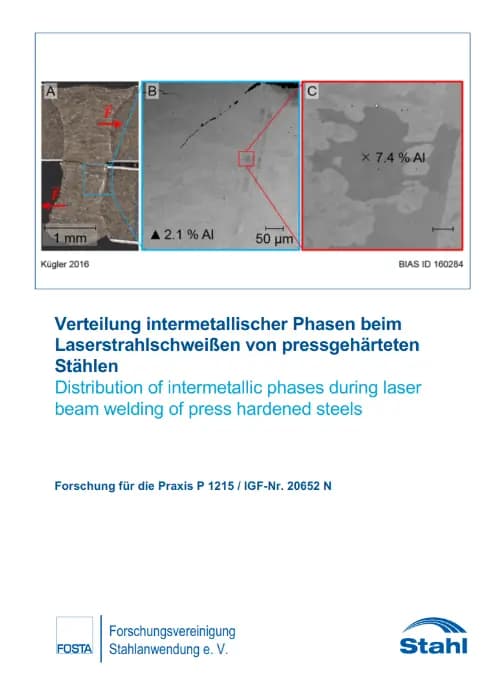
P 1215 - Distribution of intermetallic phases during laser beam welding of press-hardened steels The state of the art in joining ultra-high-strength steels shows that only reduced mechanical joining properties can be realised when press-hardened components are welded. Current results from application research on this topic show that the introduction of intermetallic phases is particularly critical in laser beam welding. These accumulate at the fusion line and have a crack-initiating effect under load. If the strength-limiting effect of intermetallic phases during laser beam welding can be minimised or avoided altogether, the potential of press-hardened components could be significantly better exploited in terms of design. The aim of the project was therefore to increase the strength of laser-welded joints of tempered manganese-boron steels by minimising the crack-initiating effect of intermetallic phases that are introduced into the weld metal. This is to be achieved by a homogeneous distribution of the intermetallic phases in the weld metal using beam modulation strategies or targeted ultrasonic coupling. Necessary basic investigations have shown, among other things, that partial decoating of one or both contact surfaces can significantly reduce the extent and size of the agglomeration of the coating components. The use of targeted ultrasonic coupling did not lead to the prevention of agglomeration formation and considerable wear of the sonotrode was found, so that no economic application could be realised for this. With regard to the use of localised beam modulation, which was comprehensively investigated using 1-D and 2-D oscillation patterns, no agglomeration could be detected with a suitable choice of parameters, which is why the method was identified as suitable for an industrial application to prevent agglomeration formation. Using energy-dispersive X-ray spectroscopy, it was possible to show that the layer residues are finely distributed in the weld structure. It was also shown that instead of a fracture along the crack-initiating agglomerations, a preferential shear fracture is achieved. Furthermore, the joint width can be increased with all modulation strategies compared to linear welding at the same welding speed, which has a positive effect on the maximum achievable force of the welded joint. The strength of the joints is less influenced by the agglomerations of the intermetallic phases, but rather in particular by the general layer penetration into the weld metal and the hardness of the microstructure and therefore a homogeneous distribution of the layer residues alone is not sufficient for an increase in strength. The applicability of localised beam modulation was demonstrated for the practice-relevant deep penetration laser welding of hat profiles. The aim of the research project to homogeneously distribute intermetallic brittle phases and thus minimise the crack-initiating effect was achieved. Publication: November 2022 Authors: Sc. M. Möbus, M. Sc. T. Mattulat
available anytime
€30.00
excl. VAT

P 1209 - Wheel load induced fatigue of crane runway girders for heavy metallurgical cranes With the replacement of DIN 18800 and DIN 4132 and the introduction of the Eurocodes for steel construction regulated by building law, it has become apparent that the fatigue analyses for highly stressed crane runway girders, such as those found in steelworks, have undergone significant changes. Compared to the previous design, stricter notch classifications, particularly in the area of wheel load application, must be taken into account. These changes can go as far as doubling the thickness of the cross-sectional components, which would mean, for example, that web plates of up to 80 mm would also have to be taken into account, whose K-seam connections to the flange would be associated with considerable problems in terms of production and monitoring and would also no longer be justifiable from an economic point of view. Against this background, the present research project derived fatigue strengths for the crane runway-specific fatigue detail "top flange-web plate connection" in EC3-1-9 Table 8.10, in particular for the heavy metallurgical crane systems concerned, and prepared them as recommendations for a rule amendment or supplement. The focus here is specifically on the detail of the wheel load introduction with KN weld design, for which no differentiation is currently made with regard to the design quality or the manufacturing process. The essential core of the methodological approach is that existing crane runway girders from practice are recorded, documented and evaluated with regard to wheel load-induced fatigue ("best practice" experience). This allows a direct quantitative statement to be made about the fatigue safety of the detail to be analysed. In addition, numerical comparative calculations are carried out to derive synthetic notch cases and existing results from previous research work are included, although these alone were not sufficient. Finally, a concept for the successful and timely implementation of the results in current standardisation is presented. FOSTA - Research Association for Steel Application e. V. Publication: April 2019 Institute for Steel Construction, RWTH Aachen University Prof. Dr.-Ing. Markus Feldmann Sandro Citarelli M.Sc.
available anytime
€30.00
excl. VAT
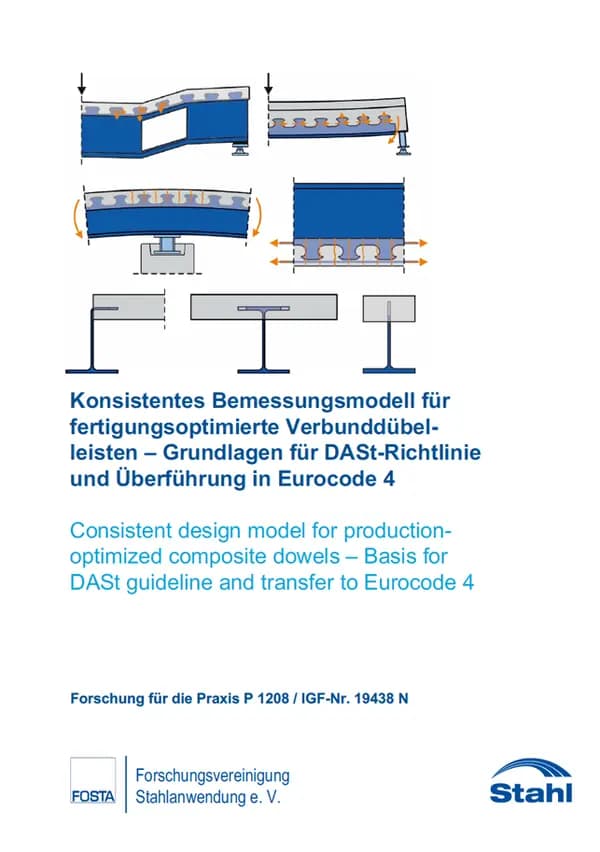
P 1208 - Consistent design model for production-optimised composite dowel bars - Basis for DASt guideline and transfer to Eurocode 4 This report summarises the investigations carried out on the load-bearing and deformation behaviour of composite dowel bars in the field of structural engineering. The competitiveness of this economical and also technically sensible composite material is limited in comparison to conventional shear stud dowels by the fact that only a national and time-limited approval is currently available. In contrast, shear connectors are firmly anchored in European regulations. In order to contribute to the integration of bonded dowel bars into the European standards, the participating research institutions focussed on the investigation of bonded dowel bars in cracked and non-cracked concrete, under longitudinal shear, tensile and combined shear-tensile loading as well as in installation positions close to the surface. New failure mechanisms were observed and recorded using appropriate design formulae. First, existing studies on composite dowel bars, as well as existing research results and design models, were reviewed and summarised. Subsequently, experimental and numerical investigations were carried out on the load-bearing capacity of bonded dowels in non-cracked concrete. The results of the small-part tests were used to derive approaches for the load-bearing behaviour under shear, tensile and combined shear-tensile loading. Component tests with three different test arrangements were used to verify the models, thus covering a wide range of possible constellations of bonded anchors under combined loading in building construction. The load-bearing capacity of the composite anchors in the beam always turned out to be better than predicted on the basis of the small-part tests. The design models therefore provide a reliable estimate of the real load-bearing capacities. Based on this, test specimens with bonded dowels were produced and tested in transversely and longitudinally cracked concrete. It was shown that longitudinal cracks have no load-reducing effect on the shear load-bearing capacity of bonded dowel bars and therefore do not need to be taken into account in the design for predominantly static loads. In contrast, a decrease in the shear load-bearing capacity was observed for transverse cracks in the concrete. Furthermore, the load-bearing behaviour of bonded dowels in installation positions close to the surface was investigated. This led to the failure case of edge breakage, which has not yet been taken into account in the current type approval and was observed in small part and beam tests. Statistically verified design equations were derived on the basis of these findings. The existing model of the shear load-bearing capacity was extended on the basis of the new findings, while the failure mode of shearing of the concrete dowel was reviewed and categorised as not relevant for the calculation. Publication: January 2021 Authors: Prof. Dr.-Ing. M. Feldmann, K. Wolters, M.Sc., Prof. Dr.-Ing. W. Kurz, Y. Broschart, M.Sc., Prof. Dr.-Ing. Hegger, Dr.-Ing. M. Claßen, G. Christou, M.Sc.
available anytime
€30.00
excl. VAT
Payment by card (Stripe) or invoice (DE, AT, CH). Download link by email: automatically after ordering by card, after order approval for invoice (valid for 30 days). Terms