
FOSTA
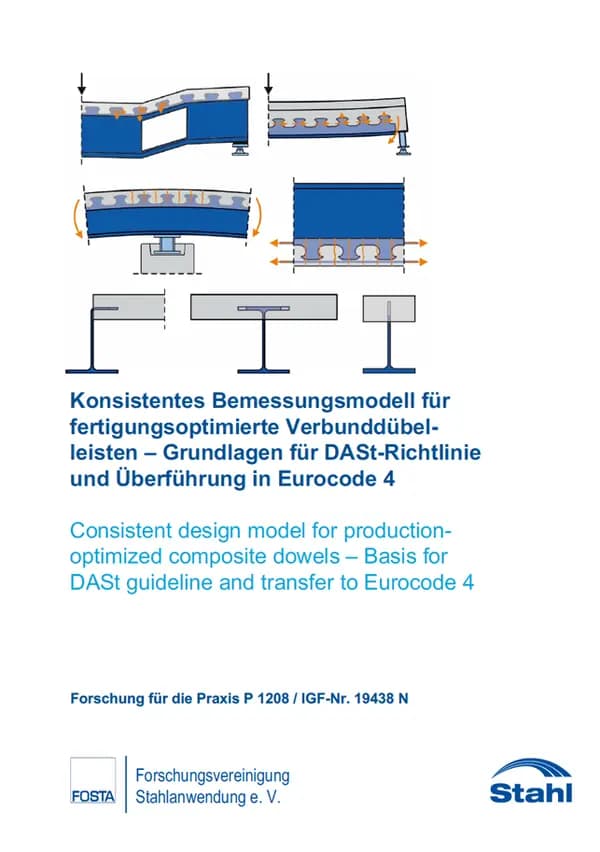
This report summarises the investigations carried out on the load-bearing and deformation behaviour of composite dowel bars in the field of structural engineering. The competitiveness of this economical and also …
This report summarises the investigations carried out on the load-bearing and deformation behaviour of composite dowel bars in the field of structural engineering. The competitiveness of this economical and also technically sensible composite material is limited in comparison to conventional shear stud dowels by the fact that only a national and time-limited approval is currently available. In contrast, shear connectors are firmly anchored in European regulations. In order to contribute to the integration of bonded dowel bars into the European standards, the participating research institutions focussed on the investigation of bonded dowel bars in cracked and non-cracked concrete, under longitudinal shear, tensile and combined shear-tensile loading as well as in installation positions close to the surface.
New failure mechanisms were observed and recorded using appropriate design formulae. First, existing studies on composite dowel bars, as well as existing research results and design models, were reviewed and summarised. Subsequently, experimental and numerical investigations were carried out on the load-bearing capacity of bonded dowels in non-cracked concrete. The results of the small-part tests were used to derive approaches for the load-bearing behaviour under shear, tensile and combined shear-tensile loading. Component tests with three different test arrangements were used to verify the models, thus covering a wide range of possible constellations of bonded anchors under combined loading in building construction. The load-bearing capacity of the composite anchors in the beam always turned out to be better than predicted on the basis of the small-part tests. The design models therefore provide a reliable estimate of the real load-bearing capacities. Based on this, test specimens with bonded dowels were produced and tested in transversely and longitudinally cracked concrete. It was shown that longitudinal cracks have no load-reducing effect on the shear load-bearing capacity of bonded dowel bars and therefore do not need to be taken into account in the design for predominantly static loads. In contrast, a decrease in the shear load-bearing capacity was observed for transverse cracks in the concrete. Furthermore, the load-bearing behaviour of bonded dowels in installation positions close to the surface was investigated. This led to the failure case of edge breakage, which has not yet been taken into account in the current type approval and was observed in small part and beam tests. Statistically verified design equations were derived on the basis of these findings. The existing model of the shear load-bearing capacity was extended on the basis of the new findings, while the failure mode of shearing of the concrete dowel was reviewed and categorised as not relevant for the calculation.
Machine-translated title and description. The document itself is in German.
Payment by card (Stripe) or invoice (DE, AT, CH). Download link by email: automatically after ordering by card, after order approval for invoice (valid for 30 days). Terms
Digital download
Other parts and editions as well as neighbouring documents of the same series.

P 1209 - Wheel load induced fatigue of crane runway girders for heavy metallurgical cranes With the replacement of DIN 18800 and DIN 4132 and the introduction of the Eurocodes for steel construction regulated by building law, it has become apparent that the fatigue analyses for highly stressed crane runway girders, such as those found in steelworks, have undergone significant changes. Compared to the previous design, stricter notch classifications, particularly in the area of wheel load application, must be taken into account. These changes can go as far as doubling the thickness of the cross-sectional components, which would mean, for example, that web plates of up to 80 mm would also have to be taken into account, whose K-seam connections to the flange would be associated with considerable problems in terms of production and monitoring and would also no longer be justifiable from an economic point of view. Against this background, the present research project derived fatigue strengths for the crane runway-specific fatigue detail "top flange-web plate connection" in EC3-1-9 Table 8.10, in particular for the heavy metallurgical crane systems concerned, and prepared them as recommendations for a rule amendment or supplement. The focus here is specifically on the detail of the wheel load introduction with KN weld design, for which no differentiation is currently made with regard to the design quality or the manufacturing process. The essential core of the methodological approach is that existing crane runway girders from practice are recorded, documented and evaluated with regard to wheel load-induced fatigue ("best practice" experience). This allows a direct quantitative statement to be made about the fatigue safety of the detail to be analysed. In addition, numerical comparative calculations are carried out to derive synthetic notch cases and existing results from previous research work are included, although these alone were not sufficient. Finally, a concept for the successful and timely implementation of the results in current standardisation is presented. FOSTA - Research Association for Steel Application e. V. Publication: April 2019 Institute for Steel Construction, RWTH Aachen University Prof. Dr.-Ing. Markus Feldmann Sandro Citarelli M.Sc.
available anytime
€30.00
excl. VAT
P 1205 - Characterisation of the load-bearing behaviour of resistance spot welded joints of ultra-high-strength steels under cyclic loading and development of a calculation concept for fatigue strength Driven by CO2 legislation and the growing demands on vehicle safety, functionality and comfort, a key approach in lightweight car body construction is to reduce the overall vehicle mass. Innovative lightweight body construction concepts with steel variants such as ultra-high-strength dual-phase and complex-phase steels are therefore required, which enable effective weight savings thanks to their outstanding strength combined with good forming properties. As knowledge of resistance spot welding of these steels, particularly in the area of fatigue strength, is only available to a limited extent, the results obtained as part of the project will help to ensure that this joining technology continues to be used successfully. Fatigue strength values are particularly useful for small and medium-sized companies, as they do not have the necessary knowledge and capacities. In order to cover a wide range of applications and for reasons of comparability and to supplement previous findings, investigations were carried out using the LWF-KS-2 test concept under cyclic loading. Fatigue strength values of spot-welded joints of these steels, determined with the aid of the LWF-KS-2 test concept, are not yet available and form the basis for the project. Experimental investigations generally entail a large financial outlay due to the required scope and duration of the tests, which is why analytical calculation methods for the design processes were developed as part of the project and corresponding design information was provided. In order to realise an efficient and practical design of spot-welded connections by analytical means, the existing set of rules, the "Rechnerische Festigkeitsnachweis für Maschinenbauteile", or FKM guideline for short, was used and expanded. A corresponding transfer function enabled the user to successively calculate the component fatigue strength for the specific application using characteristic values of the connection (e.g. quasi-static characteristic values) that could be determined at low cost or suitable literature values. In addition to the actual research objective, the crack initiation location was also analysed and the further crack progression investigated. The failure behaviour from crack initiation to complete failure of the spot-welded joints could be determined with the cut-off according to characteristic changes in stiffness or frequency and taken into account in the design based on the FKM guideline. Through simple engineering assumptions and the estimation of factors, it was possible to compare and verify analytical calculation results with the experimentally determined results for the analysed spot-welded joints. Especially in the areas of construction and design of spot-welded joints, the characteristic values determined are available to the user and extend the applicability of the FKM guideline. Against this background, the investigations carried out enable the efficient and economical development of spot-welded components made of ultra-high-strength dual-phase and complex-phase steels. Publication: 2019 Authors: Prof. Dr.-Ing. G. Meschut
available anytime
€30.00
excl. VAT
P 1203 - Design of crane structures made of laser beam and laser hybrid welded ultra-high and ultra-high strength steels under consideration of the metallurgical notch Motivated by the utilisation of the highest material strengths currently available on the market, also in joints, and against the background of the application in highly stressed areas of load-bearing structures, such as those occurring in tensile-loaded areas of the telescopic boom of mobile cranes, the research project aims at the safe and reliable use of laser beam and laser hybrid welded joints made of ultra-high-strength and ultra-high-strength fine-grain structural steels. Four fine-grain structural steels of different strength classes, one ultra-high strength (S960) and three ultra-high strength (S1100 and S1300), which are produced using different manufacturing processes (quenched and tempered and thermomechanically rolled), form the basis for this investigation. The laser beam welding process variants, laser beam without filler metal and laser-MSG hybrid, are used to produce three construction details, butt joints without and with sheet thickness jumps and welded-on longitudinal stiffeners. As a result of the test specimen welds, assessment group B or B90 is achieved regardless of the material. Significant weld seam irregularities are mainly characterised by excessive seam elevation (top and bottom side) and penetration notches (especially laser hybrid). Laser measurements of the finished samples show very small (laser beam) to moderate angular distortions (laser hybrid). Hardness measurements show high hardness values and gradients from the weld metal to the visible HAZ and, depending on the base material and as a result of the subsequent heat input, low hardness values, the so-called hardness sag, in the tempering zone. The exception here is the S1100M tested, which has hardness values at the base material level in the tempering zone. In notched bar impact bending tests for the notch position in the weld metal, only low notch impact energy values are determined; for the notch position in the HAZ, the scatter of the determined notch impact energy values increases and a crack deviation into other microstructural areas is frequently detected in the fracture surface analysis. The fatigue strength tests show that the laser-welded butt welds consistently exhibit a higher fatigue strength compared to the laser-hybrid-welded butt welds, both under constant and variable load amplitudes, clearly in the case of the butt welds without plate thickness jumps and at least moderately in the case of plate thickness jumps. The very high fatigue strength of the laser-welded butt joint made of S1100QL is striking in comparison to the other laser-welded series. The fracture surface analysis shows no to few weld seam irregularities for both the laser beam and the laser hybrid welds. The sample components made of S1300QL, which were selected based on the telescopic boom of mobile cranes, show a high degree of conformity with the corresponding laser butt-welded notch detail series. The linear accumulation of damage leads to the recommendation of a permissible damage sum of 0.5 for collective maximum values in the area of fatigue strength and for selected modifications, resulting in conservative results in approx. 97 % of cases. The applicability of the local fatigue strength assessment using the notch stress concept is shown using the example of S1100QL butt welds by comparing the recommended FAT class FAT 500 (k = 5.0) for the reference radius rref = 0.05 mm. However, compared to the FAT classes currently recommended in the regulations, a reliable estimate is not consistently made, which is why the generally valid use must be questioned on an application-specific basis. In addition, the application of the notch strain concept with the reference radii rref = 1.00 mm and rref = 0.05 mm and the cyclic material behaviour of the S1100QL is discussed on the basis of the scattering of results. For the combination of rref = 0.05 mm and the damage parameter PSWT, the overall lowest scatter is in the range of 1.32 ? 1 : TP ? 1.36. However, it is evident that the consideration of the scatter as the sole criterion of the estimation quality is not sufficient. For the classification of the fatigue strength results according to the nominal stress concept in the relevant design codes, a base material-independent consideration of the various construction details differentiated according to the welding process (laser beam without SZW or laser hybrid), based among other things on the different weld seam geometry, is expedient. Instead of the upper starting point of the design fatigue line at N = 10,000 cycles, which is selected in some codes, the definition is based on a limit upper stress, which is selected as a function of the strength class of the base material in the amount of the largest experimentally determined upper stress below the respective deformation limit. As a result, a linear extension of the Wöhler curve up to this limit stress range or a service life of well below 10,000 cycles is possible and experimentally verified, which extends the application of the nominal stress concept to a service life range that is relevant in practice. The economic efficiency analysis presented compares the analysed laser beam welding variants with the conventional MSG manufacturing variants from an economic point of view. This shows that the more detailed the analysis is to be, the more concretely the selected boundary conditions must be defined, which is why two different levels of detail are selected. In principle, a reduction in the proportion of labour costs and throughput times can be determined for the laser welding variants for two selected reference examples. In large component production, which is characterised by long lead times, the acquisition costs are a decisive factor in determining the equipment cost rates. The laser hybrid variant proves to be particularly cost-efficient due to the low-cost weld seam preparation, high welding speeds and single-pass welding. The methodological approach of setting a technical target value (e.g. fatigue strength) in direct correlation to the costs shows that, among other things, a high fatigue strength at N = 2-106 cycles in the as-welded condition cannot be achieved with all process variants. In general, it should be noted that the specific application not only plays a decisive role in cost estimation, but also provides the framework conditions for the production and use of ultra-high and ultra-high-strength fine-grained structural steels and their welded joints. Publication: 2021 Authors: Prof. Dr.-Ing. T. Melz, Prof. Dr.-Ing. T. Ummenhofer
available anytime
€30.00
excl. VAT
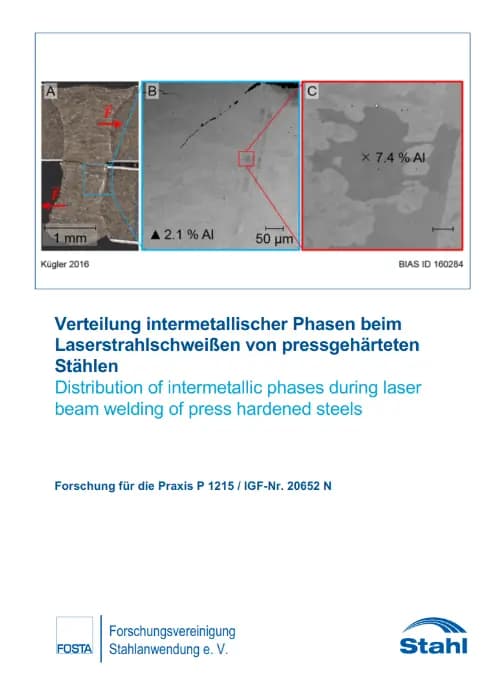
P 1215 - Distribution of intermetallic phases during laser beam welding of press-hardened steels The state of the art in joining ultra-high-strength steels shows that only reduced mechanical joining properties can be realised when press-hardened components are welded. Current results from application research on this topic show that the introduction of intermetallic phases is particularly critical in laser beam welding. These accumulate at the fusion line and have a crack-initiating effect under load. If the strength-limiting effect of intermetallic phases during laser beam welding can be minimised or avoided altogether, the potential of press-hardened components could be significantly better exploited in terms of design. The aim of the project was therefore to increase the strength of laser-welded joints of tempered manganese-boron steels by minimising the crack-initiating effect of intermetallic phases that are introduced into the weld metal. This is to be achieved by a homogeneous distribution of the intermetallic phases in the weld metal using beam modulation strategies or targeted ultrasonic coupling. Necessary basic investigations have shown, among other things, that partial decoating of one or both contact surfaces can significantly reduce the extent and size of the agglomeration of the coating components. The use of targeted ultrasonic coupling did not lead to the prevention of agglomeration formation and considerable wear of the sonotrode was found, so that no economic application could be realised for this. With regard to the use of localised beam modulation, which was comprehensively investigated using 1-D and 2-D oscillation patterns, no agglomeration could be detected with a suitable choice of parameters, which is why the method was identified as suitable for an industrial application to prevent agglomeration formation. Using energy-dispersive X-ray spectroscopy, it was possible to show that the layer residues are finely distributed in the weld structure. It was also shown that instead of a fracture along the crack-initiating agglomerations, a preferential shear fracture is achieved. Furthermore, the joint width can be increased with all modulation strategies compared to linear welding at the same welding speed, which has a positive effect on the maximum achievable force of the welded joint. The strength of the joints is less influenced by the agglomerations of the intermetallic phases, but rather in particular by the general layer penetration into the weld metal and the hardness of the microstructure and therefore a homogeneous distribution of the layer residues alone is not sufficient for an increase in strength. The applicability of localised beam modulation was demonstrated for the practice-relevant deep penetration laser welding of hat profiles. The aim of the research project to homogeneously distribute intermetallic brittle phases and thus minimise the crack-initiating effect was achieved. Publication: November 2022 Authors: Sc. M. Möbus, M. Sc. T. Mattulat
available anytime
€30.00
excl. VAT
Payment by card (Stripe) or invoice (DE, AT, CH). Download link by email: automatically after ordering by card, after order approval for invoice (valid for 30 days). Terms