Fatigue-stressed, welded hollow section constructions have great economic potential in civil engineering, mechanical engineering and plant construction. Welded hollow section joints occur particularly frequently as …
Fatigue-stressed, welded hollow section constructions have great economic potential in civil engineering, mechanical engineering and plant construction. Welded hollow section joints occur particularly frequently as plane K-joints or spatial K- or KK-joints, which are therefore the subject of this research project. Recently, more and more thick-walled structures have been designed, but there are still no rules introduced by the building authorities for their design. In particular, there are no rules for fatigue limit state checks, which often have to be carried out on the basis of the structural stress concept. The aim of the project was therefore to develop a standardised proposal for a corresponding DASt guideline based on the results of the predecessor project P815. To this end, the fatigue verification was developed on the basis of previous tests and the tests carried out as part of this project by means of statistical analyses and systematic numerical investigations, taking into account the scale effect, also for thick-walled hollow sections, and the associated area of application was defined.
Two important additional aspects of the investigations carried out were the extension of the application to large-format hollow sections d0 > 500 mm and the development of practical recommendations for the design and quality assurance of the weld seam geometry. Tests on large-format hollow sections (?660 × 60 mm flanges) were able to extend the previous area of application to formats that are particularly popular in bridge construction and in the offshore industry. The influences of weld seam irregularities and weld seam formation were quantified on the basis of 27 component-like fatigue tests on individual K-nodes with specific root gap size and seam shape. With the help of the proposal for a DASt guideline, it will be possible in the near future to provide contractors with a safeguard for the economical design of weld seams. Weld seam irregularities that do not exceed a certain value and that would otherwise have been costly to repair can thus remain inside the hollow profile nodes. These investigations were accompanied by targeted ultrasonic testing using phased array technology, in which a testing methodology for the complex weld seam geometry was also developed and validated. For steel construction SMEs in bridge, crane and building construction or for offshore projects or wind turbines, this provides an opportunity for particularly economical production, while engineering firms are no longer reliant on complex special solutions with rib reinforcements etc. thanks to a standardised solution.
Machine-translated title and description. The document itself is in German.
Payment by card (Stripe) or invoice (DE, AT, CH). Download link by email: automatically after ordering by card, after order approval for invoice (valid for 30 days). Terms
Digital download
Other parts and editions as well as neighbouring documents of the same series.

P 1162 - Minimum dowelling of composite beams in case of fire As part of the research project, the effects of increased temperatures on the bond joint of a composite beam in the event of fire were investigated. The research results should enable the safe application of the partial bond theory for composite beams in fire. For this purpose, the limits of the application of reduced dowelling in the event of fire, in particular a minimum degree of dowelling, were sought. In addition to the unit temperature-time curve as a thermal effect, natural fire curves were also analysed. For this purpose, possible fire scenarios were determined and thermal effects on composite beams were calculated on the basis of typical areas of application for composite construction. Four large-scale fire tests were carried out, each with two 9 m long composite beams. As part of the experimental investigation, the longitudinal slip in the composite joint, the vertical deformations and the temperatures of the steel girder, the concrete chord and the core temperature of the shear stud dowels were recorded. Detailed solid models were created using the FE programme Abaqus (1) and validated with the results of the fire tests. These models were used to carry out a comprehensive numerical investigation with several parameter studies. With the help of the numerical and experimental investigations, a large number of influences on the composite joint in the event of fire could be described and evaluated. Important results are the identification of three effects of increased temperatures on the composite joint, the limitation of decisive load combinations on the composite beam in the event of fire, as well as statements on a large number of decisive influences on the maximum slip of the composite joint. These include the stiffness of the bond joint, the degree of dowelling of the bond beam and the relationship between the concrete tensile strength and the shear load-bearing capacity of the bond joint. Finally, practice-oriented design equations and limits for the safe application of the partial composite theory for composite beams in the event of fire are given. Publication: 2019 Authors: Prof. Dr.-Ing. M. Mensinger, Dr.-Ing. S. Pfenning, Prof. Dr.-Ing. Zehfuß
available anytime
€30.00
excl. VAT

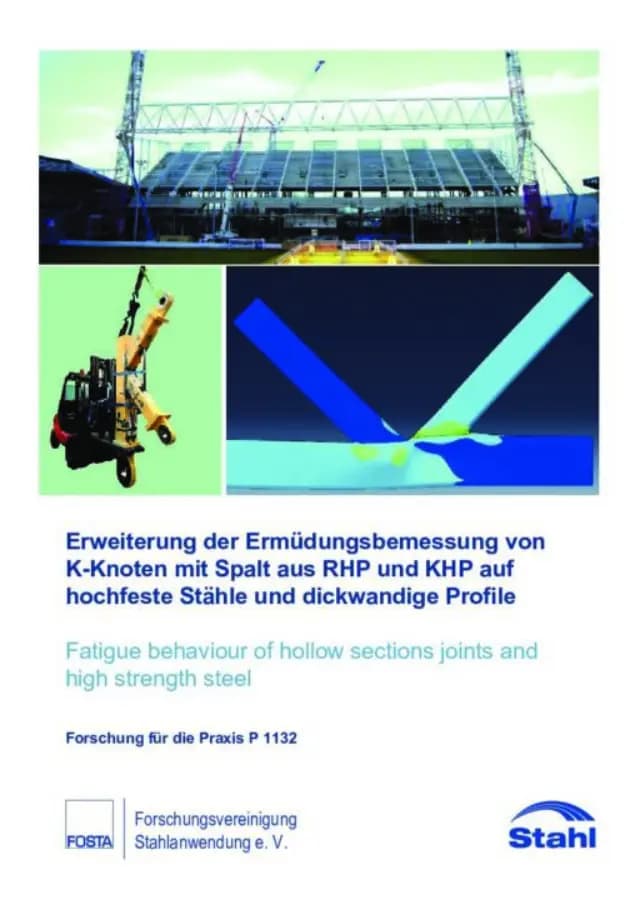
P 1132 - Extension of the fatigue design of K-nodes with gap made of RHP and KHP to high-strength steels and thick-walled sections Fatigue-stressed structures are increasingly being manufactured from high-strength steels in order to realise lightweight construction. In truss construction, the K-node with gap is the favoured node configuration. To facilitate the application and design of such nodes made of high-strength steel grades and with greater wall thicknesses, the existing design rules must be adapted and extended. The test programme carried out for this purpose comprises a total of 55 fatigue tests on K-nodes made of rectangular hollow sections (RHP) and circular hollow sections (KHP) of different dimensions made of S355, S500 and S700. K-knots of smaller dimensions are tested at TNO in Delft, Netherlands, on a test rig with individual cylinders. K-knots with large dimensions are tested at KIT in Karlsruhe on a specially manufactured test frame. The experimental tests are analysed according to the nominal stress concept of EN 1993-1-9 (2010) by creating Wöhler curves. In particular, the tests on small KHP K nodes with a welded gap show that the fatigue strength depends not only on the node dimensions and geometric parameters but also on the weld design and geometry. This is not taken into account in the design rules, but can be used for the design of fatigue-compliant structures. For example, the fatigue strength of KHP K nodes with a welded gap can be increased by two notch classes from 71 to 90. In contrast, the small RHP K-nodes investigated are manufactured with weld start and end points in the corners of the strut profiles, which means that the weak point of the weld seam coincides with the hot spot of the geometry. The test results of these test specimens therefore represent a lower limit for the fatigue strength. The fatigue strength of K-nodes depends heavily on the wall thickness of the components and their ratio value <span class="fontstyle3">t</span>. The classification for the nominal stress approach is therefore rightly based on the inverse wall thickness ratio 1/<span class="fontstyle3">Τ = t0 / Τi. The results of the fatigue tests on large RHP and KHP K-nodes made of S355 and S700 with 20 mm wall thickness fit well into the existing notch classes and can be categorised according to CIDECT Design Guide 8 or EN 1993-1-9 (2010) without wall thickness reduction. In parallel, numerical calculations are carried out to extend the scope of validity. The finite element models are calibrated using strain measurements in verification tests. Volume elements are used for this purpose and the weld seams are also modelled in order to enable an exact representation of the local stresses in the weld seam. A parameter study is carried out to extend the parameter range under consideration and to identify the influence of individual geometric parameters such as chord slenderness 2<span class="fontstyle3">y, wall thickness ratio <span class="fontstyle3">t, width or diameter ratio ß or strut inclination angle O<span class="fontstyle3">. For RHP K-nodes, 72 different node configurations are calculated, each with 4 separate load cases. KHP K-nodes are calculated in 16 different dimensions with 3 load cases each, so that a total of 336 FE models are created, calculated and analysed within the parameter study. In addition, stress concentration factors are determined on the basis of the strain measurements in the test. These are then used together with the results of numerical parameter studies to validate or adapt existing SCF formulae. For RHP K-nodes, a re-evaluation of previous and new data for the load case "Axial loading of the strut (AX)" is carried out and suitable formulas with a slight modification of existing CIDECT formulas are provided. For RHP K-nodes with gap under in-plane strut bending (IPB), no formulae are given in CIDECT. A new set of equations has been developed for this purpose. The evaluation of the structural stresses of KHP K-nodes under axial loading of the struts shows that the SCFs according to CIDECT formulas often provide very conservative values compared to the SCFs according to DNV GL-PR-C203 (2016) and from FEA. Since DNV GL-PR-C203 (2016) has a wider range of application and provides SCF formulas for the IPB and out-of-plane bending (OPB) load cases, it makes sense to use these formulas. Only the formula for SCFs for the belt under IPB is modified so that the SCFs are on the safe side. As the fatigue strength of hollow section connections is heavily dependent on the non-dimensional parameters, this should be taken into account at the planning stage by selecting suitable parameters. Through careful planning and execution, fatigue-resistant hollow section structures can be realised, even when using high-strength steels. Publication: March 2020 Authors: Dr.-Ing. S. Herion, Dr.-Ing. Hrabowski, Prof. Dr.-Ing. T. Ummenhofer, Dipl.-Ing. P. Ladendorf, Dr. ir. R. Pijpers
available anytime
€50.00
excl. VAT

P 1131 - Alloying concepts and process strategies for press-hardening steels with increased residual formability One effective way of reducing emissions from passenger cars is to reduce the weight of the vehicle. The greatest savings potential lies in the area of car body construction, where, for example, high-strength steels are now replacing conventional thin sheet materials. However, the use of high-strength steels to increase vehicle safety in the event of a crash is particularly challenging. One of the most efficient processes for manufacturing crash-relevant components, such as the B-pillar, is press hardening, in which forming and hardening are combined in a single process step. The material 22MnB5 (1.5528) is currently used in the industrial series production of press-hardened components, but its ductility in the hardened state is limited due to the alloy concept. An improved property profile consisting of strength and residual formability is being sought for increased vehicle occupant safety in the event of a crash. This project is therefore concerned with the development of new alloy concepts and process strategies to improve the residual formability of press-hardened steels. Three different alloying concepts were investigated: the dual-phase concept (DP), the grain refinement concept (KF) and the retained austenite concept (RA). Depending on their chemical composition, different heat treatment cycles were combined with press hardening for a total of 6 steels. The investigations focussed on the microstructure development and the resulting characteristic properties in the tensile and bending test. In addition, the coatability and further processability by welding were investigated. It was demonstrated that an improvement in the ductility of press-hardened materials in the RA concept can be achieved by complex Q&P structures (quench&partitioning). In contrast, the DP and KF concepts, which were also investigated, showed only a marginal improvement in the property profile. The best properties in the RA concept result for a material with 0.3 wt% C and 2.5 wt% Mn with tensile strength values of 1400-1500 MPa and elongation at break values of 14-19 % depending on the respective heat treatment. Further tests on this alloy show that the material is temper resistant and therefore suitable for stove enamelling in vehicle production. Joining can be carried out by both laser beam and spot welding. Hot-dip coating with both AlSi and zinc coatings is possible in principle. This project has thus succeeded in demonstrating possibilities for improving the material properties of press-hardened steels using a Q&P heat treatment strategy. The crash absorption potential of the materials produced was doubled compared to the reference material 22MnB5. Publication: 2021 Authors: Prof. Dr.-Ing. W. Bleck, Dipl.-Ing. A. Rüskamp, M.Sc. Y. Sparrer
available anytime
€30.00
excl. VAT

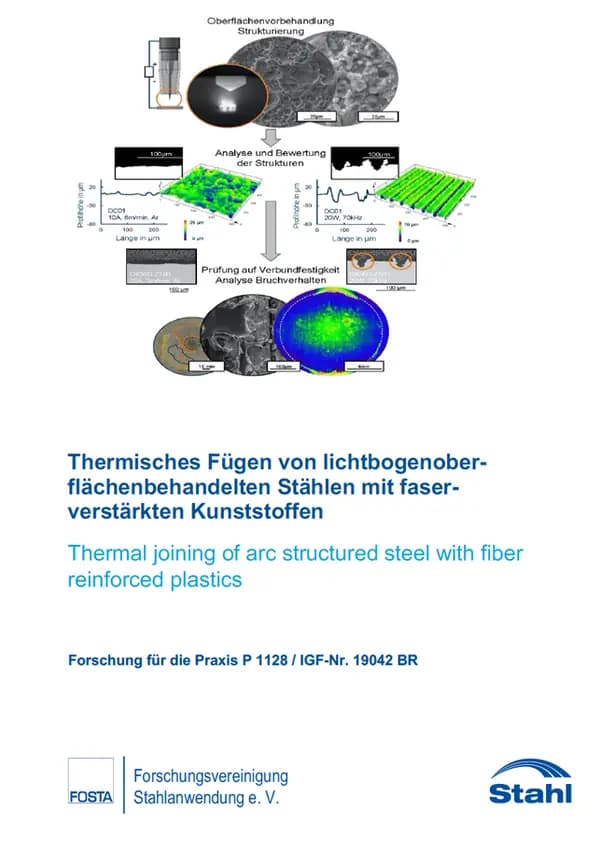
P 1128 - Thermal joining of arc surface-treated steels with fibre-reinforced plastics The thermal joining of metallic and polymer materials offers advantages over mechanical joining processes and bonding. In order to achieve sufficient adhesive strength, it is advantageous to increase the surface area of the metallic joining partner. Beam or laser processes are mainly used for this purpose. The surfaces produced are evaluated by determining geometric parameters, but also by wettability tests. Depending on the material and structuring process, adhesion strengths of between 5.2 MPa and 43 MPa could be researched in the available literature. Surface structuring using electric arcs has hardly been documented to date. The structures produced are highly irregular and it is not known to what extent existing methods can be used for surface evaluation. The aim of the project was to structure metallic surface structures using conventional arc technology. The surface-treated metals are used to produce hybrid metal-plastic composites. Laser structures were generated in continuous wave (cw) and pulsed mode as a reference for the arc structure. The focus of the investigations was the characterisation of the generated structures with regard to their topographical and energetic properties as well as their effects on the wetting and the resulting fracture behaviour. The investigations were initially carried out on model point-shaped tests to determine the tensile strength for different material pairings. The results were then transferred to industrial joining geometries (linear tests). In addition to the materials mentioned, fibre-reinforced thermoplastics were also used. The knowledge gained is intended to contribute to current research into new joining processes for hybrid material composites. The process parameter analysis for the creation of laser-structured surfaces in pulsed and cw laser operation shows clear differences in the achievable structural shapes. Using the cw process, mainly deep structures can be produced. The number of passes is decisive for the geometry of the resulting pattern. From a number of passes of i = 2, a drop-shaped pattern with undercuts is produced. Pulsed laser radiation can be used to create wide, flat structures with low pulse frequencies (f = 20 kHz). As the pulse frequency increases (f = 60 - 70 kHz), drop-shaped structures can be produced due to the resulting pressure. Publication: January 2021 Authors: M.Sc. M.-L. Solf, Dr.-Ing. K. Schricker, Univ.-Prof. Dr.-Ing. habil. J. P. Bergmann, Dipl.-Ing. M. Lohse, Dr.-Ing. M. Hertel, Prof. Dr.-Ing. habil. U. Füssel
available anytime
€30.00
excl. VAT
Payment by card (Stripe) or invoice (DE, AT, CH). Download link by email: automatically after ordering by card, after order approval for invoice (valid for 30 days). Terms