In constructions made of thicker steel sheets (approx. 3-8 mm) in agricultural machinery and plant engineering, adhesive bonding technology has so far only been used to a limited extent, although it is already an …
In constructions made of thicker steel sheets (approx. 3-8 mm) in agricultural machinery and plant engineering, adhesive bonding technology has so far only been used to a limited extent, although it is already an established joining method in other areas of application. Bonded joints are generally characterised by excellent behaviour under vibration load, which was also demonstrated on thicker steel sheets in a previous SME study by FOSTA e.V. in random sample tests. The main objectives of the project are - Experimental investigation of the strength behaviour of bonded joints made from thicker thicker sheets using higher-strength steels.
Comparison of the strength behaviour of bonded and welded joints, - Development of a procedure for the design of bonded joints under cyclic loading as an cyclic loading as an alternative to welded joints. For this purpose, the joint and seam forms of welded construction details commonly used in agricultural machinery and plant engineering are analysed at the beginning and evaluated with regard to the feasibility of adhesive bonding solutions. A bracket connection is selected as a bonded sample component for subsequent investigations. At the beginning of the research project, the strength behaviour is examined in quasi-static, Wöhler and fatigue strength tests using the example of a lap joint suitable for adhesive bonding technology without and after exposure to media or corrosion. It is shown that bonded joints under quasi-static loading fall significantly short of the strength of the welded joints investigated. However, the strength of the bonded joints can be increased by using higher-strength adhesives. The potential of bonded joints lies in the high-cycle fatigue range. Due to the significantly lower notch effect, the fatigue behaviour above approx. 105 to 106 load cycles is much more favourable compared to welded joints. The influence of medial and corrosion effects must always be taken into account, i.e. seam seals are required in zones subject to greater stress in this respect. The high resistance to fatigue identified at the lap joint is also evident in the sample components analysed, provided the joint zones are sufficiently rigid. The lightweight construction potential of bonded high-strength steels is clearly demonstrated by the fact that a reduction in sheet thickness has a significantly lower impact on the service life compared to welded joints. To ensure handling strength in production, mechanical processes accessible from one and two sides (blind rivets, etc.) are analysed and evaluated. Finally, recommendations for the methodological procedure for the development of structural adhesive bonds for agricultural machinery and plant engineering are formulated from the project results. Based on the data obtained, a concept for determining the component S-N curve and the component fatigue strength using nominal shear stresses in accordance with the FKM guideline is presented.
Payment by card (Stripe) or invoice (DE, AT, CH). Download link by email: automatically after ordering by card, after order approval for invoice (valid for 30 days). Terms
Machine-translated title and description. The document itself is in German.
Digital download
Other parts and editions as well as neighbouring documents of the same series.

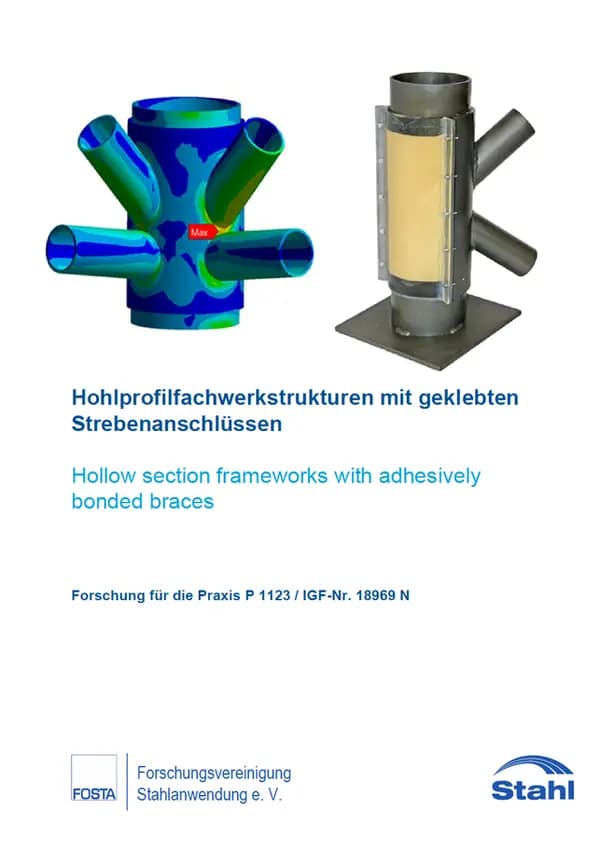
P 1123 - Hollow section truss structures with bonded strut connections Foundation structures for offshore wind turbines are often designed as jacket truss structures for water depths of more than 20 metres. Until now, the individual hollow profiles of these truss structures have been joined by welding. Due to the spatial intersection of the pipe profiles at the junctions and the resulting complex weld seam geometries, as well as the large open areas required for final assembly, this represents a major manufacturing effort. An innovative hybrid connection of the struts to the corner posts of these supporting structures is the focus of this research project. The concept combines the joining methods of bonding, welding and bolting by forming nodal partial shells at the ends of the struts. These individual partial shells are formed in such a way that they enclose the corner strut and are completed to form a complete shell during assembly. After the individual partial shells have been bolted together, the remaining gap between the gusset ring shell and the corner post tube wall is joined using adhesive technology. This work step takes place in the manufacturing plant and therefore under defined ambient conditions. This design has the advantage that permanently acting static loads (such as dead weight) are almost completely dissipated by the continuous corner stems. Furthermore, the lack of welded connections on the corner posts results in an increase in local fatigue strength. In addition, the hybrid connection enables prefabrication of the struts and the modular design of the jacket. First, the requirements and boundary conditions of the jacket support structure are analysed and defined in the research project. In close cooperation with companies from the offshore wind energy sector, the stresses from wind, wave impact and turbine operation are determined. Real climate data measured on research platforms in the North Sea is also analysed and the requirements for the adhesive bond are derived from this. Due to the dimensional tolerances of the bonded parts, thick-film bonds of up to 25 mm are required. Extensive numerical investigations are used to analyse the stress on the bonded joint and steel structure. Numerical models of the entire jacket support structure are created for this purpose. A global framework model is combined with volume models in the area of the bonded connections in order to determine the local stress of the bond. It is shown that both highly rigid and elastic adhesives can be used due to the design of the connections. In the next step, suitable, commercially available 2-component adhesives are selected on the basis of the boundary conditions and requirements. These are characterised experimentally. Based on the results, two adhesives are then prioritised in coordination: a highly rigid 2-component polyurethane adhesive and an elastic 2-component adhesive based on EP-PU hybrid. Publication date: January 2021 Authors: Dr.-Ing. M. Albiez, J. Damm, M.Sc., Prof. Dr.-Ing. T. Ummenhofer, Dipl.-Wirt.-Ing. S. Myslicki, Dr. T. Vallée, H. Ehard, M. Eng., Prof. Dr.-Ing. Ch. Schuler
available anytime
€30.00
excl. VAT

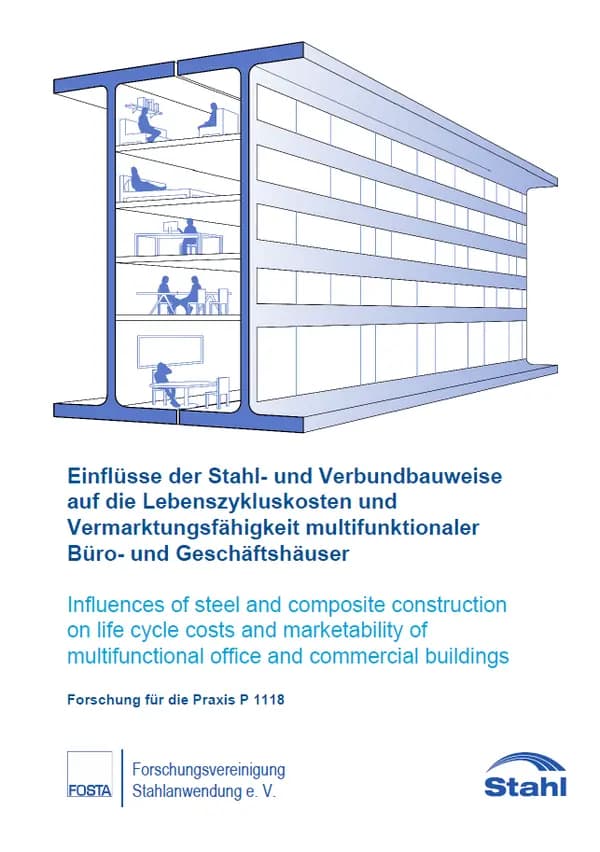
P 1118 - Influences of steel and composite construction on the life cycle costs and marketability of multifunctional office and commercial buildings Demographic change and increasing sustainability awareness are examples of changing social conditions that have an impact on the user requirements for multi-storey buildings. Resource conservation, recyclability, life cycle costs and value retention, even under changing property conditions, are increasingly at the centre of planning. The competitiveness of rental and usable space depends, among other things, on whether the spatial structures offer the necessary flexibility to adapt to these dynamic processes. Experience in recent decades has shown that the construction of low-cost monofunctional building structures and urban districts, as has been the case in many places since the 1970s, often leads to premature vacancies and even demolition, as the primary structure is not sufficiently adaptable. The aim of the research project was to develop multifunctional building structures and to utilise the potential of steel and composite construction. This should increase the long-term marketability and sustainability of the properties. The subject of the research report is firstly an analysis of the current situation of the property market and the causes of structural vacancy. This is followed by a presentation of revitalisation projects that have already been carried out and a summary of the findings for property planning. The basics of the sustainability assessment of buildings and building elements as well as the assessment methods used in the project are presented in the second chapter. Based on the findings from previous revitalisation projects, Chapter 3 develops recommendations for the property planning of multifunctional buildings. The requirements of different types of use, such as clear storey height, building depth or access, are summarised. The requirements of variable building structures result from the overlapping of these aspects. These are illustrated using designs of reference buildings with different degrees of variability. Building on the property planning requirements, Chapter 4 derives the design implications resulting from multifunctional utilisation. The properties of classic and multifunctional ceiling systems in composite construction as well as the influences of fire protection, façades and building foundations are analysed. The ecological, monetary and functional influences of the various building components are assessed in parameter studies. The effects of increased variability and the extension of the service life are analysed using the reference building as an example. Chapter 5 analyses the market segments relevant to the research project and their development. Furthermore, the utilisation type-specific revenues and monetarily assessable risks are determined. The investigations form the basis for stochastic scenario analyses, through which a statement can be made on the fluctuation range of the forecast costs, revenues and defined target figures. Building on this, Chapter 6 uses the example of the reference buildings to determine the expected returns based on the return on equity for various conversion scenarios. The effects of the individual input parameters are analysed in sensitivity analyses. The analyses carried out show that suitable planning precautions can increase the variability of building structures and enable a variety of uses. The steel and composite construction method with efficient load-bearing structures allows the adaptability of buildings without significantly increasing the ecological or monetary costs of construction. If the extension of the life cycle is created by the increased variability, there are clear advantages. Ultimately, the profitability analyses show that a higher initial investment leads to a long-term increase in returns and a reduction in the risk of vacancy in many scenarios. Publication: March 2020 Authors: Prof. Dr.-Ing. Richard Stroetmann, Dipl.-Ing. Lukas Hüttig, Prof. Dipl.-Ing. Johann Eisele, Dipl.-Ing. Architect Benjamin Trautmann, Prof. Dr.-Ing. Dipl.-Wirt.-Ing. Jens Otto, Dipl.-Ing. Anne Harzdorf, Dipl.-Ing. Cornell Weller
available anytime
€30.00
excl. VAT

P 1125 - Increasing technological properties by cryo-treatment of tool steels As part of the project, the effects of cryogenic treatment on the microstructure, mechanical properties and wear resistance of the high-alloy tool steels X38CrMoV5-3 (electroslag remelting process (ESR)), X153CrMoV12 (powder metallurgy (PM) and fusion metallurgy (SM)) and ~X190CrVMo20-4 (PM) were investigated. The tempering parameters of the samples for the mechanical tests and those of the wear samples were selected on the basis of the tempering curves so that a similar hardness was present for both the conventionally heat-treated and the cryo-treated samples. Although a finer, martensitic microstructure and a more homogeneous distribution of secondary carbides in the X38CrMoV5-3 was achieved by including a cryogenic treatment in the conventional heat treatment or an increased amount and a more homogeneous distribution of secondary and nano carbides in the X153CrMoV12 and ~X190CrVMo20-4 steels could be attributed to the cryogenic treatment, no differences were found in the mechanical properties and in various wear tests (sandpaper method, wear cup and cavitation erosion). The wear resistance of the high-alloy tool steels depends to a large extent on the primary carbides and the macro hardness, less on the secondary or nano carbides. Both cryo-treatment and tempering three times at high temperatures achieved an almost complete conversion of the retained austenite into martensite in the small samples. Cryogenic treatment of tool components with large wall thicknesses would have a positive effect, as a uniform and complete transformation of the retained austenite is achieved over the entire cross-section. This allows the user to better assess the cryogenic treatment technology and thus utilise it in a more targeted manner, thereby achieving improved results or saving costs. Publication: 2021 Authors: Dr.-Ing. A. Schulz, Dr.-Ing. F. Nürnberger, Dipl.-Ing. T. Ümit
available anytime
€30.00
excl. VAT

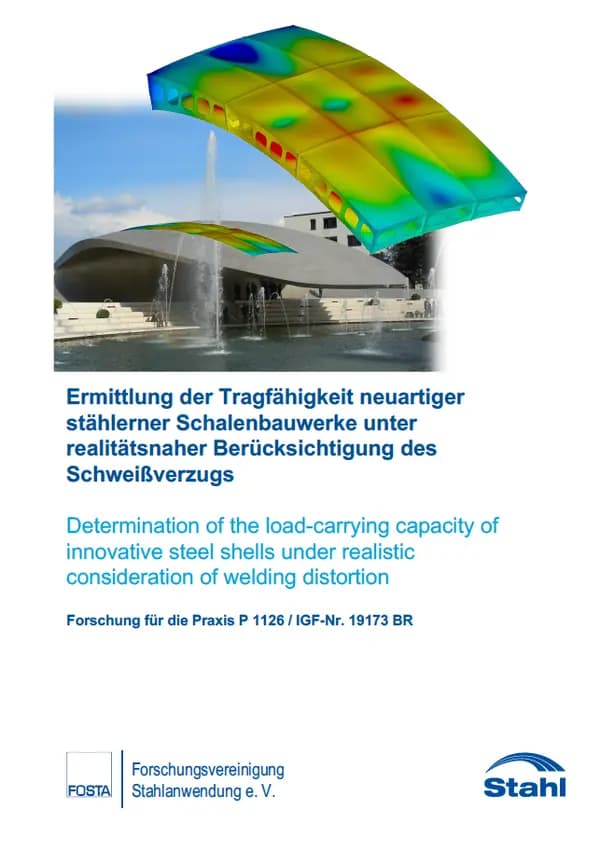
P 1126 - Determination of the load-bearing capacity of novel steel shell structures under realistic consideration of welding distortion Recently, stiffened shell structures (so-called monocoque) have been increasingly used in steel construction. Due to the slender construction methods, buckling is a limit state that must be taken into account. A geometrically and materially non-linear analysis of the imperfect shell structure (GMNIA) has the highest theoretically achievable degree of reality. Its verification quality depends crucially on whether the imperfections introduced into the calculation model describe the effect of the imperfections of real structures equivalently. In principle, it is now possible to reliably predict the effects of the welding process using welding simulation. The analytical-numerical hybrid model developed at the LFT offers a practice-relevant methodology for the welding simulation of large components. From a design perspective, an interface to the welding simulation is to be realised and subsequently verified. The aim of the project was to provide a robust and reliable calculation method for a numerically supported GMNIA verification of welded shell structures. In contrast to previous approaches, this is the first time that this has been done directly using hybrid approaches to capture the influences of the welding process. The analytical numerical hybrid model was used to calculate the welding imperfections. In order to be able to use the model to calculate the welding imperfections that occur when welding curved structures in space, the underlying analytical model had to be extended. Based on numerical variation calculations, an acquisition function was derived that takes into account the curvature in space and the resulting reduced stiffness. The hybrid model has already been successfully applied to a large number of differently complex components. However, the focus was on welding distortions. Little attention has been paid to the localised stress state in the near-seam area. However, it influences the load-bearing behaviour of welded components. Both the verification of the stresses calculated using the hybrid model with the results from thermomechanical calculations and the validation with radiographic measurements showed good agreement. Only a new meshing strategy was developed to improve this. Since in most cases the stiffeners are welded on both sides, an influence function was derived based on the source method, which takes into account the intermediate time between the two welds and records its effect on the plastic strains. Publication: August 2020 Authors: Prof. Dr.-Ing. habil. H. Pasternak, Dr.-Ing. Ch.Stapelfeld, Dr.-Ing. Launert, Prof. Dr.-Ing. habil. V. G. Michailov, Dr.-Ing. N. Doynov, C. A. Kaya
available anytime
€30.00
excl. VAT
Payment by card (Stripe) or invoice (DE, AT, CH). Download link by email: automatically after ordering by card, after order approval for invoice (valid for 30 days). Terms