 FOSTA
FOSTAP 129 - Investigation of the strength behaviour of bonded and shrink-fit shaft-hub connections under oscillating torsional loading
P 129 - Investigation of the strength behaviour of bonded and shrink-fit shaft-hub connections under oscillating torsional loading Shaft-hub connections are used for load transmission between shaft and hub. As they are one of the most commonly used machine elements, there are many different types of design, which can be categorised as positive, frictional or material-locking connections depending on the type of load transmission. Bonded connections are basically material-locking connections. The material bond eliminates all degrees of freedom of relative movement between the shaft and hub. Whereas a few decades ago shaft-hub connections were mainly designed as parallel key connections, nowadays the shrink-fit connection is increasingly coming to the fore. The advantages of this type of connection are the absence of additional connecting elements and the favourable mechanical behaviour under varying loads. Parallel key connections, on the other hand, can deflect with changing torques, so that proper operation is no longer possible. Shrink-fit connections also eliminate the additional operation of groove milling and the resulting reduction in the cross-section of the shaft. Since adhesive bonding technology has also become increasingly important for joining metals over the last 30 years, it makes sense to produce shaft-hub connections both exclusively as an adhesive joint and in combination with adhesive bonding and shrinking. Anaerobic adhesives are particularly suitable for shaft-hub joints, as these single-component products can be cured at room temperature in the narrow joining gap in the absence of air. Even the bonded wave-grain joint leads to quite high breaking strengths when subjected to rapid stress. The adhesive joining process therefore also opens up an interesting field of application for wave-grain joints. The advantages of such joints are manifold. Adhesive bonding can be used to join parts made of a wide variety of materials with low heat and without distortion. Especially with bonded shaft-hub connections, lower tolerance qualities are also possible in many cases than with conventional connections. The elastic plastic bonding layer - to name just a few advantages - has a damping effect and exerts a sealing and corrosion-inhibiting effect. Adhesive-shrink joints also have other advantages, but there is a lack of comprehensive test results on their mechanical behaviour, particularly under vibrating loads. In order to further increase user confidence in this type of joint, it is necessary to carry out such tests. Results on this problem area are the subject of this report. Based on the knowledge available in the literature, investigations into the mechanical behaviour under rapid quasi-static and oscillating torsional loading are reported. Publication: 1987 Authors: Prof. Dr.-Ing. Hahn, Dr.-Ing. A. Grunau
available anytime
View details →€20.00
excl. VAT
 FOSTA
FOSTAP 125 - Experimental investigations on the plastic behaviour of composite columns
P 125 - Experimental investigations on the plastic behaviour of composite columns Publication: 1988 Authors: Prof. Dr.-Ing. K. Roik, Dipl.-Ing. K. Schwalbenhofer
available anytime
View details →€30.00
excl. VAT
 FOSTA
FOSTAP 124 - Load-bearing capacity of composite continuous beams for building and industrial construction with special consideration of flexible dowelling
P 124 - Load-bearing capacity of composite continuous beams for building and industrial construction with special consideration of flexible dowelling By utilising their cross-sectional and system reserves, continuous composite beams can be designed plastically if the indented parts of the steel sections fulfil the requirements of Class 1. In the case of slender cross-sections assigned to class 2, only the plastic reserves could previously be utilised. This can be a disadvantage for composite beams, as the main load-bearing capacity is in principle determined by the span cross-section area. However, it cannot be fully utilised if the redistribution of the support cross-sections into the span sets a tracking limit. It was therefore desirable, despite the prevailing risk of buckling, to allow large plastic deformation on the internal supports even with Class 2 cross-sections. This was achieved. However, it should be noted that the support cross-section must be reduced by calculation in such cases. One of the aims of this research project was to determine the effect of such a reduction on the load-bearing capacity. On a two-span beam with a centred concentrated load, it was shown that the reduction of Mpl,s to 80 % due to local instability reduces the ultimate load by only 4 %. In cases where the plastic zero line is high and thus the span cross-section becomes ductile, the ultimate load can even increase if the steel beam in the span is transferred to the hardening zone. The work has also shown that the yield hinge theory can be applied to continuous steel composite systems of the type presented here, even if the rolled sections only fulfil the requirements of class 2. If the beams are sufficiently deformable in the area of the support moments, the full moment redistribution can be taken into account - with a mathematical reduction of the column cross-section. Since the tests were carried out on rolled beams with complete dowelling and support stiffeners on both sides, it was also shown that the bending load-bearing capacity does not have to be reduced due to the simultaneously acting shear force. The tests apply specifically to the hot-rolled beams of the corresponding dimensions analysed here and under the other specified conditions. For higher beams, where lateral-torsional buckling may be expected, special tests must be carried out. STUDIENGESELLSCHAFT FüR ANWENDUNGSTECHNIK VON EISEN UND STAHL e.V. Publication: 1987 Authors: Prof. Dr.-Ing. H. Bode, Dipl.-Ing. W. Fichter, Dipl.-Ing. J. Schanzenbach, Dipl.-Ing. H.-J. Uth
available anytime
View details →€50.00
excl. VAT
 FOSTA
FOSTAP 123 - Electro gas narrow gap welding with filler material in strip form for vertical welding positions
P 123 - Electro gas narrow gap welding with filler material in strip form for vertical welding positions Despite some significant progress in the field of mechanised high-performance welding processes for vertical seams with large connection dimensions, manual electrode welding and MIG / MAG welding still predominate for this application in the construction of large containers, ships and heavy machinery in German and international industry. The disadvantages of these processes are well known: low deposition rates of 2-3 kg / h, the risk of errors in the welded joint due to a lack of care and attention on the part of the welder, high labour costs due to the need for qualified welder training in conjunction with the limited working speed due to the achievable deposition rate and often even the lack of availability of a sufficient number of adequately qualified welders. The step towards mechanising the welding of vertical butt welds of non-alloy and low-alloy structural steels led to the development of electrogas and electroslag processes. For sheet thicknesses of around 8 to 40 mm, the electrogas welding process has a special place. In contrast to manual welding, whether electric arc or MIG/MAG, the process offers clear technological advantages in terms of accuracy and uniformity of the seam formation, as the human, unavoidable uncertainty factor is reduced to a minimum by the use of machines. But even compared to other partially or fully mechanised processes, such as submerged arc welding in a tank position, the process has advantages, as the weld pool has long periods of time available for degassing due to the design of the process and these effects are further supported in the vertical position by utilising the force of gravity. Furthermore, many joining tasks, such as the production of cylindrical shots from segments, can be solved much more easily and quickly if the individual segments can be welded vertically. This is because there is no need for complex positioning and support measures, which are necessary for welding the sheets in the trough position and can cause considerable problems depending on the component dimensions and wall thickness. If economic aspects are also taken into account, such as the high performance of the process and the relatively low investment costs for the purchase of new electrogas welding equipment, the advantages in terms of economical production become clear. The fact that the process has not yet become widely accepted (at least in Germany), despite the above-mentioned arguments, is due to the relatively high energy input of the process into the base material, which is at a higher level than that of submerged arc welding, for example. If it were possible to modify the concept of gas metal arc welding in such a way that the disadvantages of the high energy input into the base material could be avoided while retaining the advantages of high seam quality, high reproducibility of the welding results, high deposition rates, ease of operation and simple seam preparation, it would be possible to offer a welding process that would be competitive even in comparison with other processes generally used today, such as submerged arc welding, and possibly even offer clear advantages in technological, economic and metallurgical terms. In order to achieve this goal, the project investigated the usability of strip filler material for gas metal arc welding. The strip was to be inserted into the gap parallel to the sheet edges in order to make the best possible use of the characteristic properties of the strip as a filler material, especially for the vertical constrained position. Publication: 1987 Authors: Prof. Dr.-Ing. F. Eichhorn, Dipl.-Ing. Pyrasch
available anytime
View details →€20.00
excl. VAT
 FOSTA
FOSTAP 121 - Stabilisation of hot-rolled I-beams with gratings
P 121 - Stabilisation of hot-rolled I-beams with gratings Gratings are used as easy-to-install load-bearing prefabricated elements, in particular as a covering material for walkable and drivable floor surfaces such as platforms, tegals or as a cover over horizontal openings. Of decisive importance in such applications are the good light and air permeability, high load-bearing capacity with low dead weight, easy installation and removal, the inherently slip-resistant surface and the fact that liquids and dirt cannot be deposited. The clear focus for the use of gratings is in industrial construction; however, they have also been increasingly introduced in the construction industry in general, for example as sun protection gratings and as façade walkways or as step elements for outdoor staircases. The present research work focusses on the interaction of steel girder scaffolding and mounted grating. By taking into account the stabilising effect of the grating element, the load-bearing capacity of the supporting steel girders is to be increased, thereby improving the cost-effectiveness of the overall structure. The work was carried out with financial support from the Federal Minister for Research and Technology at the Institute for Building Structures and Strength, TU Berlin, Prof.Dr.-Ing. J. Lindner, on behalf of the Studiengesellschaft für Anwendungstechnik von Eisen und Stahl e.V. (Study Association for Application Technology of Iron and Steel). STUDIENGESELLSCHAFT FÜR ANWENDUNGSTECHNIK VON EISEN UND STAHL e.V. Publication: 1985 Authors: Prof. Dr.-Ing. J. Lindner, Dipl.-Ing. I. Stickel
available anytime
View details →€30.00
excl. VAT
 FOSTA
FOSTAP 111 - Cold-formed, lightweight steel profiles as structural components in structural engineering applications
P 111 - Cold-formed, lightweight steel profiles as structural components in structural engineering applications The expansive development in the field of thin-walled cold-formed components used as linear and planar structural components (cold-formed profiles and profiled sheets) poses a variety of problems for partners in the construction process, as this construction method involves a development towards the structural unity of the load-bearing structure and interior design. The basic concept of lightweight construction technology is the end product - the wall, the room or the building - thanks to the possibility of forming flat construction elements, to which the user makes justified demands in terms of safety, functionality, environment and economy. Lightweight construction technology therefore lies at the intersection of different schools of thought and disciplines, which requires the dismantling of facultative boundaries and the integration of knowledge across many disciplines. These overarching problems form the framework of the research project "Cold-formed lightweight steel profiles as structural components in structural engineering applications"; they are systematically presented in section 2 of the report. The choice of the actual research object is also to be understood in this sense. The so-called "V-beam" is a load-bearing structure composed of cold-formed profiles and trapezoidal profile panels and designed as a hall construction system that can fulfil a wide range of functional requirements. The system thus exemplifies the possibilities of lightweight construction technology with regard to interior design, the adaptation of the supporting structure to installation requirements for various media and acoustic requirements, while the supporting structure itself is an example of the functional and statically possible design of the individual load-bearing elements with regard to the forms of loading and the rational "online" production of the construction elements, transport and assembly, which is reported on in Section 3. The overall concept was studied in detail at the beginning of the research project on a model (1:30) by the project team. This model construction is worth mentioning because the "hands-on" involvement with the very slender and flexible supporting structure components, followed by the assembly and the associated increase in the load-bearing capacity and rigidity of the supporting structure via the flat discs to the spatial system, simultaneously awakened a feeling for possible load-bearing conditions and motivated the task. The theoretical and experimental investigations on parts of the overall structure were focussed on the load-bearing behaviour of the structural components and their interaction in accordance with the objective of the research project. The experimental investigations, which were planned and carried out by H. Urschel and R. Wolfram, included the study of the girder webs consisting of trapezoidal profiles under predominantly shear loading and consideration of the load transfer at the support, tests on elastically bedded cold-formed chord profiles and the study of the connecting means between chord and web and in the vertical joints of the trapezoidal profiles. The test results are presented in connection with the analytical treatment of the three sub-problems mentioned. Section 4 contains the analysis of the shear field behaviour, for which R. Wolfram is responsible, section 5 the analysis of the load-bearing behaviour of the chords carried out by H. Urschel and section 6 the evaluations of the load-bearing behaviour of the connections in entire structures jointly prepared by both employees. Section 7 rounds off the research report with recommendations for a future set of rules for the dimensioning and structural design of load-bearing structures made of thin-walled cold-formed components and trapezoidal profiled sheets. Publication: 1985 Authors: Prof. tekn. dr. R. Baehre
available anytime
View details →€50.00
excl. VAT
 FOSTA
FOSTAP 110 - Measures to improve utilisation and increase the load-bearing capacity of cold profiles
P 110 - Measures to improve utilisation and increase the load-bearing capacity of cold profiles The research "Measures to improve the utilisation and increase the load-bearing capacity of cold-formed sections" aims to utilise the load-bearing reserves not covered by the simplified verification and the increases in load-bearing capacity that can be achieved by design measures. The report is divided into three parts, the contents of which are summarised below. Part 1 deals with the following topics: - Solution of the branching problem " lateral-torsional buckling with profile deformation" for thin-walled but not buckling-prone top-hat and C-profiles. A Fortran programme system is available. - Quantification of the warping stress effect of truss nodes. - Constructive measures to increase the vault leg tension effect. - Model tests to validate the theoretical findings. - Development of a lateral-torsional buckling analysis suitable for manual calculation for members supported under arch loads with detailed calculation examples. Part 2 deals with the problems: - Solution of the branching problem "lateral-torsional buckling with section deformation" for single or frame members stiffened with tie plates. A Fortran programme system is also available here. - Carrying out model tests a) Torsion tests b) Bending-torsional buckling tests 2to check the theoretical approaches. - A simplified verification method suitable for manual calculation is proposed for single bars with hat or C-profile cross-sections. Part 3 analyses the longitudinal stiffening of plates by beads. The common calculation model - beams on elastic bedding as buckling bars - is compared with precise calculations. The difficulties in determining the stiffness values are shown and curve tables for the buckling loads of the beads are given for total and partial buckling. The appendix contains curve tables for C and hat profiles, from which all cross-section values required for the lateral-torsional buckling analysis with profile deformation can be read. The application is shown in a calculation example. This research has made a remarkable contribution to the mathematical determination of the load-bearing capacity of open cold-formed profiles. In addition, design measures have been shown that lead to an increase in the load-bearing capacity of cold-formed profiles. The design aids provided lead to a significant simplification of the stability analyses and set priorities for the applying engineer. While the investigations in Parts 1 and 2 were able to lead to a simple design method that can be used in practice, the design concept in Part 3 has not yet been fully clarified to the point of simple methods for practical application because the time available was not sufficient. The work was funded by the Federal Ministry of Research and Technology (BMFT) and was supervised by Kernforschungsanlage Jülich GmbH (KFA) as the project sponsor for the raw materials research programme. The work was carried out at the Technical University of Darmstadt, Institute for Statics, Prof. Dr.-Ing. The administrative management of the project was the responsibility of the Studiengesellschaft für Anwendungstechnik von Eisen und Stahl e.V. STUDIENGESELLSCHAFT FÜR ANWENDUNGSTECHNIK VON EISEN UND STAHL e.V. Publication: 1986 Authors: Prof. Dr.-Ing. R. Schardt, Dipl.-Ing. M. Hanf, Dipl.-Ing. Chr. Schardt
available anytime
View details →€40.00
excl. VAT
 FOSTA
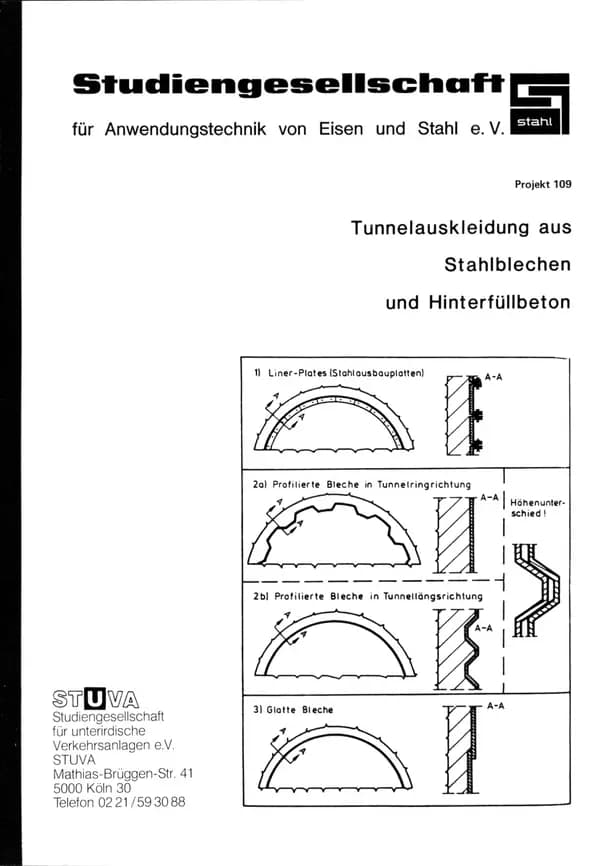
FOSTAP 109 - Tunnel lining made of steel sheets and backfill concrete
P 109 - Tunnel lining made of steel sheets and backfill concrete The Studiengesellschaft für Anwendungstechnik von Eisen und Stahl and the Studiengesellschaft für unterirdische Verkehrsanlagen e . V. - STUVA - have long been concerned with the question of whether tunnel linings made of steel can offer a technically and economically viable alternative to today's standard tunnelling lining methods. Research reports from earlier years are available, which included the following investigations: - Recommendations on the construction and corrosion protection of underground steel structures, sheet piling, segments, plates - Load-bearing capacity tests for thin-walled steel tunnelling profiles - The design and ultimate load calculation of steel tunnel linings - Underground steel structures, notes and recommendations for planning, calculation and execution It is well known that concrete and cast iron are the predominant lining materials used in tunnelling. The examples of the use of steel linings in the Federal Republic of Germany and abroad (Austria, Great Britain, USA or Japan) must still be regarded as exceptions. While there is already extensive positive experience in the Federal Republic of Germany with tunnels constructed using the cut-and-cover method and with steel linings, it is still largely unclear whether the use of steel in the lining of tunnels excavated underground is economically feasible, especially in low mountain ranges. The following considerations played an important role in the realisation of this research work: In comparison to today's conventional support and lining methods in underground tunnelling, advantages can be achieved with the steel lining. This single-shell construction makes it possible to achieve the final lining in a single work step when produced in stages. The high final safety standard is therefore achieved immediately. In contrast, those lining methods that install the shell in two stages exhibit reduced stability over a period of months. The new type of lining using steel means significantly greater occupational safety for the miners, in particular improved head protection. Furthermore, the lining work can be mechanised to a greater extent with the steel composite construction method, again in contrast to shotcrete construction methods, for example, which require a great deal of manual work in the front excavation area. Finally, the new lining enables high-quality sealing of the tunnel against the ingress of rock water. In addition, any leaks can be easily localised and repaired thanks to the steel sheet construction on the inside. In contrast, all concrete linings require extensive grouting work in the event of leaks. This report, which is available to experts, shows some alternatives for the new type of tunnel lining with technical and - as far as possible - economic assessments. Although initial comparative calculations with conventional solutions show that composite steel sheet construction methods cause additional costs of approx. 5-10% depending on the rock cover, rock water, water pressure and type of lining, it must be borne in mind that such tunnels have not yet been built. It was therefore necessary to calculate with some uncertainties. A realistic cost calculation can only be made after a demonstration project in which all previous estimates are replaced by practical empirical values. It may well turn out that the new sheet steel composite construction method is also more economical than conventional experience. STUDIENGESELLSCHAFT FÜR ANWENDUNGSTECHNIK VON EISEN UND STAHL e.V. STUDIENGESELLSCHAFT FÜR UNTERIRDISCHE VERKEHRSANLAGEN e.V. - STUVA Publication: 1986 Authors: Dr.-Ing. J. Schreyer, Dipl.-Ing. P. Heffels
available anytime
View details →€30.00
excl. VAT
 FOSTA
FOSTAP 104 - Investigations into the reduction of noise emission from steel railway bridges by design measures
P 104 - Investigations on the reduction of noise emission from steel railway bridges by design measures As part of the research project "Investigation into the reduction of noise emission from steel railway bridges through structural measures", extensive theoretical and experimental investigations were carried out on a railway box girder bridge on behalf of the German Federal Railway and the German Steel Construction Association under the auspices of the Studiengesellschaft für Anwendungstechnik von Eisen und Stahl e.V. (Study Society for Application Technology of Iron and Steel). The main part of the investigations was carried out at the Krupp Research Institute in Essen and the Thyssen Research Centre in Kassel in cooperation with the DB Testing Institute in Munich. Sound intensity measurements and an operational vibration analysis were carried out by the company Deutsche Metravib GmbH, Ostfildern. The Federal Railway Central Office in Munich was responsible for providing the measurement trains, preparing the measurement route and coordinating all operational procedures. The Krupp Research Institute in Essen was responsible for the technical management of the project. The project began on 1 July 1984, but preparations had already been made in the spring of 1984. After preliminary investigations on approx. 10 railway bridges, the box girder bridge over the Aitrach (line kilometre 16.287, the single-track line between Leutkirch and Memmingen) built in 1980 was chosen as the test object. Although this bridge can be described as particularly quiet in comparison to other steel bridges originally considered and also to the open line, it was particularly suitable for the fundamental investigations planned here, above all because of its simple and clear construction. This report summarises all the important results and findings resulting from the project. Where cross-references ("HB") are made at certain points to another source, this is in all cases a planned documentation that may be set up at a central location at a time not yet determined. Publication: 1988 Authors: o.A.
available anytime
View details →€20.00
excl. VAT
 FOSTA
FOSTAP 102 - Experimental investigation of the load-bearing capacity of steel profile columns set in concrete with special consideration of the long-term behaviour of concrete
P 102 - Experimental investigation of the load-bearing capacity of steel profile columns set in concrete with special consideration of the long-term behaviour of concrete Increasingly, composite columns are being used in industrial and building construction. Due to the small cross-sectional dimensions combined with high load-bearing capacity, the special requirements of industrial construction in particular can be met. In terms of their favourable load-bearing behaviour - especially under fire stress - concrete-encased I-profiles are of particular importance. In addition, this cross-sectional design gives the column component greater rigidity than a pure steel profile; the concrete encasement can be used as impact protection and also ensures corrosion protection. Composite columns have also proven themselves in production and assembly practice. The advantages of precast concrete construction can be utilised in the production of the columns and the proven connection technology of steel construction can be used in the assembly. The design and construction of composite columns is regulated in DIN 18806 Part 1 "Composite structures, composite columns" /1/. Taking into account the design principles for reinforced concrete columns and steel columns, this standard contains a calculation method that enables the practical calculation of composite columns. Numerous tests were analysed to develop the simplified design method of DIN 18806. These were essentially short-term tests, i.e. without the influence of creep and shrinkage of the concrete. The method specified in the standard for taking into account the influence of the long-term behaviour on the load-bearing capacity was derived from the regulations for solid construction on the basis of theoretical investigations. For concrete-filled pipes, the method has already been confirmed by tests /10/. The aim of the present test programme was to check or, if necessary, modify the regulations of the standard for concrete-filled profiles as well. Publication: 1987 Authors: Prof. Dr.-Ing. K. Roik, Dr.-Ing. I. Mangerig
available anytime
View details →€20.00
excl. VAT
 FOSTA
FOSTAP 101 - Investigations into the fatigue and fatigue strength of the dowelling of composite beams using shear stud dowels
P 101 - Investigations into the fatigue and fatigue strength of the dowelling of composite beams using shear stud dowels Dowelling plays an extremely important role as a method of creating and securing the bond between the steel girder and the concrete chord in composite construction as a whole, but especially in composite girders. In the practice of bridge construction, welded head bolt ends of various makes have already become widely accepted. While the load-bearing and failure behaviour of shear connectors for static loads has been well researched experimentally for some time, this has not yet been the case for dynamic loads, such as those occurring in composite girders in railway and road bridge construction, crane runways and other plant engineering structures. The object of this research, the results of which are presented in this final report, is to answer these still open questions and to gain better knowledge of the fatigue and operational strength of dowelling in the sense of a safe and at the same time economical design of such structures. Taking into account the fact that individual investigations of certain sub-areas in this subject area have led to different interpretations and sometimes conflicting interpretations in various national rules and regulations, this work is intended to contribute to the fact that the knowledge gained within the framework of this research can be used both for well-founded advice on the "European Recommendations" (European Recommandations for composite constructions, Chapt. 6 Connectors/ January 1985) as well as for the development of a new German composite beam standard. The final report is divided into two volumes: Volume I contains the actual research results; the material is presented in detail and should therefore fulfil all practical requirements. Volume II summarises the data material, which is available in the form of tables of measured values, design sheets, material characteristics and plots of measured values. This volume of material is only issued on special request. STUDIENGESELLSCHAFT FÜ R ANWENDUNGSTECHNIK VON EISEN UND STAHL e.V. Publication: 1986 Authors: Prof. Dr.-Ing. K. Roik, Dipl.-Ing. H. J. Holtkamp
available anytime
View details →€70.00
excl. VAT
 FOSTA
FOSTAP 100 - Development of characteristic values for the production of cold rolled profiles from the point of view of economical production of dimensionally accurate profiles
P 100 - Development of characteristic values for the production of cold rolled profiles from the point of view of economical production of dimensionally accurate profiles Cold profiling using the roll forming process is a forming process that has been used industrially for over half a century. It allows the production of cold-formed profiles with consistent and high dimensional accuracy, some with sharp-edged bends, many curved sections, complicated double folds, with - if desired - targeted work hardening of the starting material and finally the combination of profile shaping with further processing steps such as punching, beading and bending. Although the diverse requirements and the general technical development of mechanical engineering have led to a wide variety of roll forming systems over the course of time, the technology of roll forming is still largely based on practical experience. This applies both to the dimensioning of production facilities and to the design of forming tools. This unsatisfactory situation can probably be explained essentially by the fact that the entire process - in addition to the rather difficult geometric relationships of forming - is governed by numerous working conditions which influence each other. For this reason, the Technical Committee of the German Cold Forming Association has been working closely with a well-known plant manufacturer for several years on the development and dimensioning of a machine and drive concept for research purposes. A machine and control technology solution was developed and realised which for the first time makes it possible to empirically investigate the interactions between the parameters of the production process and the properties of the product in a reproducible manner. This research work was carried out on behalf of the Studiengesellschaft für Anwendungstechnik von Eisen und Stahl e.V. by Prof. Dr.-Ing. D. Schmoeckel, Institute for Forming Technology at Darmstadt Technical University. In addition to confirming some of the results of earlier investigations, new findings of practical relevance were obtained. This applies in particular to the experiments on slip reduction, which resulted in a drastic saving in the energy used, and on the relationship between the quality of the finished product and the selected forming strategy. These results represent a step towards a better understanding of the complex manufacturing process, but at the same time demonstrate the need for further intensive efforts to conduct in-depth research into roll forming technology. The research project was funded by the Federal Ministry of Research and Technology (BMFT) and was supervised by Kernforschungsanlage Jülich GmbH (KFA) as the project sponsor for the raw materials research programme. STUDIENGESELLSCHAFT FÜR ANWENDUNGSTECHNIK VON EISEN UND STAHL e.V. Publication: 1986 Authors: Prof. Dr.-Ing. D. Schmoeckel, Dipl.-Wirtsch.-Ing. U. Eichler
available anytime
View details →€30.00
excl. VAT