
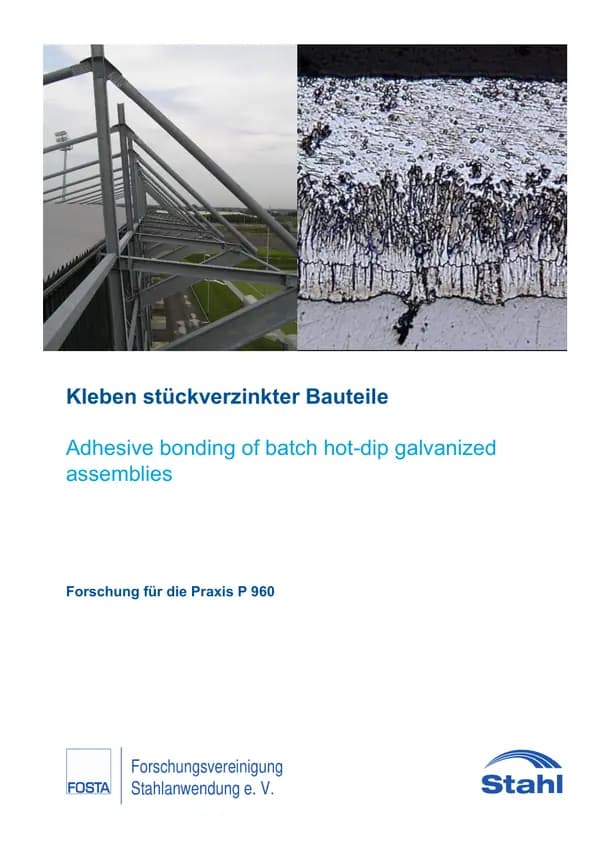
P 960 - Bonding of piece galvanised components
P 960 - Bonding of galvanised components The aim of the research project was to develop an application concept for reliable adhesive bonding of galvanised semi-finished products with a focus on applications in …
Content
- Publication
- January 2019
- Authors
- Univ.-Prof. Dr.-Ing. M. Feldmann, Dipl.-Ing. B. Abeln, Dr.-Ing. Richter, Univ.-Prof. Dr.-Ing. P. L. Geiß, Dr.-Ing. J. Stahl
P 960 - Bonding of galvanised components The aim of the research project was to develop an application concept for reliable adhesive bonding of galvanised semi-finished products with a focus on applications in commercial vehicle construction and the building industry. The focus was particularly on determining the adhesive strength of the zinc layer in terms of mechanical load-bearing capacity and defining suitable surface pre-treatment processes. Preliminary tests were used to investigate the influence of the steel alloy and galvanising method on the adhesion of batch-galvanised surfaces. A selection of three high-strength and high-modulus adhesives was made for the special requirements of the construction and commercial vehicle industries.
Show full description
Taking into account the steel alloy and galvanising method, adhesive surface pre-treatments were examined and classified with regard to their layer removal on piece-galvanised surfaces. Based on a simplified utility value analysis, a selection of predominantly wet-chemical surface pretreatments was made and, by means of light microscopic investigations on metallographic sections, a selective layer removal in the area of the pure zinc phase of the zinc layer could be set. In addition to the usual "sweeping" process, two pickling media were selected for use on batch galvanised surfaces by immersion and spraying. Furthermore, the condition of the zinc layer without layer removal before bonding was analysed using unaged and pre-weathered zinc layers. Three sample geometries from the field of bonding and surface technology were batch galvanised and subjected to accelerated ageing exposures and outdoor weathering. This revealed a clear influence of the surface pre-treatment on the ageing resistance of the composites in combination with the adhesives used. The wet-chemical surface pre-treatments investigated were listed in pickling instructions in order to ensure reliable application to small galvanised components and to serve as a contribution to the application guideline. The results of the standardised test specimens could be transferred to small component samples and the applicability of the pickling instructions was confirmed during the production of the small component samples. With the help of the component tests, the load transfer in the steel-zinc layer-adhesive composite could be investigated on practical component geometries, the applicability of the surface pretreatments to commercially available sizes could be ensured and the numerical models could be calibrated and optimised. Finally, design and dimensioning rules for construction practice were derived. The knowledge gained will enable the subsequent long-term joining of piece-galvanised semi-finished products using adhesive bonding technology.
Zum Zoomen hovern
€50.00excl. VAT
Payment by card (Stripe) or invoice (DE, AT, CH). Download link by email: automatically after ordering by card, after order approval for invoice (valid for 30 days). Terms
P 960 - Bonding of piece galvanised components—
€50.00