
P 950 - Strain-based design criteria for unfired pressure vessels - Demonstration of an extended DBF method
High-strength steels enable a significant reduction in material and energy consumption, e.g. through reduced wall thicknesses and shorter welding times. Nevertheless, these materials are currently hardly used in …
Content
- Publication
- July 2019
High-strength steels enable a significant reduction in material and energy consumption, e.g. through reduced wall thicknesses and shorter welding times. Nevertheless, these materials are currently hardly used in pressure vessel construction. One reason for this is the lower permissible utilisation rates of the yield strength prescribed in the regulations due to high safety factors on the tensile strength. However, these normative specifications are based on experience with normal-strength steels and do not take into account the very good toughness properties of modern high-strength steels. Damage mechanics models are able to reproduce the failure of high-strength steels in finite element simulations.
Show full description
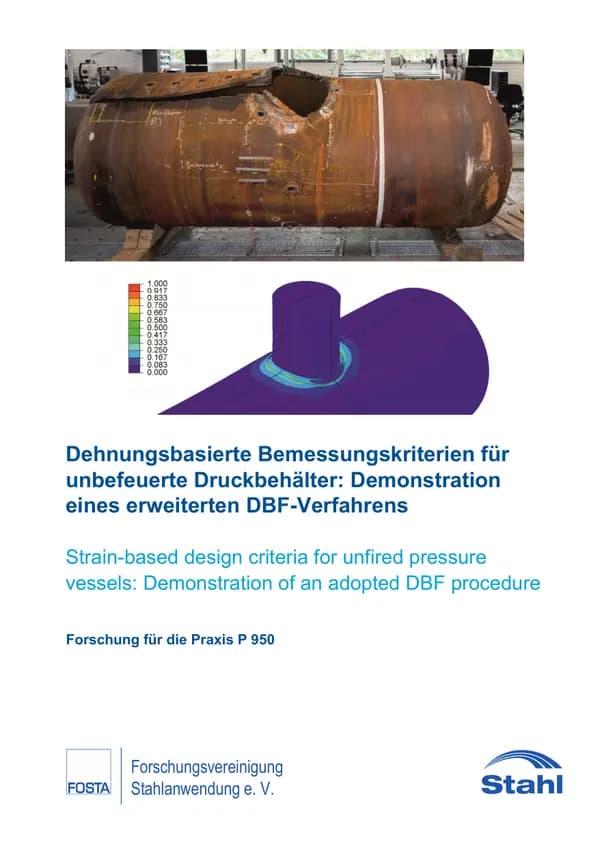
Probabilistic safety concepts, such as those defined in EN 1990, can be used to derive specific safety factors for a desired reliability level based on component tests. The combination of both approaches represents an innovative way of deriving improved safety factors for high-strength steels. This makes the application of probabilistic concepts in pressure vessel construction possible in the first place, as an approach based purely on burst tests is not feasible due to the high costs of the tests. As part of this research project, a damage mechanics approach for burst pressure prediction was developed and the framework conditions for reliable application were investigated. The failure criterion derived in this way was used in the simulation of a large number of design situations. With the help of this approach, simulation results could be used to derive new safety factors instead of complex bursting tests, which are normally required for the application of probabilistic safety concepts. To demonstrate the reliability of the method, a pressure vessel made of the high-strength steel grade P690Q was designed, manufactured and destructively tested in a bursting test by the research centres and the industrial partners in the project committee. The tank has a wall thickness of 50 mm, a length of 3 metres and an outer diameter of 1.20 metres. The design pressure according to EN 13445 is 226 bar. In the burst test, the tank failed at 680 bar, three times the design pressure. The applicability of high-strength steels was impressively demonstrated; the failure occurred after significant plastic deformation. The applicability of the developed methodology was thus validated. The final application of the probabilistic safety concept showed the potential for a significant reduction in safety factors for high-strength steels. The findings were then incorporated into the standardisation process. The research project was carried out at the Institute of Ferrous Metallurgy and the Institute of Steel Construction at RWTH Aachen University with expert support and financial assistance from the Forschungsvereinigung Stahlanwendung e. V., Düsseldorf, with funds from the Stiftung Stahlanwendungsforschung, Essen. Institute of Ferrous Metallurgy, RWTH Aachen University Prof. Dr Wolfgang Bleck Prof. Dr.-Ing. Sebastian Münstermann Dr Victoria Brinnel Institute of Steel Construction, RWTH Aachen University Prof. Dr.-Ing. Markus Feldmann Dr Simon Schaffrath Dipl.-Ing. Dirk Schäfer Responsible for FOSTA - Forschungsvereinigung Stahlanwendung e. V. Dr Gregor Nüsse M.Sc.
Zum Zoomen hovern
€30.00excl. VAT
Payment by card (Stripe) or invoice (DE, AT, CH). Download link by email: automatically after ordering by card, after order approval for invoice (valid for 30 days). Terms
P 950 - Strain-based design criteria for unfired pressure vessels - Demonstration of an extended DBF method—
€30.00