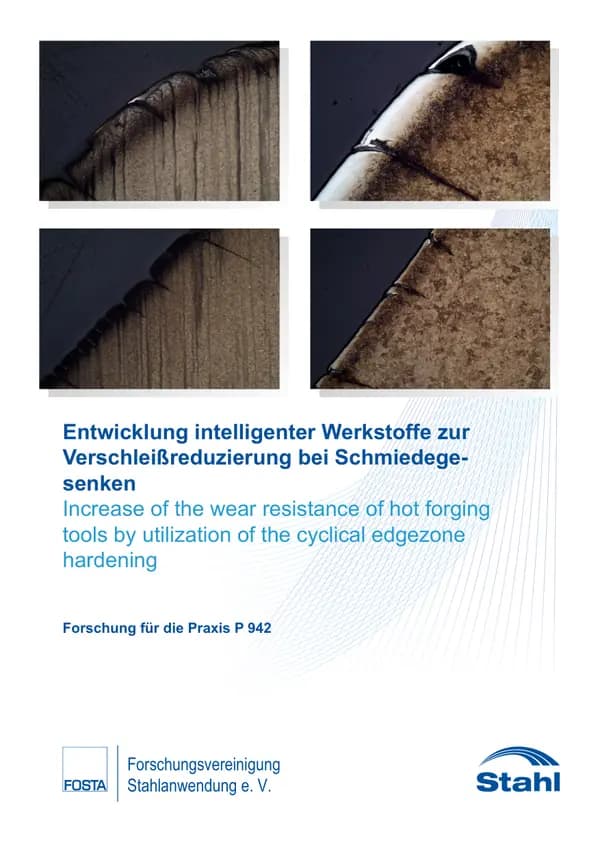
The service life of hot forging dies is limited by various types of damage resulting from the complex cyclical stresses. The tool edge zone in particular is subjected to considerable thermal, mechanical, tribological …
The service life of hot forging dies is limited by various types of damage resulting from the complex cyclical stresses. The tool edge zone in particular is subjected to considerable thermal, mechanical, tribological and chemical stresses during operation. Compared to other manufacturing processes, the resulting load collective leads to tool failure even after short tool life. The main cause of failure is wear of the moulding tool component. Methods for reducing wear in hot forming tools are therefore the subject of numerous research projects. Even though significant improvements in the tool life of hot forming tools have already been achieved through measures such as the generation of high surface layer hardness through nitriding and/or the application of hard coatings, there is still no satisfactory cost-benefit ratio.
Previous measures to reduce wear are predominantly associated with high investment and tool costs, so that the resulting increase in tool life does not cover the costs of the wear protection measures. A simple and cost-effective measure to reduce wear on hot forging tools was investigated as part of this research project. To this end, a new type of hot-work tool steel was developed in which the additional costs are limited to the alloying elements required for this purpose. The alloy was developed on the basis of the hot-work tool steel 32CrMoV12-28 (material no. 1.2365) with varying proportions of the austenite-stabilising elements manganese, nickel and cobalt, with the aim of lowering the material-specific austenite starting temperature and specifically influencing the microstructural changes in the tool edge zone. This intelligent reaction of the material to the thermomechanical environmental conditions prevailing in the process was intended to achieve an increased new hardening effect, which is maintained over many forging cycles and thus ensures continuous wear protection. The investigations showed that lowering the austenite starting temperature by means of alloying measures can contribute to a strengthening of the new hardening if the thermomechanical stresses cause austenitisation of the tool surface layer. In areas subject to high thermomechanical stresses, exceeding the austenitising start temperature and subsequent quenching of the material lead to the formation of a new hardening zone. In contrast, tempering zones with reduced hardness form in areas of the tool where the microstructure is not transformed and rehardened due to insufficient thermomechanical stress, which promotes wear on the tool and reduces the tool life. The potential of the new hot-work tool steel can therefore only be fully utilised in coordination with the forging parameters and knowledge of the stress condition on the tool. A combination of the new hot-work tool steel with additional nitriding treatment proved to be advantageous in the investigations. This led to an increase in the wear resistance of the non-rehardened areas, so that an overall increase in the tool life could be achieved. The IGF project 445 ZN of FOSTA - Forschungsvereinigung Stahlanwendung e. V., Düsseldorf, was funded via the AiF within the framework of the programme for the promotion of joint industrial research (IGF) by the Federal Ministry for Economic Affairs and Energy on the basis of a resolution of the German Bundestag. The project was carried out by the Institute of Forming Technology and Machines, Gottfried Wilhelm Leibniz Universität Hannover and the Institute of Materials Science, Gottfried Wilhelm Leibniz Universität Hannover.
Payment by card (Stripe) or invoice (DE, AT, CH). Download link by email: automatically after ordering by card, after order approval for invoice (valid for 30 days). Terms
Machine-translated title and description. The document itself is in German.
Digital download
Other parts and editions as well as neighbouring documents of the same series.

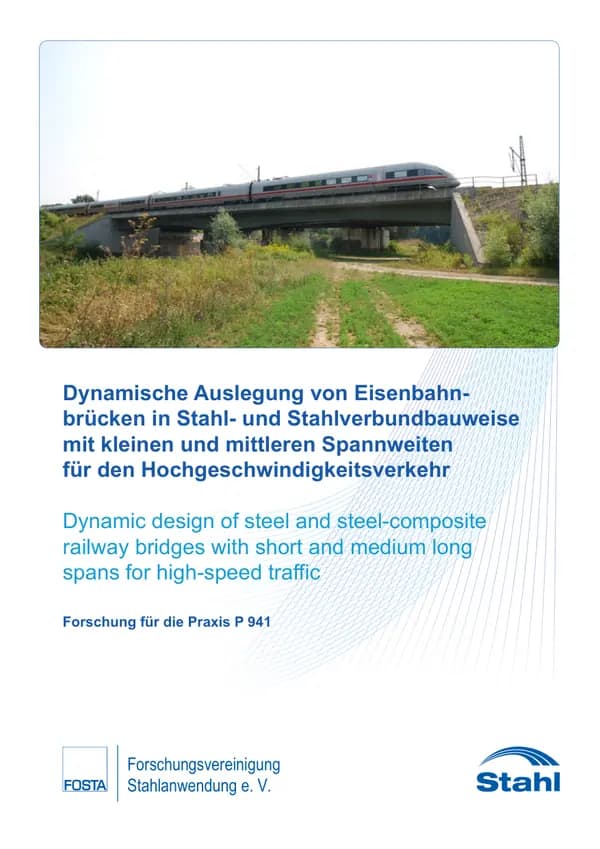
P 941 - Dynamic design of steel and steel composite railway bridges with small and medium spans for high-speed traffic The further development of the European railway network is characterised, among other things, by the increased use of high-speed trains and a significant increase in operating speeds. Along with this development, more and more railway lines will be needed in future that are built and upgraded for high-speed traffic or need to be converted. Steel and composite steel bridge structures represent economical and technologically advanced solutions. In addition to the WIB bridges (rolled concrete girders) that have been used in the Deutsche Bahn rail network for more than 100 years, the aim is also to use more modern composite cross-section types with a high degree of prefabrication. Composite prefabricated girders (VFT) are of particular interest to DB. Furthermore, the trough bridges in steel construction with thick deck plates (d ≥ 100 mm) developed in recent years are proving to be advantageous due to their low construction height and favourable noise emission properties, among other things. When designing railway bridges for high-speed traffic, the engineer responsible must provide dynamic verification to show that the bridge structure fulfils the requirements for load-bearing capacity and serviceability even when realistic dynamic tensile loads are applied. For speeds of v > 200 km/h, however, this verification is currently only possible with a great deal of work and computational effort and only with the use of special software, the use of which requires a high level of expertise in the field of bridge modelling. The aim of the research project is to provide a method for the simplified dynamic design of steel and steel composite railway bridges at high speeds and to develop a guideline for realistic numerical modelling. In addition to trough bridges in steel construction, both classic WIB cross-sections and modern VFT girders are the subject of the investigations. As part of the project, measurements were carried out on existing railway bridges in order to assess the dynamic behaviour of the various cross-sectional shapes and bridge systems. The results form the basis for further numerical simulation calculations for detailed structural analyses. The research objectives will result in a significant increase in competitiveness not only for engineering offices, but also for the technical departments of steel processing companies and construction firms involved in bridge building. In addition, the research project can make a significant contribution to the increased use of steel and steel composite structures in railway bridge construction. The research project was carried out at the Institute of Steel Construction at RWTH Aachen University and the Institute of Structural Mechanics at Bauhaus University Weimar with expert support and financial assistance from the Forschungsvereinigung Stahlanwendung e. V., Düsseldorf, with funds from the Stiftung Stahlanwendungsforschung, Essen. Publication: 2016 Authors: M. Feldmann, B. Hoffmeister, H. Bigelow, C. Könke, V. Zabel, S. Höll, I. Reichert
available anytime
€40.00
excl. VAT

P 944 - Flexible production of locally reinforced support structure variants using bonded blank One lightweight construction strategy is the production of load-optimised components using bonded blanks technology, which involves doubling sheets in areas subject to high loads. The bonded blanks technique involves deep-drawing a base sheet together with a reinforcing sheet to produce a double-layer sheet composite. After the joint deep-drawing process, the deep-drawn sheets are structurally joined using adhesive. As part of the research project, various aspects of the bonded blanks technique are being investigated to expand the range of possible applications. A new tool concept for the flexible deep drawing of bonded blanks components was developed and implemented. The mould design was carried out with the aid of FE simulation. The tool system has adjustable pockets for the reinforcing sheet to enable the flexible production of reinforced and unreinforced bonded blank components with the same forming tool. In addition, the integration of a joining process into the deep drawing process was realised in the forming tool. Further research foci were the investigation and identification of suitable adhesives and the determination of the bond strength of the bonded blanks components. The adhesives were rheologically analysed with regard to their temperature-dependent viscosity. The bonded blanks produced were artificially aged by means of a corrosion test in order to assess the effects of the corrosion condition on the bonded joint and thus on the bond strength. Determining the bond strength of the bonded blanks as a function of the corrosion condition was a key focus of the component tests. These investigations were supplemented by non-destructive testing using Lockin thermography to evaluate the bonded joint. Publication: 2016 Authors: Prof. Dr.-Ing. Prof. h. c. K. Dilger, Dipl.-Ing. G. Wisner
available anytime
€30.00
excl. VAT
Payment by card (Stripe) or invoice (DE, AT, CH). Download link by email: automatically after ordering by card, after order approval for invoice (valid for 30 days). Terms