
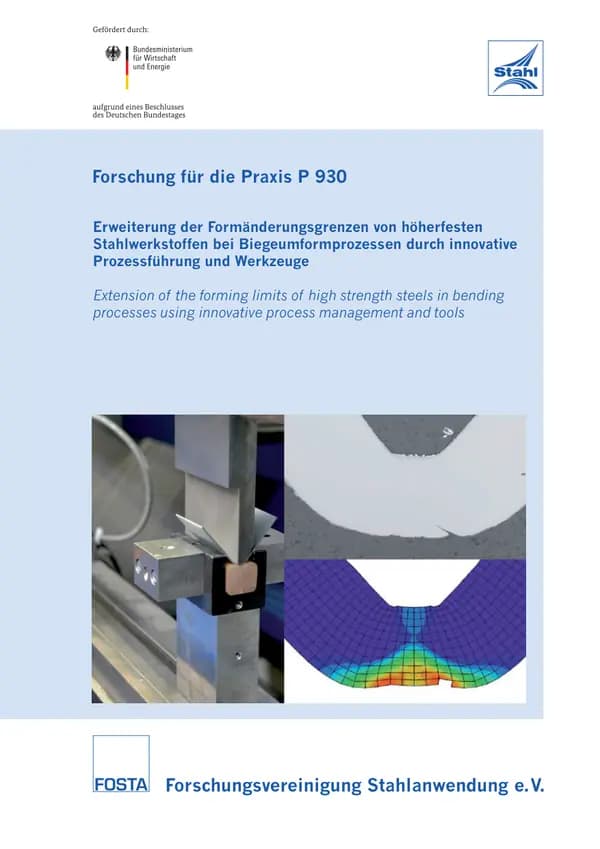
P 930 - Extension of the deformation limits of high-strength steel materials in bending forming processes through innovative process control and tools
As a result of the more stringent legal requirements and customer awareness of the economic and ecological compatibility of products, there is an increasing demand for innovative lightweight structures that require the …
Content
- Publication
- 2016
- Authors
- E. Tekkaya, M. El Budamusi, C. Becker, T. Clausmeyer, L. Chen, J. Gebhard
As a result of the more stringent legal requirements and customer awareness of the economic and ecological compatibility of products, there is an increasing demand for innovative lightweight structures that require the use of lightweight materials. In addition to aluminium, magnesium11 or titanium, high-strength to ultra-high-strength steel materials are used, whereby the latter are characterised by high weight-specific strength and cost-effectiveness. The increasing strength proves to be problematic due to the associated lower ductility, as conventional bending forming processes reach their process limits at an early stage.
Show full description
Especially with the free bending process, which is widely used in industry, the process limits are reached early, meaning that customer-specific requirements cannot be met. This is particularly true for small bending radii, which are often required by the customer to increase rigidity. Furthermore, the energy introduced into the material increases with increasing strength, which manifests itself in the form of significantly greater residual stresses and springback, which impairs dimensional and shape accuracy. The failure behaviour of high-strength steel materials during free bending and roll forming was therefore investigated as part of this research project. The resulting knowledge of the material behaviour was then used to adapt conventional bending forming processes in order to influence the process limits and the material-specific forming limits. A significant extension of the forming limits and a reduction in springback were demonstrated. In addition to experimental investigations, numerical investigations were also carried out to expand the understanding of the process. For this purpose, it was first necessary to characterise the material behaviour using conventional material testing methods. The material data obtained here was implemented in the material models to map the damage behaviour. These formed the basis for optimising the processes and generating an understanding of the process. An industry-relevant demonstrator component was then manufactured. The knowledge gained from the numerical and experimental investigations carried out previously was incorporated so that the material and process potential could be fully utilised. The objectives of the research project were thus achieved. The IGF project 16585 N of FOSTA - Forschungsvereinigung Stahlanwendung e.V., Düsseldorf, was funded via the AiF as part of the programme to promote joint industrial research (IGF) by the Federal Ministry for Economic Affairs and Energy on the basis of a resolution of the German Bundestag. The project was carried out at the Institute for Forming Technology and Lightweight Construction at the Technical University of Dortmund.
Zum Zoomen hovern
€30.00excl. VAT
Payment by card (Stripe) or invoice (DE, AT, CH). Download link by email: automatically after ordering by card, after order approval for invoice (valid for 30 days). Terms
P 930 - Extension of the deformation limits of high-strength steel materials in bending forming processes through innovative process control and tools—
€30.00