
P 923 - Application of wear protection layers up to 5 mm thick made of metal-hard material powder mixture by means of resistance welding
Protective coatings are often applied to components to protect them from wear caused by external influences. In the case of metallic components, especially those subject to high mechanical loads, this is often done by …
Content
- Publication
- September 2018
- Authors
- Prof. Dr.-Ing. U. Reisgen, Dipl.-Ing. A. Schiebahn
Protective coatings are often applied to components to protect them from wear caused by external influences. In the case of metallic components, especially those subject to high mechanical loads, this is often done by welding on layers with correspondingly good wear properties, known as hardfacing. Arc-based welding processes such as gas metal arc welding (GMAW) or submerged arc welding (SAW) are usually used. These processes have the disadvantage of a relatively high energy input and the associated high thermal load on the materials used. In the area of the component to be protected, this means that the use of higher-grade steels is not necessarily advisable, as the material properties, some of which have been elaborately adjusted, are impaired by the heat input.
Show full description
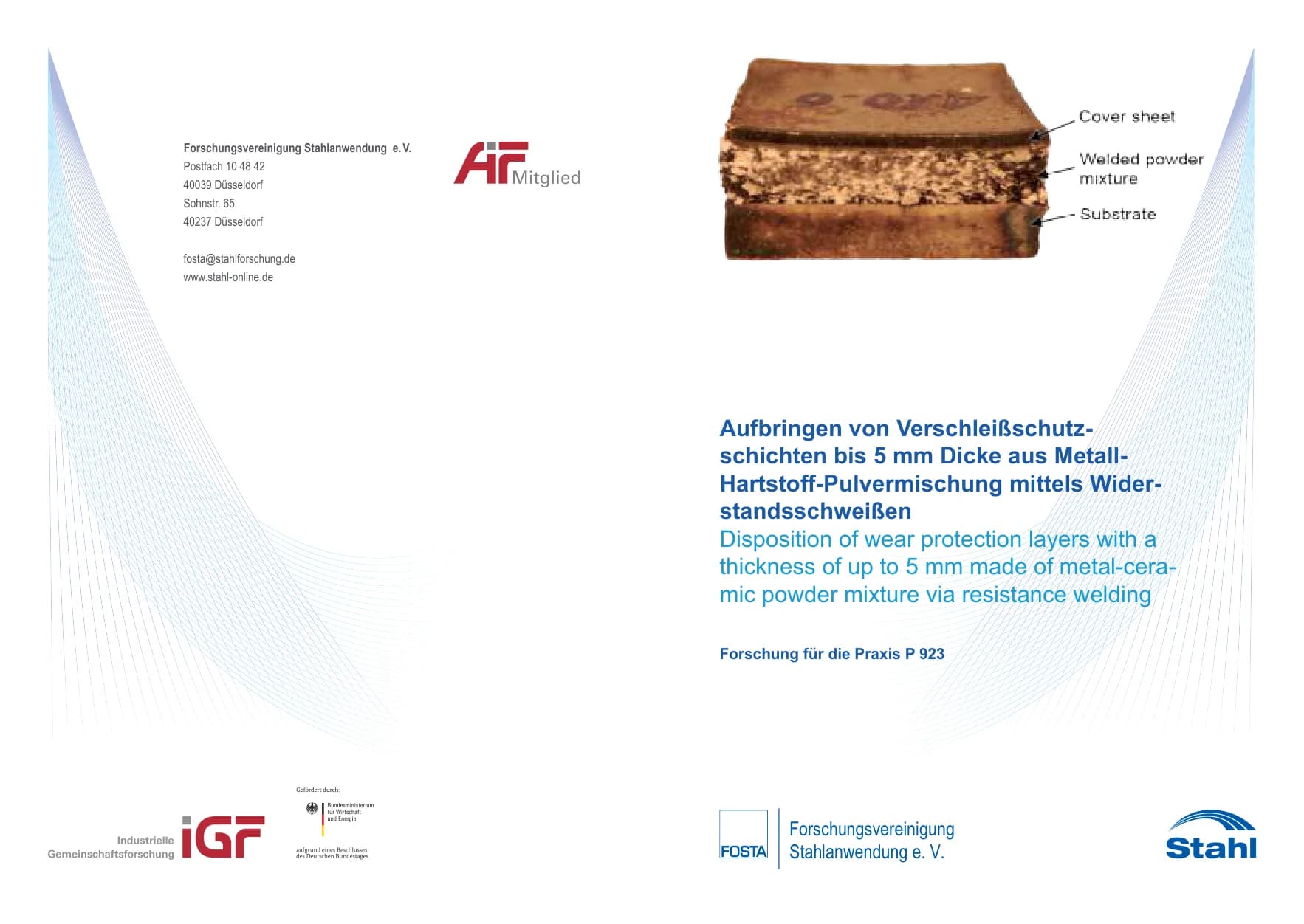
Consequently, simpler steel grades are used, which means that a great deal of lightweight construction potential is lost. In the area of coating materials, only hard materials that do not decompose during build-up welding can be used to improve wear resistance due to the high process temperatures. However, such hard materials are usually quite expensive. In this project, the process of build-up welding using resistance welding was investigated. This involves using conductive resistance heating to weld a mixture of hard material powder and an iron-based matrix powder to form a closed layer, which is simultaneously applied to a substrate. In addition to silicon carbide and zirconium mullite, the low-cost hard materials used in the project are mainly those based on aluminium oxide. Iron powder and cast iron powder are mainly used as matrix materials. The achievable layer thicknesses are around 3 mm and, with the appropriate wear mechanism, achieve a significant increase in wear resistance. Greater layer thicknesses can be realised by building up the coating layer in several layers. The degree of mixing is far below that of conventional build-up welding processes, and the heat-affected zone is also significantly smaller. In further investigations, the further optimisation of the wear properties, the development of continuous processes for coating larger surfaces and the direct generation of contoured surfaces are conceivable. The IGF project 17421 N of FOSTA - For-schungsvereinigung Stahlanwendung e. V., Düsseldorf, was funded via the AiF as part of the programme to promote joint industrial research (IGF) by the Federal Ministry for Economic Affairs and Energy on the basis of a resolution of the German Bundestag. The project was carried out by the Institute of Welding and Joining Technology at RWTH Aachen University.
Zum Zoomen hovern
€30.00excl. VAT
Payment by card (Stripe) or invoice (DE, AT, CH). Download link by email: automatically after ordering by card, after order approval for invoice (valid for 30 days). Terms
P 923 - Application of wear protection layers up to 5 mm thick made of metal-hard material powder mixture by means of resistance welding—
€30.00