
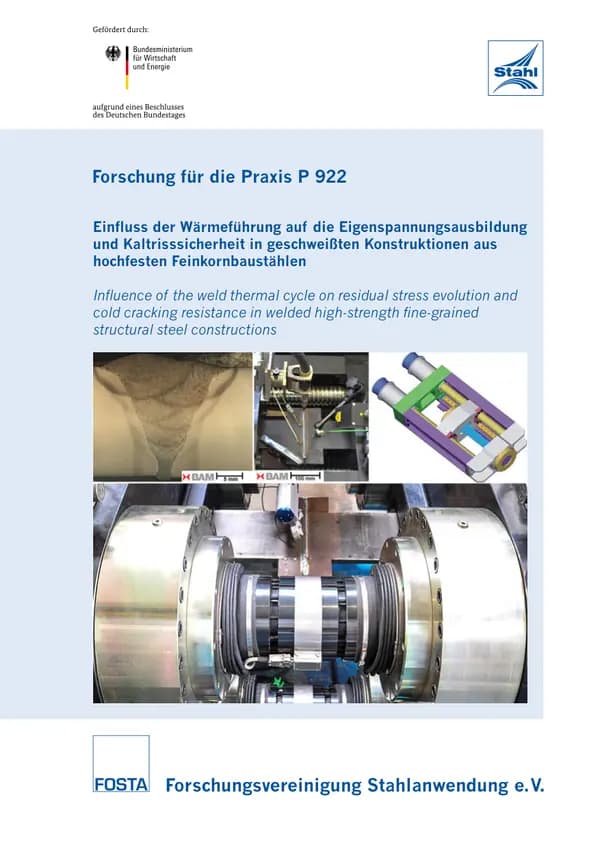
P 922 - Influence of heat conduction on residual stress formation and cold cracking resistance in welded structures made of high-strength fine-grained structural steels
For economic, structural and aesthetic reasons, modern steel structures are becoming increasingly slimmer and lighter. High-strength fine-grain structural steels with yield strengths ≥ 690 MPa are increasingly being …
Content
- Publication
- 2015
- Authors
- T. Kannengießer, D. Schröpfer
For economic, structural and aesthetic reasons, modern steel structures are becoming increasingly slimmer and lighter. High-strength fine-grain structural steels with yield strengths ≥ 690 MPa are increasingly being used for this purpose, enabling weight reductions of 30 % to 50 % and cost savings of 5 % to 15 % to be achieved. However, the potential of high-strength fine-grain structural steels cannot be utilised without further ado in compliance with current guidelines and regulations. The research project investigated the influence of heat conduction on residual stress formation and cold cracking, taking into account realistic stiffness conditions.
Show full description
On the basis of these findings, a contribution was made to improving the processing guidelines, which enables the processor to carry out safe welding processing with improved utilisation of the material properties. Above all, the load-bearing capacity and the safety of the welded joint determine the design of the structure and thus the sustainable and economical use of these steel grades. The relationship between the level of residual stresses generated and the heat conduction in real structures is currently only qualitatively manageable and leads to a rather conservative design of today's welded structures. The economic processing of high-strength steels is determined not only by the achievement of mechanical properties in the weld seam area that fulfil the requirements, but above all by the avoidance of cold cracks. However, the relevant recommendations in the applicable regulations are primarily based on findings from laboratory welding on small samples under free external shrinkage. However, the main causes for the formation of residual stresses such as inhomogeneous, localised heating and cooling of the areas close to the weld seam and, in particular, the structural shrinkage impediment due to surrounding assembly groups are not mapped in this way. The influence of heat conduction, in particular local pre-heating, on the inherent stress of a structure is currently largely unknown. The aim of the research project was to quantify the influence of heat conduction on the formation of residual stresses in welded structures and to develop statements on the influence and reduction of residual stresses and thus the overall residual stress of welded structures. For this purpose, by successively increasing the The relationship between heat conduction and the resulting residual stress under additional shrinkage restraint was clarified. Furthermore, the transferability of the small specimen results on which the regulations are based to real constructions was investigated. With the help of systematic small and large load welding tests on defined shrinkage-restrained specimens, the influence of high residual stresses as well as global residual stresses due to reaction stresses could be analysed. It was shown that a reduction in the local residual stresses and the internal stresses of welded constructions is possible through a lower heat input. is possible. Lowering the interpass temperature proved to be particularly favourable. This makes it possible to optimise existing heat conduction concepts for high-strength steels and thus avoid cold cracking. The IGF project 17267 N of the Forschungsvereinigung Stahlanwendung e.V., Düsseldorf, was funded via the AiF as part of the programme to promote joint industrial research (IGF) by the Federal Ministry for Economic Affairs and Energy on the basis of a decision by the German Bundestag. The project was carried out at the Federal Institute for Materials Research and Testing (BAM), Department 9.4 - Integrity of Welded Joints, Berlin carried out.
Zum Zoomen hovern
€30.00excl. VAT
Payment by card (Stripe) or invoice (DE, AT, CH). Download link by email: automatically after ordering by card, after order approval for invoice (valid for 30 days). Terms
P 922 - Influence of heat conduction on residual stress formation and cold cracking resistance in welded structures made of high-strength fine-grained structural steels—
€30.00