
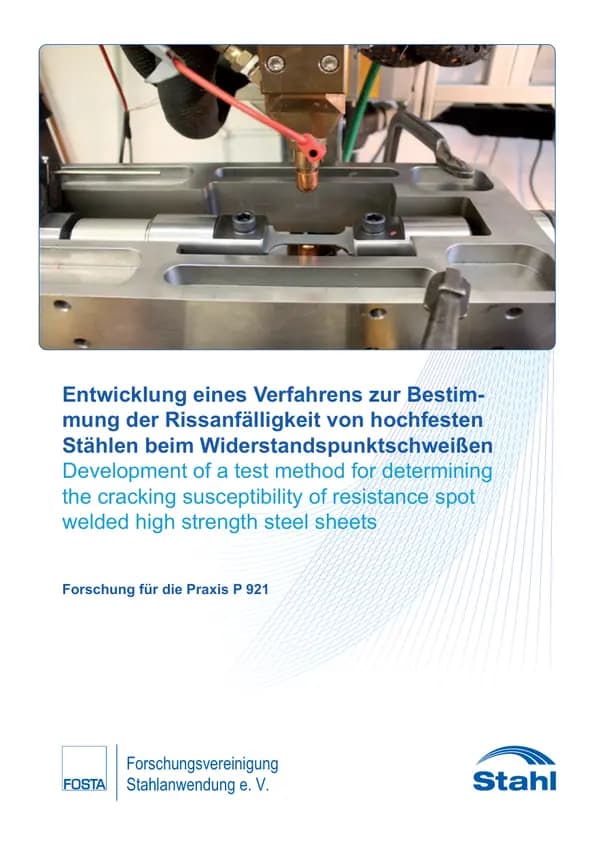
P 921 - Development of a method for determining the susceptibility of high-strength steels to cracking during resistance spot welding
The ever-increasing demands for lower fuel consumption, reduced pollutant emissions and increased passive safety have presented the automotive industry with challenges that can only be met by the consistent use of …
Content
- Publication
- 2017
- Authors
- M. Rethmeier, H. Suwala, J. Frei
The ever-increasing demands for lower fuel consumption, reduced pollutant emissions and increased passive safety have presented the automotive industry with challenges that can only be met by the consistent use of modern steel materials. However, the complex microstructure and the special mechanical properties of these materials cause an increased tendency for cracks to form, particularly in resistance spot-welded joints. For small and medium-sized companies in particular, which are unable to carry out time-consuming and expensive preliminary investigations into the susceptibility of steels to cracking during resistance spot welding, knowledge of the susceptibility to cracking of a material combination they are processing is of considerable importance for maintaining competitiveness.
Show full description
An easy-to-use, material-independent method for determining the susceptibility to cracking during resistance spot welding can provide SMEs with the opportunity to quickly and cost-effectively assess the processing safety of material combinations to be processed. The aim of the research project is therefore to develop a simple and production-related method for determining the susceptibility of high-strength steels to cracking during resistance spot welding, based on the targeted, reproducible generation of cracks. Such a test method was developed, which is based on easy-to-perform experimental tests. Samples to be analysed are loaded with a tensile force during the welding process. A hydraulic device is used for this purpose, which applies a defined force to waisted flat tensile specimens. This results in a state of stress that favours the formation of cracks. This means that sufficient crack initiation rates can be achieved that allow a comparative assessment of the resulting crack lengths between the materials. The simple, mobile tensile device allows the existing system technology to be utilised. By standardising the resulting crack lengths to the yield strength of the material and the loaded cross-sectional area, a material ranking or a classification of the crack susceptibility of the high-strength material combinations tested can be created. Potentially higher strength steel materials developed in the future can also be analysed. Furthermore, the method developed can be used as a basis for obtaining basic data for investigating different types of crack formation during resistance spot welding.
Zum Zoomen hovern
€20.00excl. VAT
Payment by card (Stripe) or invoice (DE, AT, CH). Download link by email: automatically after ordering by card, after order approval for invoice (valid for 30 days). Terms
P 921 - Development of a method for determining the susceptibility of high-strength steels to cracking during resistance spot welding—
€20.00