
P 920 - Use of novel steels and generation of graded lightweight structures in the press hardening process
According to the current state of the art, the press hardening process is usually used for the production of ultra-high-strength steel components within a vehicle body. In this thermomechanical manufacturing process, a …
Content
- Publication
- January 2019
- Authors
- Prof. Dr rer. nat. T. Tröster, Dr.-Ing. T. Marten
According to the current state of the art, the press hardening process is usually used for the production of ultra-high-strength steel components within a vehicle body. In this thermomechanical manufacturing process, a mould blank is first heated above the austenitising temperature of the steel material and then, in the subsequent process step, formed into the later component geometry with simultaneous hardening of the microstructure. This makes it possible to produce very complex components with component strengths of >1500MPa. In practice, the standard material used here is 22MnB5, which has a strength level of approx. 1500MPa-1600MPa after the process.
Show full description
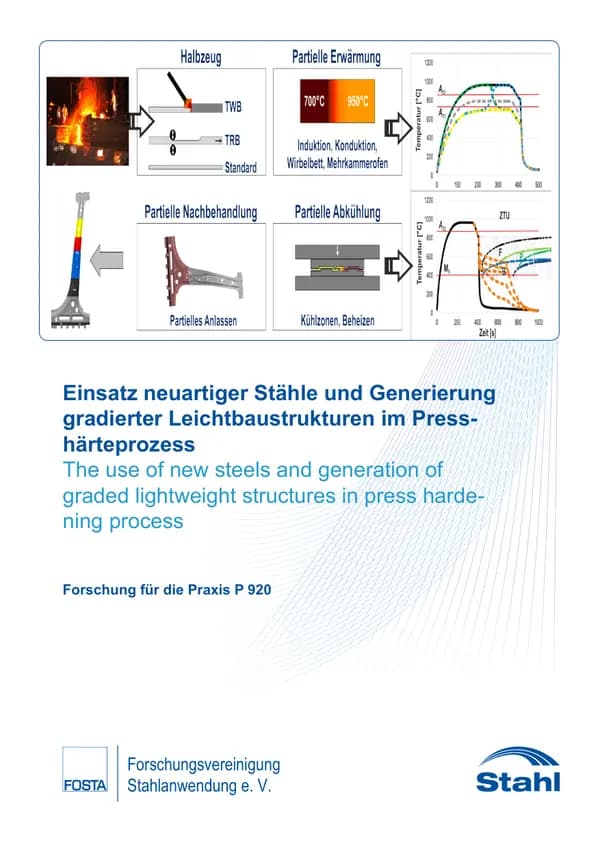
More recent developments are pursuing a further increase in strength after the process. Through the targeted modification of process parameters within the press hardening production route, areas with different mechanical properties can also be produced within a component. This option enables a load-oriented component design, which is a key factor in the production of weight-optimised and therefore resource-saving and efficient car body components. The options for producing different mechanical property levels in the component are currently limited, both in terms of the process and the material, so that the possible lightweight construction potential cannot be fully utilised by the process. In this research project, this possible range of properties is therefore to be extended through targeted material development of a material and a process modification towards lower strengths. Due to the large number of influencing variables, the work on the project routes is accompanied by suitable simulations. The aim is to generate a resulting tensile strength in the component after the process of approx. 1200MPa-1300MPa. The simulation software JMatPro is used to determine the mechanical properties as a function of the process parameters and the alloy composition. The determination of the process parameters for a partial austenitisation process is validated in parallel by an experimental process window investigation. Based on the simulations, material casts of the new material to be developed are produced and characterised. Finally, the two development routes are validated in the component test and comparatively evaluated. Both development routes were successfully realised during the project period and finally validated on the component. The material properties were within the targeted mechanical properties, although the microstructure of the material differed significantly for the two routes. This changed the flow behaviour of the material. Based on the experimental investigations, the use of the material development process route is therefore clearly recommended due to the homogeneous microstructure formation and very good deformation properties. The research project was carried out at the Chair of Lightweight Automotive Design at the University of Paderborn with technical support and financial assistance from the Forschungsvereinigung Stahlanwendung e. V., Düsseldorf, with funds from the Stiftung Stahlanwendungsforschung, Essen.
Zum Zoomen hovern
€30.00excl. VAT
Payment by card (Stripe) or invoice (DE, AT, CH). Download link by email: automatically after ordering by card, after order approval for invoice (valid for 30 days). Terms
P 920 - Use of novel steels and generation of graded lightweight structures in the press hardening process—
€30.00