
FOSTA
The state of the art in the welding of high-strength press-hardened steels makes it clear that the development of a low-energy welding process that is also tolerant of gap and edge misalignment is required. In …
The state of the art in the welding of high-strength press-hardened steels makes it clear that the development of a low-energy welding process that is also tolerant of gap and edge misalignment is required. In particular, requirements such as high joining speeds and minimised thermal component stress under the boundary conditions that occur in production, such as tolerances in the joining area, must be taken into account. A major disadvantage of laser beam welding is the high demands placed on seam preparation. In contrast, arc processes such as GMA welding are used due to their ability to tolerate gaps and edge offsets, but with a higher thermal load on the component.
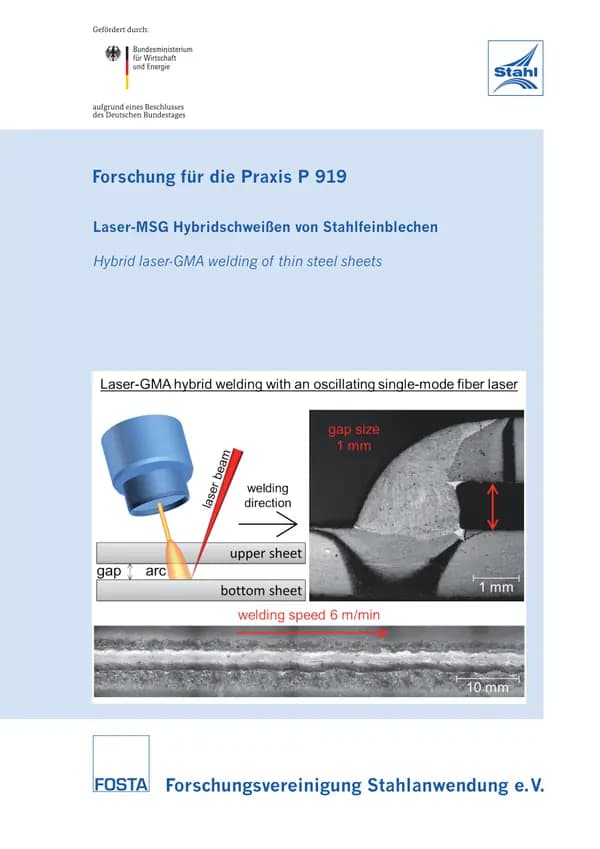
The hybrid process used in this project allowed the advantages of the individual processes to be utilised synergistically by combining the processes. The hybrid welding process designed in this research project for the material 22MnB5 combines a laser welding process with a single-mode laser and a MAG welding process. The energy input from the laser beam could be precisely controlled thanks to the beam oscillation used. This achieved a high level of process reliability with a tolerance of gaps of up to 1 mm. The welding speed of 6 m/min reduces the thermal load on the component and guarantees a high level of economic efficiency for the process. The low-energy laser-MSG hybrid welding of ultra-high-strength sheet steel could also be applied to mixed joints of 22MnB5 and galvanised DP800. Furthermore, a temperature-controlled welding process was developed using integrated imaging temperature measurement and control. This control system will be used for further projects in order to significantly reduce the energy input in welding processes such as the laser-MSG hybrid process. The thermal influence on the material was analysed with regard to all welding parameters and seam properties. It should be emphasised here that joint strengths of up to 917 MPa were achieved for the quasi-static tensile load. The welding process described in this research project significantly improves the joining quality of welded joints on high-strength press-hardened 22MnB5 sheet steel compared to the previous state of the art. The advantage of the newly developed process, a combination of MIG and laser beam welding, simultaneously enables increased welding speeds and a high tolerance of joint gaps. These results will help steel manufacturers and steel processors in SMEs and large companies to use press-hardened steel safely and efficiently in production. The IGF project 17585 BG of the FOSTA-Forschungsvereinigung Stahlanwendung e. V., Düsseldorf, was funded by the Federal Ministry for Economic Affairs and Energy via the AiF as part of the programme for the promotion of joint industrial research (IGF) on the basis of a resolution of the German Bundestag. The project was carried out at the Bremer Institut für angewandte Strahltechnik GmbH (BIAS) and at the Brandenburg University of Applied Sciences, Mechanical Engineering Manufacturing/Production Technology, Joining Technology.
Machine-translated title and description. The document itself is in German.
Payment by card (Stripe) or invoice (DE, AT, CH). Download link by email: automatically after ordering by card, after order approval for invoice (valid for 30 days). Terms
Digital download
Payment by card (Stripe) or invoice (DE, AT, CH). Download link by email: automatically after ordering by card, after order approval for invoice (valid for 30 days). Terms
Other parts and editions as well as neighbouring documents of the same series.
P 914 - Experimental and numerical simulation of the influence of design and manufacturing tolerances on the crash behaviour of bonded joints The demands placed on the automotive industry with regard to reducing fleet fuel consumption and the associated reduction in vehicle weights mean that developers are focussing on the consistent implementation of multi-material design in body-in-white construction. One key to realising these lightweight construction concepts lies in bonding technology. However, in order to fully utilise the enormous potential of this joining technology, manufacturing and process-related questions need to be answered. A significant part of this arises from the tolerances that occur in series production with regard to the geometric characteristics of the bonded seam. The influencing variables, such as the adhesive layer thickness and the geometry of the joint filling, can have a significant influence on the mechanical properties of the joint. Knowledge of the effects of the scattering that occurs during the manufacturing process, also taking into account the stress state and the load speed, is essential for the reliable design of components manufactured using adhesive bonding technology. Since the real product manufactured in series production shows deviations from the idealised variables of the simulation model, so that the measured mechanical component and structural behaviour can deviate significantly from that of the virtual model, these influencing variables must be taken into account. In particular, the question must be asked as to how large these deviations may be as a result of the series scatter without the overall behaviour of the body changing noticeably unfavourably in the event of a crash and then lying outside the permissible specification range. In order to answer this question, a simulation method for estimating the crash behaviour of bonded joints is qualified to the extent that it enables sufficiently accurate calculations of the crash behaviour of the overall structure with varying design and production-related tolerances. are possible. For this purpose, basic characteristic values for parameter identification of the material models used must first be determined. These are generated on the basis of basic tests on standardised samples. This applies in particular to shear stress-strain curves and normal stress-strain curves as a function of the adhesive layer thickness. Using these functions, the necessary parameters for a corresponding material model can be identified and the dependence of the individual material parameters on the adhesive layer thickness can be determined. The verification and validation of the material model is carried out using technological tests (single overlapped shear tensile specimen, peel tensile specimen) and component-like specimens (T-joint). These specimens were used in particular to analyse the influence of the joining component materials. A clear effect on the load-bearing behaviour of the joints could be determined for different joining part materials, which can be attributed in particular to the different joining part deformation and the resulting stress peaks in the adhesive layer. If glass fibre reinforced plastic (GRP) is used as a joining part material, a changed failure pattern often occurred, which can be described by partial delamination of the top layer in the GRP. As a consequence, this complex failure pattern, which also led to less reproducible test results, could not be predicted with the simulation methodology used. A very high prediction quality was achieved for the material combinations of steel materials. Publication: 2017 Authors: Prof. Dr.-Ing. G. Meschut, , Prof. Dr.-Ing. A. Matzenmiller
available anytime
€30.00
excl. VAT
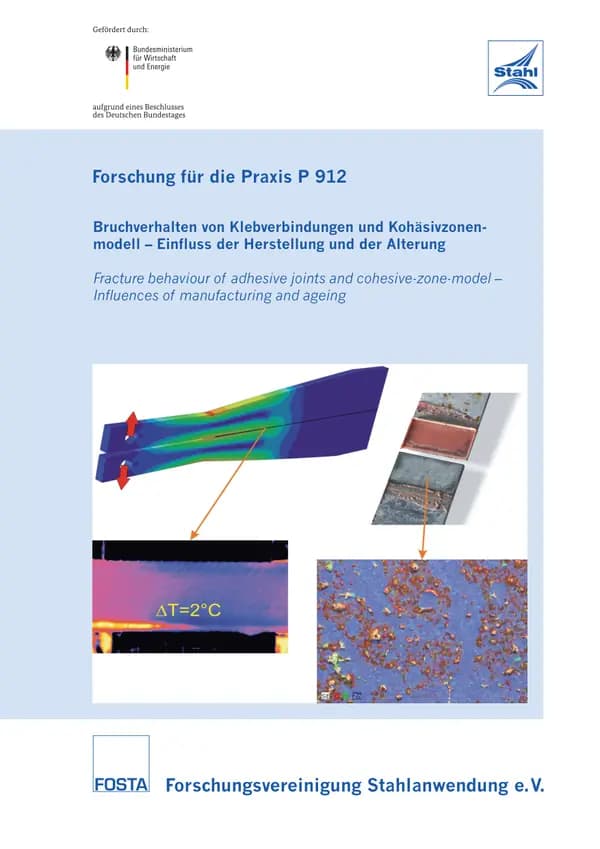
P 912 - Fracture behaviour of bonded joints and cohesive zone model Influence of manufacture and ageing Partial report on the AiF/DFG cluster: Understanding and calculating the durability of bonded joints (BestKleb) This sub-project 4 of the BestKleb cluster dealt with four related topics. The first thematic block dealt with the finite element simulation of adhesive layers using cohesive zone models. Such models, which are characterised by high efficiency, were used with the parameters identified here in BestKleb sub-projects 7 and 8, which deal with applications in the construction industry. To further develop the cohesive zone models, a viscoelastic material model developed in SP 3 was transferred to a cohesive zone model, taking into account temperature, moisture and adhesive layer thickness. Methods were also developed to take into account the effect of transverse contraction restraint in the cohesive zone model, resulting in significant improvements in the prediction of joint stiffness. A fundamental parameter in the cohesive zone models is the critical energy release rate GIc during crack growth in the adhesive layer, the understanding of which was deepened in the second focus of the work. Two investigation methods were developed, which together make it possible for the first time to estimate the energy balance during crack growth. The first approach is based on a simulation of the TDCB test, in which both the crack propagation and the plastic deformation of the adhesive layer are taken into account. The second approach supplements the TDCB test by measuring the surface temperature of the adhesive layer using a thermal imaging camera and allows the amount of heat generated at the crack to be quantified. The critical energy release rate GIc was investigated in the third part of the project in relation to ageing, whereby various adhesives were analysed in close connection with BestKleb sub-projects 1 and 3. A method for calculating the effect of water diffusing into the adhesive layer was developed for a polyurethane adhesive. Finally, the fourth thematic block dealt with a process for improving ageing resistance. The increasing use of adhesive bonding technology requires a robust bonding process that can be used to achieve a load-bearing bond despite possible contamination that could reduce adhesion. Even minor surface adsorbates can lead to the failure of a bonded joint. With the help of adhesive application under power ultrasound, it is possible to remove contamination from the interface between the bonded part and the adhesive and thus ensure a contamination-tolerant process with reproducible strengths. As part of the BestKleb cluster, the conditions under which the selected adhesive systems are suitable for ultrasonic coupling were first discussed. To this end, the influence of ultrasonic coupling on the chemical (IRATR) and mechanical (DSC, DMA, tensile strength) properties of the adhesive system was analysed. This results in optimised process parameters for an adhesive system. These are characterised by a high cleaning performance and only a slight influence on the curing and pot life. The optimised process was used to investigate the ageing resistance of adhesives by means of destructive testing after climate exposure. ' The IGF project 17276 N of the Forschungsvereinigung Stahlanwendung e.V. - FOSTA, Düsseldorf, was funded by the Federal Ministry for Economic Affairs and Energy via the AiF as part of the programme for the promotion of joint industrial research (IGF) on the basis of a resolution of the German Bundestag. The research project was carried out at the Fraunhofer Institute for Manufacturing Technology and Applied Materials Research IFAM, Bremen and the Defence Research Institute for Materials and Operating Materials (WIWeB), Erding. Publication: December 2015 Authors: Dr.-Ing. O. Hesebeck, Dipl.-Phys. A. Sondag, Dipl.-Phys. U. Meyer, Dr M. Brede, M.Sc. B. Schneider, Dr.-Ing. Holtmannspötter, Prof. Dr J. von Czarnecki
available anytime
€40.00
excl. VAT
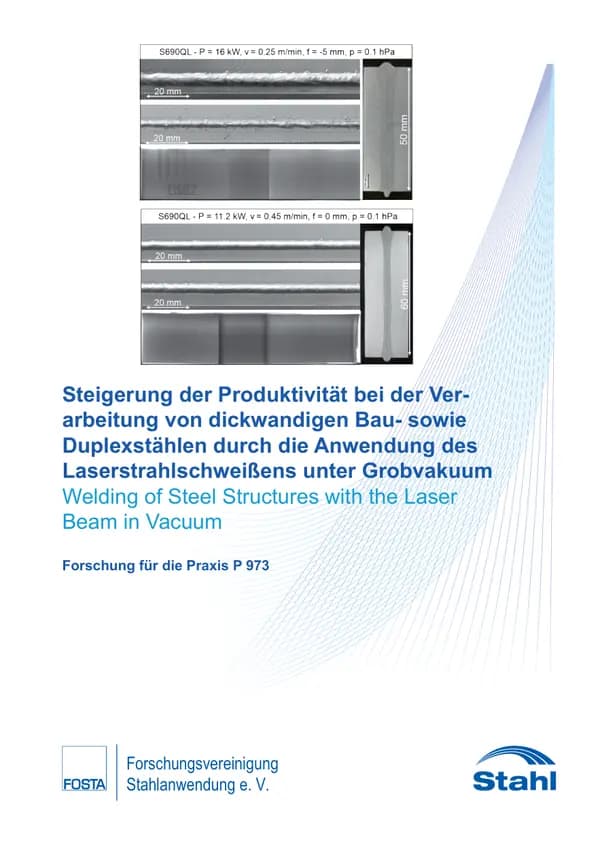
P 973 - Increasing productivity in the processing of thick-walled structural and duplex steels by using laser beam welding under rough vacuum Welding thick sheet metal is still the domain of the submerged arc welding (SAW) process with all its process-related requirements and limitations. The laser beam or electron beam processes in a vacuum offer great potential for increasing efficiency. The combination of a drastic reduction in the number of welding layers and the ability to dispense with filler material leads to an enormous reduction in welding times and costs. The aim of this research project is to provide the industry with an innovative and highly productive welding process for joining thick-walled structures made of structural steel and duplex steels. The process is intended to prepare the steel processing industry for the upcoming challenges in the field of renewable energies and the construction sector and thus create the basis for increased steel sales. To realise the research project, the first step was to convert a system for laser beam welding in a vacuum to the sheet thicknesses to be joined. Welding tests were used to determine the relationships between ambient pressure, welding speed, focal position etc. on the aspect ratio and seam quality when joining structural steel of large sheet thicknesses. The knowledge gained was then transferred to joint welds on unalloyed structural steel. The project objectives applied for (30 mm sheet thickness in one layer and 60 mm sheet thickness in layer/counter-layer) were clearly exceeded in this part. A sheet thickness of 50 mm was successfully joined in one layer and 110 mm in layer/counter layer. The seam quality achieved was tested using metallographic methods, non-destructive testing (visual inspection in accordance with DIN EN ISO 13919 and X-ray) and by determining the mechanical-technical properties. The results obtained were transferred to the welding of duplex materials in the second part of the project. This proved to be difficult due to the different properties (viscosity of the melt, heat conduction) and in particular due to the addition of nitrogen. Thanks to extensive process development, it was possible to achieve the project goals of 10 to 30 mm sheet thickness in one layer. in one layer. The seam quality was also tested using metallographic methods, non-destructive testing (visual inspection in accordance with DIN EN ISO 13919 and X-ray) and by determining the mechanical technological properties of the weld seams. In addition, the microstructure was analysed to determine the austenite-ferrite ratio and corrosion tests were carried out. The working hypothesis that different nitrogen partial pressures in the working atmosphere reduce or prevent the outgassing of nitrogen (austenite former) from the duplex steels and thus positively influence the microstructure distribution was proven by measurement. However, the effect is not pronounced enough to produce a balanced austenite-ferrite ratio in the weld metal. The use of filler material or post-weld heat treatment is therefore currently not possible. Publication: 2017 Authors: U. Reisgen, S. Jakobs, S. Olschok, C. Turner
available anytime
€30.00
excl. VAT