
P 909 - Complementary concept for bubble-free seam sealing of seam bonding
Interior and exterior parts of automotive add-on parts such as doors, flaps and bonnets are joined by seam bonding. This can result in air-filled cavities within the seam bond, which lead to bubble-shaped defects in the …
Content
- Publication
- January 2019
- Authors
- Prof. Dr rer. nat. B. Mayer, Dr H. Fricke, B.Sc. Ivo F. Neumann, Prof. Dr.-Ing. D. Landgrebe, Dipl.-Ing. F. Jesche, Dipl.-Ing. (FH) S. Menzel
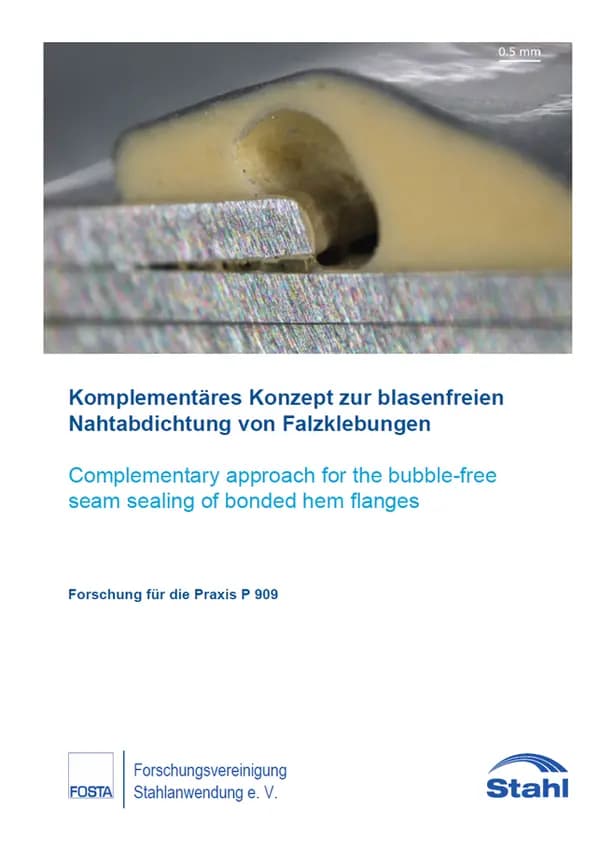
Interior and exterior parts of automotive add-on parts such as doors, flaps and bonnets are joined by seam bonding. This can result in air-filled cavities within the seam bond, which lead to bubble-shaped defects in the PVC seam seal during the subsequent manufacturing process. The seam seal is in the customer's field of vision, so the bubbles represent a visual quality problem. There is also a risk that defects will be destroyed by mechanical influences during the life of the vehicle. This would allow direct access of electrolytes into the seam and would not guarantee reliable corrosion protection for the seam bonding. Therefore, any defects in the seam seal that occur during the production process have to be laboriously reworked and repaired.
Show full description
In order to avoid the costs for the repair work, the increased expenses in quality assurance and a potential loss of image in the event of a serious corrosion problem, the mechanisms of the formation of defects and measures to reduce them as well as the development of a bubble-free seam seal are the subject of research. The aim of the research project was to develop the technological basis for the industrial production of bubble-free seam seals on seam bonding. The project is based on two complementary approaches: The reduction of cavities within the seam bonding on the process path (minimising the damage potential), as well as the substitution of the PVC plastisol, which is prone to defects, with a bubble-free seam sealing material on the material path (increasing the damage tolerance). Comparative tests of alternative NAD materials were carried out on the material path, which led to the qualification of an MS polymer as a potential PVC substitute. As part of the process path, the formation of cavities and the influence of process and individual part tolerances on the filling level were investigated. Based on these findings, detailed recommendations for optimising the seam bonding process and seam sealing were developed. The seam bonding process investigated is used both in large-scale production and in the production of small batches and individual parts. The integration of the recommendations for action developed in the project into the series processes will increase process reliability when joining steel components using seam bonding. The prevention of bubbles in the seam seal means a considerable economic benefit for the automotive industry and its suppliers, as the additional work involved in reworking and the risk of corrosion are prevented.
Zum Zoomen hovern
€30.00excl. VAT
Payment by card (Stripe) or invoice (DE, AT, CH). Download link by email: automatically after ordering by card, after order approval for invoice (valid for 30 days). Terms
P 909 - Complementary concept for bubble-free seam sealing of seam bonding—
€30.00