
P 906 - Influence of zinc phosphating replacement technologies on new and classic steel substrate surfaces in automotive engineering on corrosion protection in multi-metal composites
Multi-metal substrate materials are becoming increasingly important in automotive engineering. In addition to the conventional materials of steel and galvanised steel, aluminium and other new materials such as steel …
Content
- Publication
- 2016
- Authors
- C. Bauder, U. Christ, R. Nothhelfer-Richter
Multi-metal substrate materials are becoming increasingly important in automotive engineering. In addition to the conventional materials of steel and galvanised steel, aluminium and other new materials such as steel with zinc-magnesium coatings are increasingly being used. This new mix of materials poses a challenge to the established zinc phosphating process. The proven trication zinc phosphating process for the corrosion protection of steel and galvanised steel sometimes achieves inadequate corrosion protection with new materials. Another argument in favour of developing replacement technologies is the toxicity of the nickel salts used, which is why alternative thin-film pre-treatments (thin-film pre-treatment) are increasingly coming into focus.
Show full description
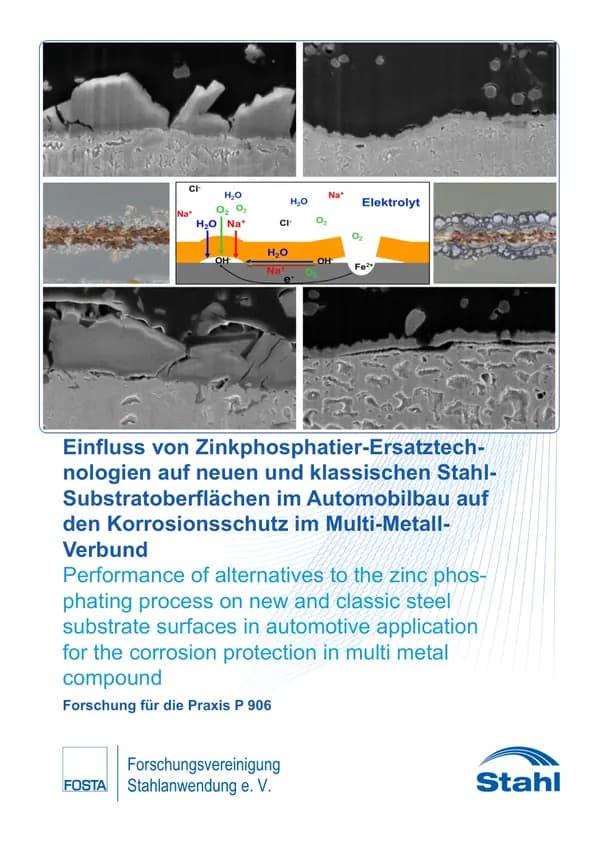
The corrosion protection effect of these new technologies has not yet been sufficiently investigated. Phenomenological studies and scientific methods have been used to investigate the relevant factors influencing corrosion protection. To this end, the corrosion processes on standard and new substrate materials (including steel, galvanised steel, steel with zinc-magnesium coatings, aluminium) were tested and evaluated in combination with new thin-film BCs in comparison with the zinc phosphating process. The substrates prepared with various pre-treatments were coated with a typical automotive cathodic dip coating. The systems were compared with each other in terms of their performance in order to gain an insight into the relevant corrosion processes. One aim of the investigations was to find out which parameters mainly influence the corrosion protection of the different systems. It has been shown that there is a very complex interaction between all three components substrate-VBH-KTL. The pre-treatment process is robust, which means that different substrates can be pretreated and cathodic dip coated in the multi-metal CVT process without any problems. The corrosion protection effect is highly dependent on the selected material combinations. Alkali and chloride ions chloride ions appear to be the critical corrosive stresses for thin-film VBHs. The higher alkali sensitivity is noticeable in the form of stronger cathodic delamination of the cathodic dip-paint coating during corrosion protection tests. Interface analyses show that penetrating media or corrosion products are deposited in the interfaces. The results show that some established laboratory corrosion tests appear to have been developed specifically for the benchmark (zinc phosphating), but cannot reproducibly reproduce the corrosion phenomena in other systems with new pre-treatments. In the "new" alternating test VDA 233-102 - which has shown good reproducibility in interlaboratory tests - cannot distinguish between different pre-treatments for substrates with intrinsic corrosion resistance such as aluminium or galvanised steel, even if the test duration is extended. can be distinguished. A possible starting point for reliably testing and evaluating the suitability of new substrate VBH systems could be electrochemical tests using polarisation and cyclic voltammetry. The investigations show that the systems with thin-film VBHs perform just as well as zinc phosphating under mild corrosive stress on galvanised, ZM and aluminium substrates. They are therefore suitable for applications with mild corrosive loads. In the case of high corrosive loads, some systems with thin-film BC show an equally good corrosion protection effect as corresponding systems with zinc phosphating. The results of the tested systems (substrate-VBH-KTL) can only be transferred to other systems to a limited extent. The user must therefore check each system for his requirements before use and decide whether the use of thin-film VBH is suitable in his case.
Zum Zoomen hovern
€30.00excl. VAT
Payment by card (Stripe) or invoice (DE, AT, CH). Download link by email: automatically after ordering by card, after order approval for invoice (valid for 30 days). Terms
P 906 - Influence of zinc phosphating replacement technologies on new and classic steel substrate surfaces in automotive engineering on corrosion protection in multi-metal composites—
€30.00