
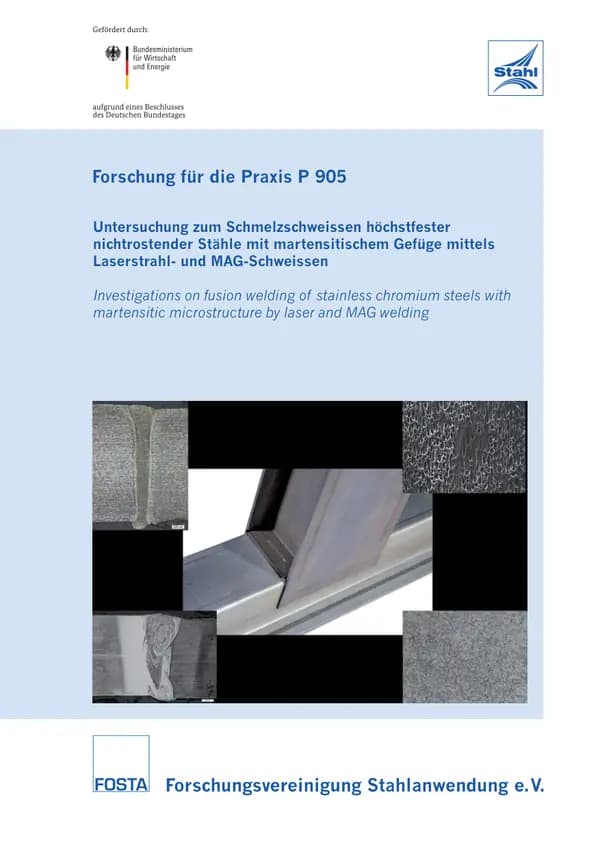
P 905 - Investigation of fusion welding of ultra-high-strength stainless steels with martensitic microstructure by means of laser beam and MAG welding
Anyone concerned with resource efficiency and lightweight construction in mobile structures cannot ignore ultra-high-strength steels. Recent considerations have led to the use of stainless steels with a martensitic …
Content
- Publication
- 2015
- Authors
- M. Dahmen, V. Janzen, S. Lindner, R. Wagner
Anyone concerned with resource efficiency and lightweight construction in mobile structures cannot ignore ultra-high-strength steels. Recent considerations have led to the use of stainless steels with a martensitic microstructure. These steels have advantages due to their inherent corrosion resistance, excellent formability and hardenability. However, due to their carbon content of up to 0.46 per cent by mass, they have so far been classified as non-weldable. An investigation was therefore carried out with the aim of testing the weldability and determining the mechanical properties of welded joints. As part of process development, a concept for customised heat conduction was developed.
Show full description
The mechanical properties were determined in fatigue strength tests on butt joints for use in the production of tailored blanks and in the assembly of already hardened sheet metal. Tests according to the KS-2 concept as well as quasi-static and impact load tests on components similar to parts were carried out to determine the load-bearing capacity. Finally, corrosion tests were carried out with and without load in order to obtain information on the influence of the welded materials on environmental conditions. Short heat cycles are generally favourable for welding martensitic steels. In order to limit the scattering of hardness in the heat-affected zone, a welding heat treatment adapted to the individual materials was developed and applied. Preheating to the martensite starting temperature in combination with a tempering treatment below the solution temperature of the carbides leads to a relaxation of the tetragonal martensite and increases the toughness in the weld zone. Preheating also increases the width of the welding zone and makes the process less sensitive to mispositioning.martensitic steels can be welded using standard heat treatment. In the case of tailored blank production, heat treatment is not absolutely necessary, but welding heat treatment leads to a significant increase in fatigue strength. The effect is not as pronounced when welding hardened sheet metal. With optimised temperature control, the fatigue strength of the base materials in the rolled state is achieved in both cases. In dissimilar joints, the fatigue strength is limited by the weaker partner. The load-bearing capacity depends more on the seam geometry and the load direction than on the heat treatment. Compared to hardened manganese-boron steels, very high load-bearing capacities can be achieved. The manganese-boron steels exhibit higher breaking forces and a more ductile behaviour in the head tensile test. In dissimilar joints with conventional deep-drawing steels, a higher load-bearing capacity was again achieved with the chromium steels. In tests on components similar to parts, it was found that the fracture behaviour depends not only on the load speed but also on the load direction. In order to optimally utilise the material properties under crash conditions, precise knowledge of the load collective is essential. The corrosion properties were determined in the alternating climate test and in the sensitisation test according to ASTM. No influence of the corrosion load on strength and deformation behaviour could be determined in the climate change test. There was no attack on the material. The sensitisation behaviour is generally improved by press hardening. With increasing carbon content, the precipitation of carbides also increases. This in turn leads to increased susceptibility to intercrystalline corrosion. Welding heat treatment after press hardening can lead to a reduction in the ICC resistance of the weld seam. A significant influence of the welding heat treatment on the sensitisation in welded hardened sheets could not be found. All welding zones showed an attack in the heat-affected zone, which becomes stronger with increasing carbon content. The high-alloy steels with 12% chromium are used where their intrinsic corrosion resistance coupled with strengths of up to 1900 MPa are required, such as in commercial vehicles and railway vehicles. With the new developments, possibilities for the construction of welded structures with chromium steels with a martensitic microstructure will be demonstrated. The IGF project 17433 N of FOSTA - Forschungsvereinigung Stahlanwendung e.V., Düsseldorf, was funded via the AiF as part of the programme for the promotion of joint industrial research (IGF) by the Federal Ministry for Economic Affairs and Energy on the basis of a resolution of the German Bundestag. The project was carried out at the Fraunhofer Institute for Laser Technology, Aachen, the Laboratory for Materials and Joining Technology at the University of Paderborn and the Fraunhofer Institute for Structural Durability and System Reliability, Darmstadt.
Zum Zoomen hovern
€30.00excl. VAT
Payment by card (Stripe) or invoice (DE, AT, CH). Download link by email: automatically after ordering by card, after order approval for invoice (valid for 30 days). Terms
P 905 - Investigation of fusion welding of ultra-high-strength stainless steels with martensitic microstructure by means of laser beam and MAG welding—
€30.00