
P 902 - Press hardening of pipes and profiles using mouldless solid materials
With increasing demands on safety in motor vehicles, but also with the aim of constantly reducing weight, press-hardened sheet metal is increasingly being used in motor vehicles. The sheets are usually produced using …
Content
- Publication
- 2011
- Authors
- A. E. Tekkaya, T. Mennecart, J. Witulski, W. Homberg, T. Rostek
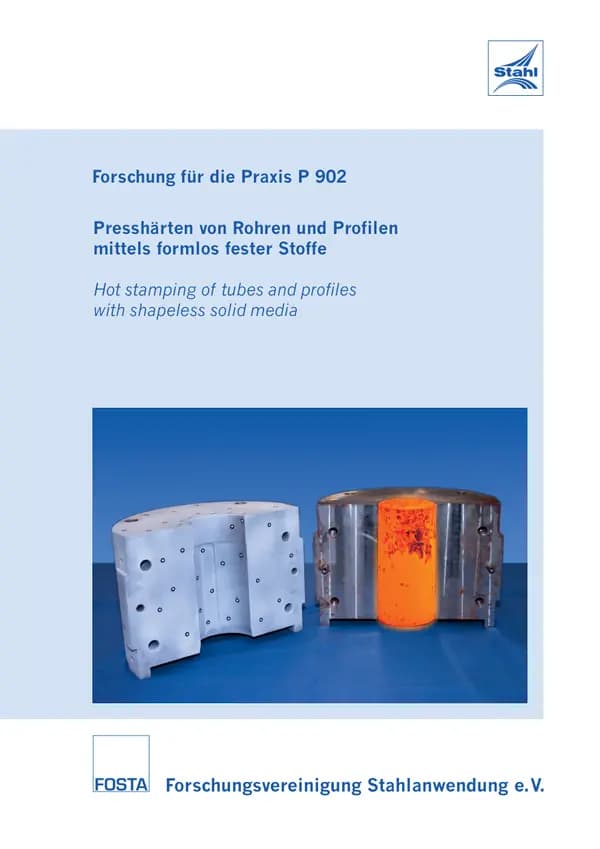
P 902 - Press hardening of pipes and profiles using shapeless solid materials With increasing demands on safety in motor vehicles, but also with the aim of constantly reducing weight, press-hardened sheet metal is increasingly being used in motor vehicles. The sheets are usually produced using conventional deep-drawing processes. In order to extend the application to profiles and tubes, the tubes must be formed using hydroforming processes. Both gases and shapeless solid materials can be used for this purpose. The suitability of shapeless solid substances as an active medium for the press hardening of pipes and profiles has not yet been researched.
Show full description
The aim of this research project is therefore to demonstrate the feasibility of press hardening pipes and profiles with reusable shapeless solid materials. Using a geometrically simple test tool, this feasibility study was able to show that shapeless solid materials are basically suitable for realising the forming process, but also that the critical cooling rate of 27 K/s is not jeopardised. Temperature measurements during the cooling processes show that the shapeless solid materials hardly influence the cooling behaviour of the 22MnB5 tube, so that a sufficiently high temperature for forming is present after filling. This also ensures that pressure is applied to the cooling mould. The critical cooling rate can be achieved so that the microstructure also solidifies martensitically. Final hardness measurements across the wall thickness and analyses of the microstructure show that the material could be fully hardened during press hardening with the selected materials. Depending on the shapeless solid materials, different deformations were observed over the pipe height. This is due to the different behaviour of the media in transferring the force and compacting. The tests showed that this process is applicable. It was also shown that materials can be reused. A disadvantage that emerged from these tests was that the deformation is not homogeneous over the pipe height. This could be avoided in further investigations by using a mould that enables biaxial pressing, for example. The research project was carried out at the Institute for Forming Technology and Lightweight Construction at the Technical University of Dortmund with technical support and financial backing from the Forschungsvereinigung Stahlanwendung e. V., Düsseldorf.
Zum Zoomen hovern
€20.00excl. VAT
Payment by card (Stripe) or invoice (DE, AT, CH). Download link by email: automatically after ordering by card, after order approval for invoice (valid for 30 days). Terms
P 902 - Press hardening of pipes and profiles using mouldless solid materials—
€20.00