
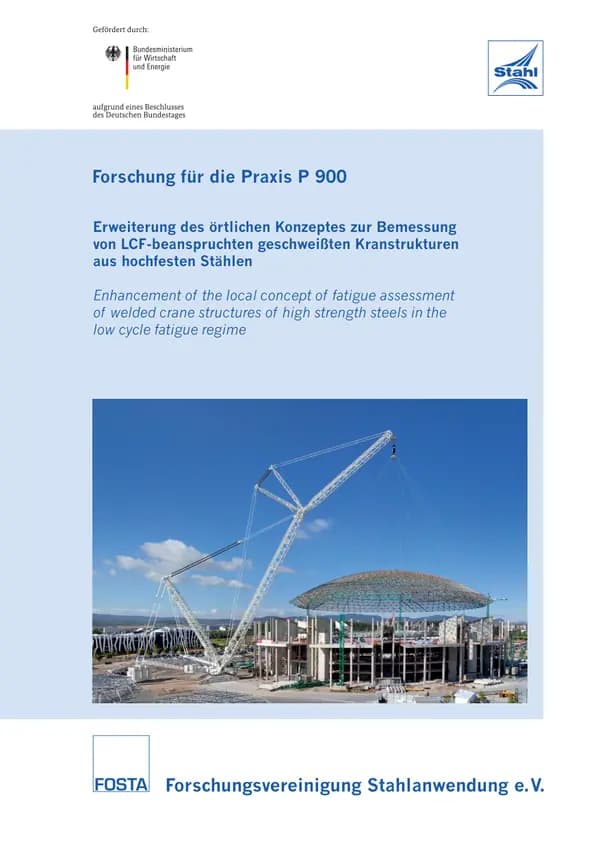
P 900 - Extension of the local concept for the design of LCF-stressed welded crane structures made of high-strength steels
In crane construction, the dead weight has a significant influence on the payload and therefore also on the economic efficiency of the structure. By reducing the dead weight without compromising the load-bearing …
Content
- Publication
- 2015
- Authors
- T. Melz, B. Möller, J. Baumgartner, T. Ummenhofer, S. Herion, J. Hrabowski, J. Henkel, B. Boos, E. Baier
In crane construction, the dead weight has a significant influence on the payload and therefore also on the economic efficiency of the structure. By reducing the dead weight without compromising the load-bearing capacity, the load capacity and thus the payload can be increased accordingly. This demand for higher load-bearing capacity with lower weight and material savings is achieved by using modern high-strength and ultra-high-strength steels. This research report examines the question of whether the higher static strength of the fine-grained structural steels S960QL, S960M and S1100QL can also be utilised in the welded state under cyclic loading in the short-term strength range (LCF range).
Show full description
For this reason, the fatigue strength behaviour of the high-strength and ultra-high-strength steels in the welded condition without and with post-weld treatment in the LCF range was characterised within this research project and prepared for numerical design. The fatigue strength results under constant as well as under variable load amplitudes based on operational measurements with a stress ratio of Rs = 0.1 show that the high static strength can also be utilised under fatigue in the short-term strength. While the fatigue strength of welded butt welds under constant load amplitudes can be continued linearly up to a nominal stress amplitude of Dsn = 900 MPa, a bilinear curve occurs under variable load amplitudes. The advantage of high-strength fine-grain structural steels is also demonstrated by the fatigue strength results of welded transverse stiffeners. The Wöhler and Gaßner lines are also linear up to the area of the static material yield strength. The influence of the weld seam quality and the associated welding distortion is not negligible. The test results were analysed in the nominal stress system in the form of a classification into notch classes (FAT classes) for the investigated weld details and crane-typical tube-fork components. The effectiveness of post-weld treatment by grinding, high-frequency hammering or TIG re-melting is also shown in the decisive application area, the short tensile strength range, on the basis of nominal stresses by increasing the service life. A design based on local stresses can be carried out taking into account the elastic-plastic material behaviour with the strain concept as well as with the notch stress concept and a linear-elastic consideration. This shows that the notch stress concept in particular can be used to design welded constructions made of high-strength steel in the LCF range using a reference radius of rRef = 1 mm. The global specimen and local weld geometry are mapped in the modelling. The improved structural design forms a broad basis for a more economical application of high-strength steels through more precise knowledge of the fatigue behaviour in the LCF range. The IGF project 17102 N of the Forschungsvereinigung Stahlanwendung e.V., Düsseldorf, was funded via the AiF within the framework of the programme for the promotion of joint industrial research (IGF) by the Federal Ministry for Economic Affairs and Energy on the basis of a resolution of the German Bundestag. The project was carried out at the Technical University of Darmstadt, Department of System Reliability and Machine Acoustics SzM and at the Karlsruhe Institute of Technology KIT, Research Centre for Steel, Wood and Stone.
Zum Zoomen hovern
€70.00excl. VAT
Payment by card (Stripe) or invoice (DE, AT, CH). Download link by email: automatically after ordering by card, after order approval for invoice (valid for 30 days). Terms
P 900 - Extension of the local concept for the design of LCF-stressed welded crane structures made of high-strength steels—
€70.00