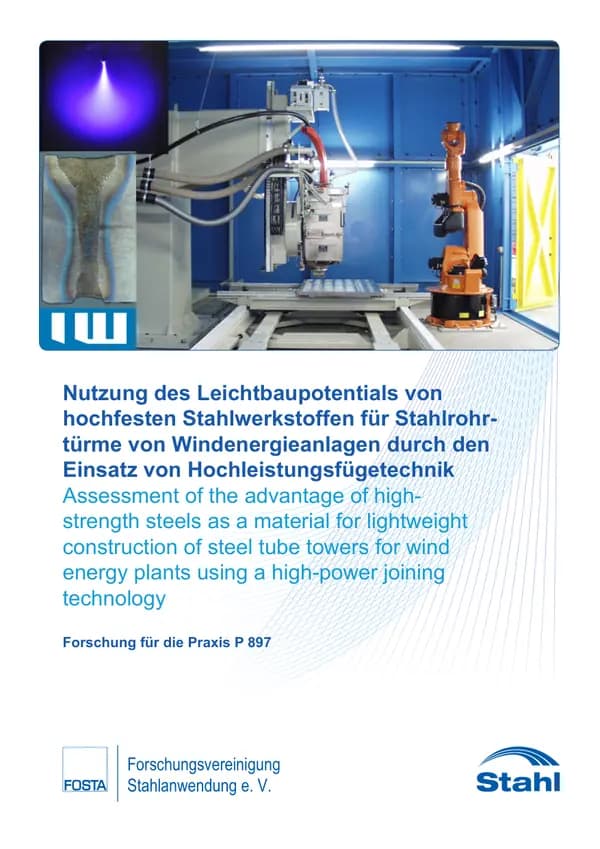
P 897 - Utilisation of the lightweight construction potential of high-strength steel materials for tubular steel towers of wind turbines through the use of high-performance joining techniques
Due to limited energy supplies and the global endeavour to reduce CO2 emissions, renewable energy sources such as wind energy are gaining in economic interest and promise great growth opportunities. The production of …
Content
- Authors
- F.-W. Bach, H. J. Maier, T. Hassel, R. Konya, N. Murray, A. Beniyash
- Publication
- 2017
P 897 - Utilisation of the lightweight construction potential of high-strength steel materials for tubular steel towers of wind turbines through the use of high-performance joining techniques Due to limited energy supplies and the global endeavour to reduce CO2 emissions, renewable energy sources such as wind energy are gaining in economic interest and promise great growth opportunities. The production of ever more powerful wind turbines goes hand in hand with increasing turbine heights. This requires turbines to be produced with ever thicker walls. The process times for welding processes and the associated non-productive times increase disproportionately with the wall thickness.
Show full description
This is mainly due to the significantly increased number of layers in submerged arc welding and the associated intensive seam preparation. The consumption of additional material, which is always necessary, also increases accordingly. The research project aims to establish a more economical production of tubular steel towers for wind turbines by utilising the advantages of modern high-strength steel materials and the high-performance non-vacuum electron beam welding (NVEBW) process. By using high-strength steel alloys, a reduction in the required wall thicknesses can be achieved. By using NVEBW, the total number of welding layers required can be greatly reduced. A particularly important aspect of the project is the investigation of the mechanisms of crack formation and their avoidance in the NVEBW of thick-walled components. Different strategies are being investigated and evaluated, including the consideration of heat conduction as well as alloying or through-welding. For comparison, conventionally submerged arc welded sheets and sheets welded using the NVEBW-UP process combination developed in the project are analysed metallographically and in tensile and fatigue tests. It is of great interest to enable the construction of ever taller tubular steel towers by utilising the advantages of modern steel materials and high-performance welding techniques. This research project is an important contribution to the introduction of such technologies for the construction of tubular steel towers. The findings can also be applied to other branches of industry, such as shipbuilding and crane construction.
Zum Zoomen hovern
€20.00excl. VAT
Payment by card (Stripe) or invoice (DE, AT, CH). Download link by email: automatically after ordering by card, after order approval for invoice (valid for 30 days). Terms
P 897 - Utilisation of the lightweight construction potential of high-strength steel materials for tubular steel towers of wind turbines through the use of high-performance joining techniques—
€20.00