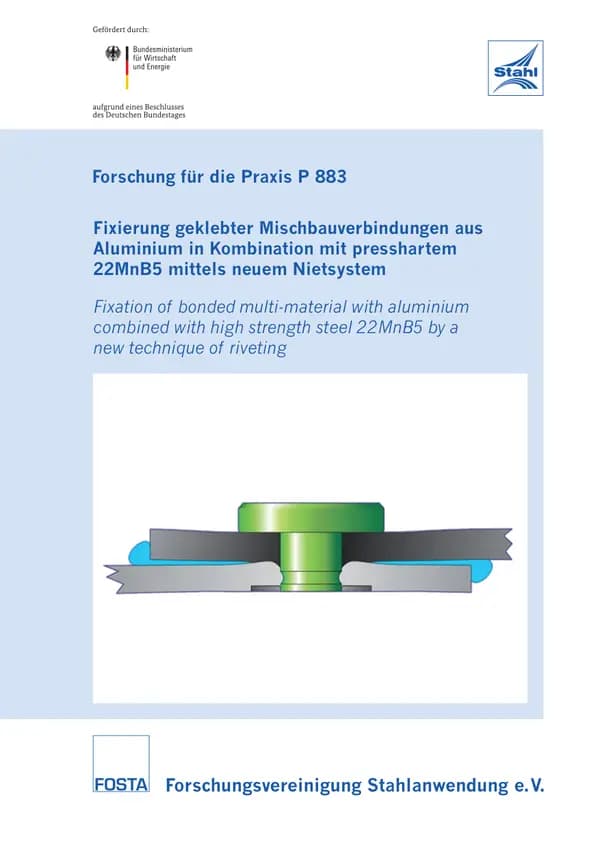
P 896 - Pilot hole insertion using shear cutting for functional elements and clinching points in ultra-high-strength steels
"Pre-punching by shear cutting for functional elements and clinch points in ultra-high-strength steels" The aim of the project was to set specific geometry ratios for pilot holes and to investigate their quantitative …
Content
- Publication
- 2014
- Authors
- Prof. Dr.-Ing. habil. U. Füssel
P 986 - Pilot hole insertion using shear cutting for functional elements and clinch points in ultra-high-strength steels "Pre-punching by shear cutting for functional elements and clinch points in ultra-high-strength steels" The aim of the project was to set specific geometry ratios for pilot holes and to investigate their quantitative effect on the formation and load-bearing capacity of the joint and to work out to which materials these effects can be transferred or applied. The results derived from this are 1. piercing of ultra-high-strength steels with minimum force requirement and reduction of reaction forces of up to 60% can be realised by bevel cutting, 2. targeted adaptation of the pilot hole and hole wall geometry to the requirements of setting functional elements and clinching can be realised by parallel and diagonal cutting, 3. integration of additional functions of the pilot hole for functional elements and clinching points in the sheet metal plane to increase torsional rigidity and independence of assembly direction is possible, 4. fundamental statements on a new clinching variant for high-strength and press-hardened steels, which makes it possible to perform joining tasks that cannot be joined using previous methods for geometric and/or material reasons, as only the forming capacity of the punch-side joining partner must be taken into account, can be made. only has to be taken into account, 5. testing of the load-bearing capacity of joints optimised in this way was carried out. From an economic point of view, this results in lower system and tool loads during the cutting process, which leads to an increase in tool life.
Show full description
This allows systems and tools to be dimensioned smaller so that, for example, lighter C-clamps with greater freedom of movement and action can be used. The project results lead to an expansion of the range of applications for existing products and systems, as joining can be carried out with existing tools. The new technical findings could be transferred to practical application in the short term, in some cases without modifying the system, as the joining systems are already integrated into the production process. The setting devices of these joining systems and the assembly process do not require any modification, as the pre-hole operation can be decoupled from the joining process in terms of location and time. A tool or model change, a design-related component change or the introduction of a new product can define the time for implementation.
Zum Zoomen hovern
€30.00excl. VAT
Payment by card (Stripe) or invoice (DE, AT, CH). Download link by email: automatically after ordering by card, after order approval for invoice (valid for 30 days). Terms
P 896 - Pilot hole insertion using shear cutting for functional elements and clinching points in ultra-high-strength steels—
€30.00