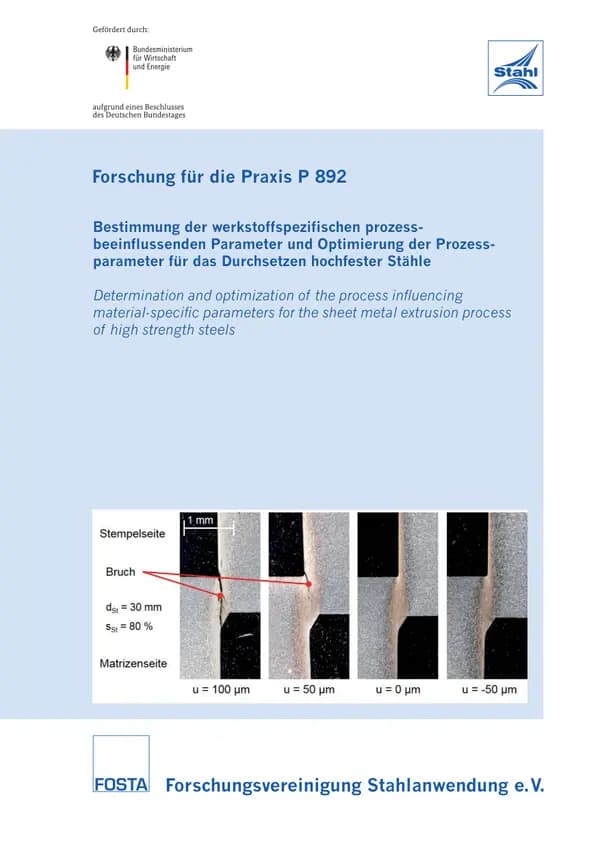
P 892 - Determination of the material-specific process-influencing parameters and optimisation of the process parameters for clinching of high-strength steels
The aim of this research project was to determine process parameters and influencing variables such as material characteristics for the clinching of conventional and high-strength sheet materials by means of experiments …
Content
- Authors
- W. Volk
- Publication
- 2015
The aim of this research project was to determine process parameters and influencing variables such as material characteristics for the clinching of conventional and high-strength sheet materials by means of experiments and simulations and, if necessary, to optimise the process in order to enable the reliable use of high-strength materials. Systematic, scientifically based, experimental and numerical analyses were carried out to gain a deeper understanding of the process, the process parameters and to determine the process-specific process limits. The experimental investigations in the clinching process were initially carried out on the basis of simple circular geometries using conventional sheet steel materials.
Show full description
By modelling the forming process as accurately as possible in the simulation, it was possible to gain insights into the stresses occurring in the tool. The tests also served to validate the simulation model created. Based on the knowledge gained from the tests and simulation, the geometry of a rotary and a toothed piercing punch was optimised. The aim of the punch optimisation in the form of a chamfer-radius combination on the punch surface was to increase the tool life. In addition, investigations were carried out into the material hardening, the process forces and the profile characteristics of the components as a function of the test material, the piercing gap, the piercing edge rounding and the punch surface preparation as well as the test geometry. On the basis of the experimental and theoretical test results, it was possible to demonstrate the limits of the clinching process. By mastering the clinching of high-strength steels, a significant reduction in costs and an increase in process reliability can be achieved. Furthermore, the current technically feasible limits of the process were demonstrated. Mould design guidelines were developed, enabling the process to be put into practice quickly. The IGF project 17103 N of FOSTA - Forschungsvereinigung Stahlanwendung e.V., Düsseldorf, was funded via the AiF within the framework of the programme for the promotion of joint industrial research (IGF) by the Federal Ministry for Economic Affairs and Energy on the basis of a resolution of the German Bundestag. The project was carried out at the Chair of Forming Technology and Foundry Engineering, Technical University of Munich, Garching.
Zum Zoomen hovern
€30.00excl. VAT
Payment by card (Stripe) or invoice (DE, AT, CH). Download link by email: automatically after ordering by card, after order approval for invoice (valid for 30 days). Terms
P 892 - Determination of the material-specific process-influencing parameters and optimisation of the process parameters for clinching of high-strength steels—
€30.00