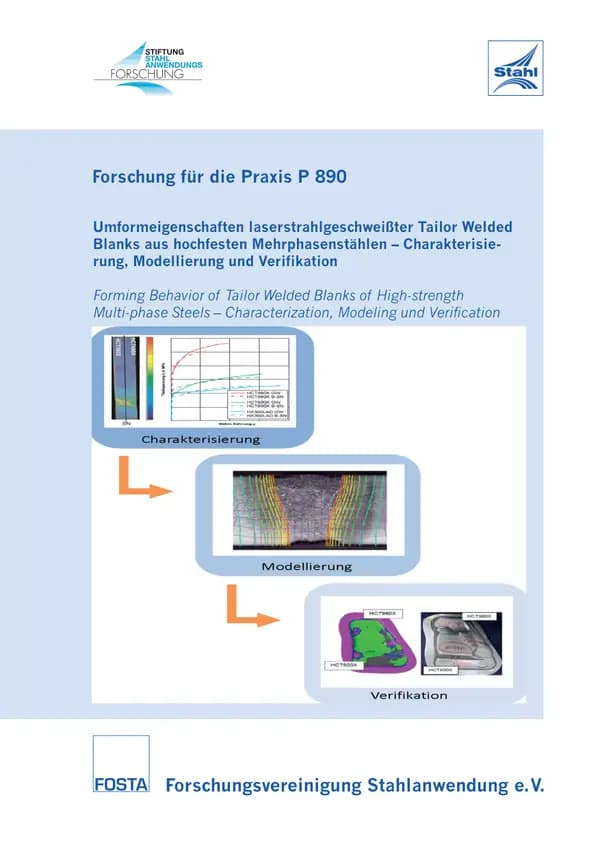
P 890 - Forming properties of laser-welded tailor-welded blanks made of high-strength multiphase steels - Characterisation, modelling and verification
Tailor-welded blanks (TWB) made of high-strength multiphase steels are currently only rarely used in the automotive industry, as the weld seam cannot be precisely modelled in the forming simulation. The aim of this …
Content
- Authors
- T. Mennecart, A. Güner, A. E. Tekkaya, M. Linnepe, A. Marx
- Publication
- 2015
Tailor-welded blanks (TWB) made of high-strength multiphase steels are currently only rarely used in the automotive industry, as the weld seam cannot be precisely modelled in the forming simulation. The aim of this project was to characterise the weld seam with regard to its properties, to improve the weld seam modelling and to verify this with real experiments. Within this project, which was carried out with ThyssenKrupp Steel Europe, TWBs from three common steel grades were characterised and a model was created for the simulation. The steel grades in question are the high-strength grades HCT980X, HXT600X and HX300LAD. In addition to a comprehensive characterisation of the weld seam, from which flow curves are determined, modelling approaches are verified with real tests.
Show full description
The linear weld seams are placed in differently stressed regions of the component and the behaviour (crack, weld seam migration) is analysed. Two forming tools were available for this purpose, which allowed high stresses to be applied to the weld seam. It was found that these TWBs made of HCT600X/HCT980X and HCT600X/HX300LAD can be formed if the weld seam is placed in non-critical areas. Modelling the weld seam in the simulation with its own flow curves can lead to an improvement in the simulation. The key results are - TWBs made from high-strength multiphase steels are suitable for forming in deep-drawing processes. - To ensure optimum forming, the weld the weld seam must first be placed in non-critical areas. areas. This design is carried out simulatively with a high degree of accuracy. The research project was carried out at the Institute for Forming Technology and Lightweight Construction at the Technical University of Dortmund and ThyssenKrupp Steel Europe AG, Duisburg, with technical support and financial assistance from the Forschungsvereinigung Stahlanwendung e. V., Düsseldorf, with funds from the Stiftung Stahlanwendungsforschung, Essen.
Machine-translated title and description. The document itself is in German.
Zum Zoomen hovern
€30.00excl. VAT
Payment by card (Stripe) or invoice (DE, AT, CH). Download link by email: automatically after ordering by card, after order approval for invoice (valid for 30 days). Terms
P 890 - Forming properties of laser-welded tailor-welded blanks made of high-strength multiphase steels - Characterisation, modelling and verification—
€30.00