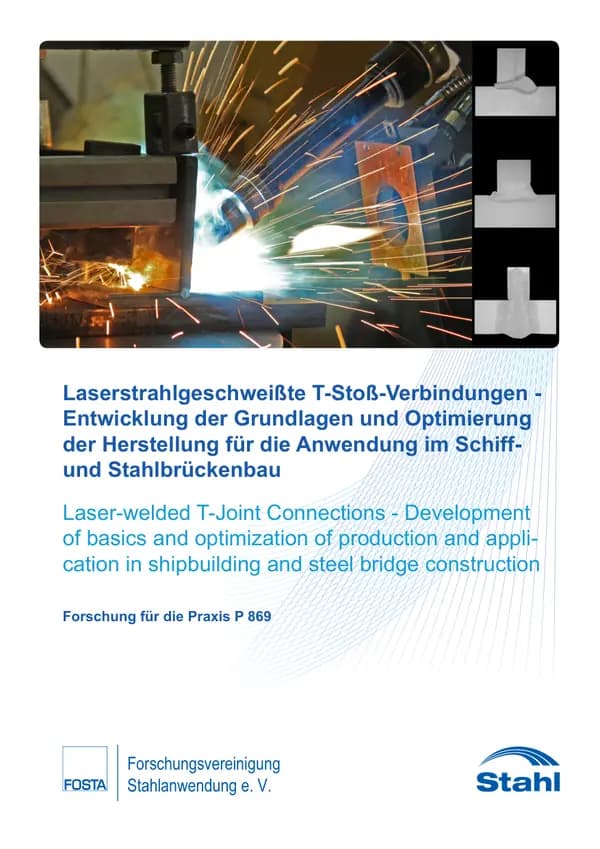
P 869 - Laser-welded T-joints - Development of the fundamentals and optimisation of production for use in shipbuilding and steel bridge construction
The joining of steel components using laser welding technology is increasingly replacing conventional welding techniques in some areas of the steel processing industry (shipbuilding, pipeline construction, special …
Content
- Authors
- D. Ungermann, C. Rüsse, W. Fricke, C. Robert, R. Peters, A. Sumpf
- Publication
- 2016
The joining of steel components using laser welding technology is increasingly replacing conventional welding techniques in some areas of the steel processing industry (shipbuilding, pipeline construction, special profile construction). The reasons for this are the high welding speeds that can be achieved with narrow and slender seams with good seam properties, as well as the low heat load and low distortion of the components as a result of welding. In addition, closed structures such as hollow steel plates can be produced economically with the help of so-called laser stitch seams. However, there is currently a lack of experimentally verified design methods for laser-welded T-joints under load combinations that are relevant for the construction of steel structures and steel bridges.
Show full description
Laser stitch welds are not anchored in current standards such as EC3, nor are there any investigations into the fatigue strength of laser-welded T-joints under normal force, bending and shear loading as well as under combined loading. The aim of the research project was to develop and provide all the necessary scientific and technical knowledge for the use of laser and laser-hybrid welded T-joints in steel structures. Furthermore, basic connection options for laser-welded hollow plates were to be developed for their use in large steel structures and the connections were to be specified for the application areas of shipbuilding and steel bridge construction and their different requirements. The aim was to significantly improve the cost-effectiveness and quality of such steel structures by using laser-welded profiles and hollow plates. Within the project, welding parameters and minimum production standards were developed for laser and laser-hybrid welded solid connections and laser stitch welds. Design models were derived for the normal force, bending and shear loads typical in steel construction on the detail of the T-joint by means of experimental investigations. Based on these models, the laser-welded semi-finished product "hollow plate" was extensively analysed analytically and numerically as well as constructively with regard to its use in ship and steel bridge construction. It was found that hollow plates using the laser welds improved within the project are fundamentally suitable for use in highly stressed decks in ship structures as well as in structures subject to high fatigue loads in steel bridge construction. Initial fatigue tests on connecting structures for the closed structures also showed promising results for a practical application of the semi-finished products investigated. The IGF project 16935 BG of the Forschungsvereinigung Stahlanwendung e. V., Düsseldorf, was funded via the AiF within the framework of the programme for the promotion of joint industrial research (IGF) by the Federal Ministry for Economic Affairs and Energy on the basis of a resolution of the German Bundestag. The project was carried out at the Faculty of Civil Engineering, Department of Steel Construction, Technical University of Dortmund, the Institute for Construction and Strength of Ships, Technical University of Hamburg-Harburg and the Schweißtechnische Lehr- und Versuchsanstalt Mecklenburg-Vorpommern GmbH, Rostock.
Zum Zoomen hovern
€50.00excl. VAT
Payment by card (Stripe) or invoice (DE, AT, CH). Download link by email: automatically after ordering by card, after order approval for invoice (valid for 30 days). Terms
P 869 - Laser-welded T-joints - Development of the fundamentals and optimisation of production for use in shipbuilding and steel bridge construction—
€50.00