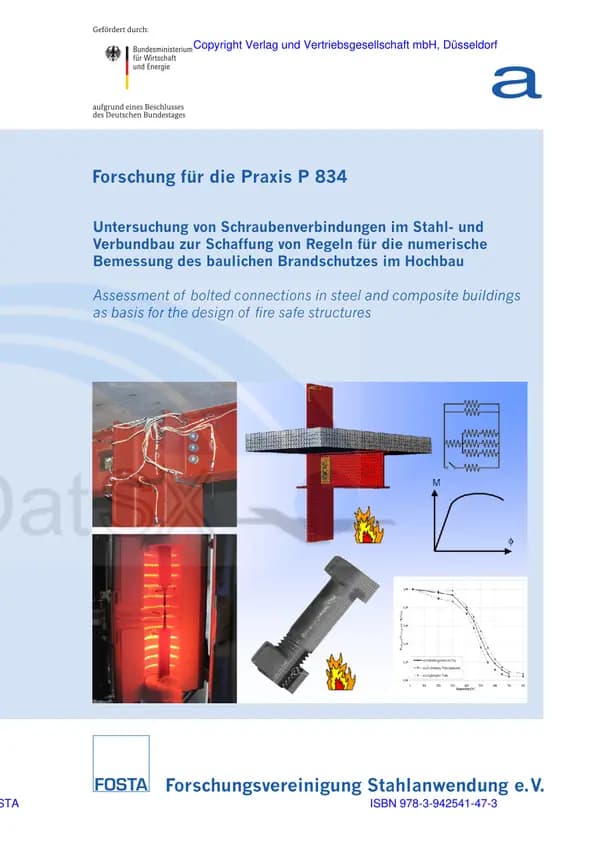
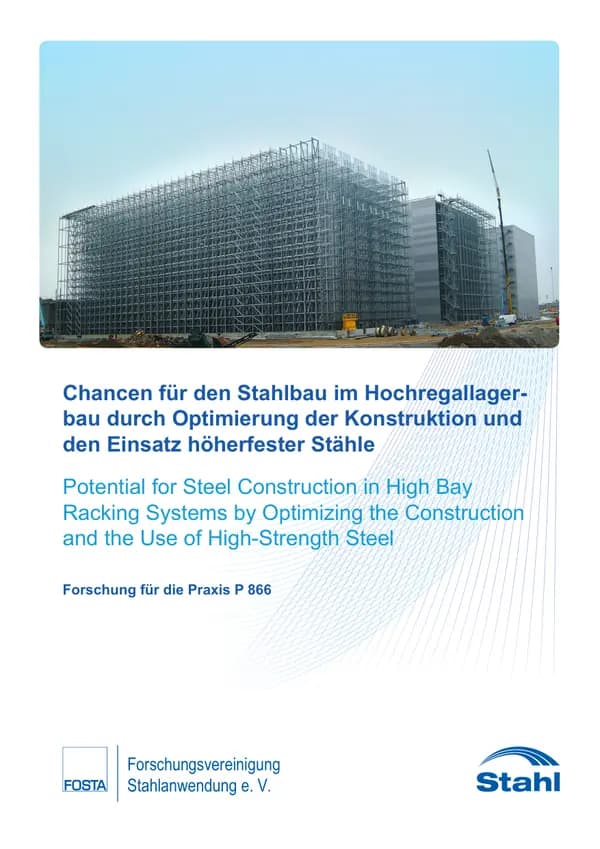
P 866 - Opportunities for steel construction in high-bay warehouses through optimisation of the design and the use of higher-strength steels
High-bay warehouses are usually constructed using thin-walled, cold-formed and non-standardised steel profiles of steel grade S350GD+Z. From a construction height of 20 metres, it makes sense to build high-bay …
Content
- Authors
- D. Ungermann, M. Schulze Bertelsbeck
- Publication
- 2016
High-bay warehouses are usually constructed using thin-walled, cold-formed and non-standardised steel profiles of steel grade S350GD+Z. From a construction height of 20 metres, it makes sense to build high-bay warehouses in silo construction. In silo construction, the space-enclosing roof and wall panelling is supported by the racking structure. Due to the upturn in the logistics industry and the general shortage of space, high-bay warehouses are now being built up to 50 metres high. With the rapid increase in height, current construction practice is reaching its structural limits. In addition, such structures cannot be designed directly in accordance with the regulations of DIN EN 1993-1-3 due to the complex profile design.
Show full description
The aim of the research project was therefore to analyse and optimise the load-bearing tolerance design of high-bay warehouses in silo construction and to assess the possible uses of higher-strength steels. To this end, both the overall design of the high-bay silo and individual components and connecting structures were analysed. Static-constructive analyses of typical high-bay silos were carried out in detail, the findings of which were used to develop optimisation parameters for the supporting structure. Extensive experimental investigations into the load-bearing behaviour of compression-loaded column profiles and pallet beams under constant moment loads made it possible to develop design concepts for these cross-sections in accordance with DIN EN 1993-1-3. Pallet beam tests were also carried out with a realistic load application via the pallets, which showed that the pallet impedes the lateral-torsional buckling of the beam and thus increases the load-bearing capacity of the pallet beams. However, it was shown that this increase in load-bearing capacity is crucially dependent on the surface quality of the pallets. Experimental tests were also carried out to analyse the load-bearing behaviour of the "transom-to-column" and "diagonal-to-column" connections. The tests on the "beam-column" connection showed that conservative results are achieved with the evaluation method in accordance with DIN EN 15512. Therefore, a recommendation was made for an alternative evaluation method, with which higher connection stiffnesses can be achieved with a reduced design moment. In order to be able to assess the possibility of using higher-strength steels, comparative tests were carried out with the steel grade S350GD+Z and the steel grades HX460LAD and HX500LAD, which are normally used in high-bay warehouse construction. It was shown that the use of higher-strength steels can, in certain cases, contribute to the optimisation of the load-bearing system and the cost-effectiveness of the structure. The IGF project 16998 N of the Forschungsvereinigung Stahlanwendung e.V., Düsseldorf, was funded via the AiF within the framework of the programme for the promotion of joint industrial research (IGF) by the Federal Ministry for Economic Affairs and Energy on the basis of a resolution of the German Bundestag. The project was carried out at the Technical University of Dortmund, Chair of Steel Construction.
Zum Zoomen hovern
€30.00excl. VAT
Payment by card (Stripe) or invoice (DE, AT, CH). Download link by email: automatically after ordering by card, after order approval for invoice (valid for 30 days). Terms
P 866 - Opportunities for steel construction in high-bay warehouses through optimisation of the design and the use of higher-strength steels—
€30.00