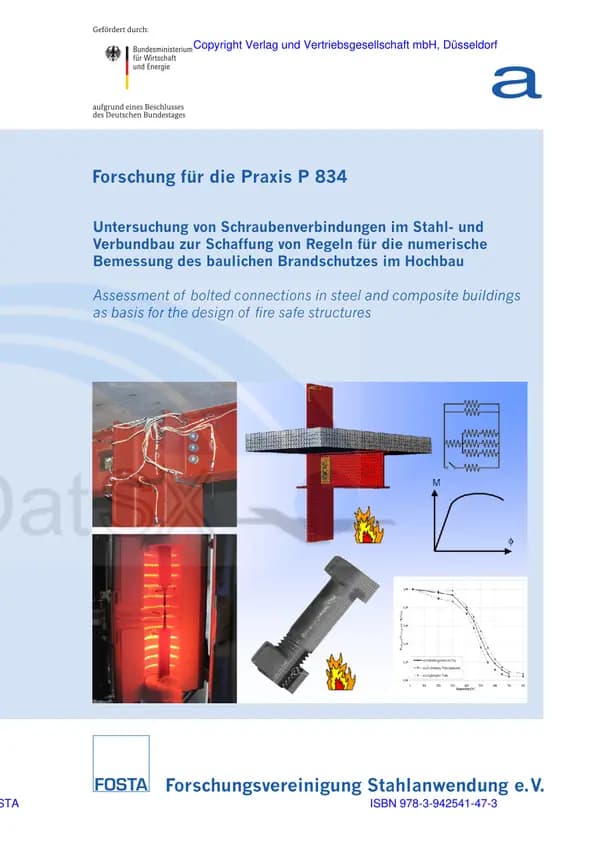
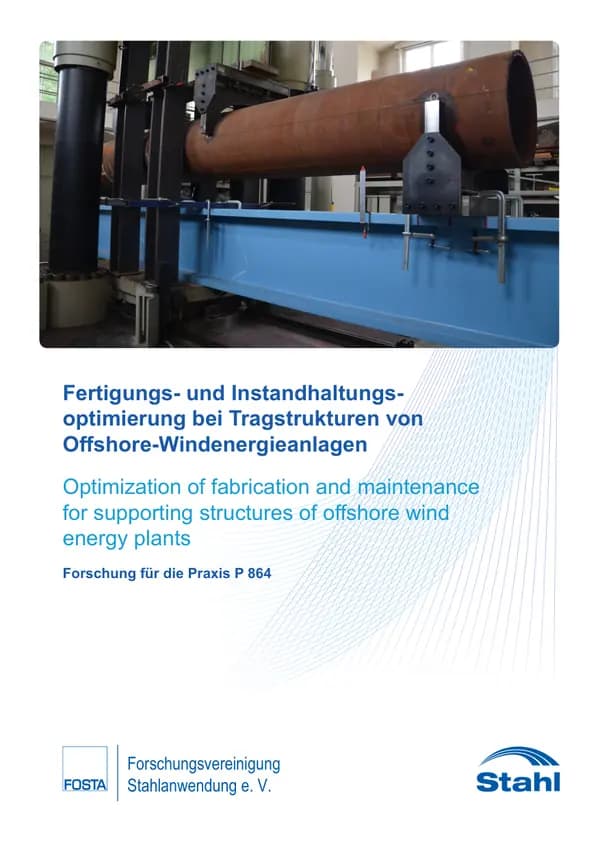
P 864 - Production and maintenance optimisation for support structures of offshore wind turbines
Support structures of offshore wind turbines (OWT) are often realised as welded round hollow section constructions, such as jacket or tripod constructions, and are exposed to the stresses from wind and waves as well as …
Content
- Authors
- T. Ummenhofer, P. Weidner, T. Zinke, M. Mehdianpour, A. Rogge
- Publication
- 2016
Support structures of offshore wind turbines (OWT) are often realised as welded round hollow section constructions, such as jacket or tripod constructions, and are exposed to the stresses from wind and waves as well as from the turbine operation itself during their service life. As a result of the high dynamic load components from wind and wave loads, the fatigue analysis is usually decisive for support structures of offshore wind turbines, which means that the design and optimisation of fatigue-critical details as well as the development of effective maintenance procedures and methods are of decisive importance. As part of the research project, fatigue strength tests were carried out on construction details that are frequently used in the foundation structures of WTGs.
Show full description
The focus here was on determining the fatigue strength of single-sided welded round hollow section connections and investigating the possibilities for partial welding of these connections. Based on the documented manufacturing steps of the experimentally analysed round hollow section joints, the individual manufacturing processes were evaluated economically and ecologically. A repair procedure was developed for the maintenance of existing structures and its effectiveness was tested for welded joints. For one-sided butt-welded round hollow section connections, the notch case classifications of applicable regulations, which are currently based on insufficient testing, were reviewed, extensive experimental investigations were carried out and the fatigue strength of this detail was determined. Fatigue-related parameters such as existing imperfections and production-specific aspects were identified, evaluated and their influence taken into account in numerical calculations. Based on the results, a notch case recommendation was developed that leads to technically sensible designs and enables an accurate service life estimate. This notch-catch recommendation can serve as a basis for future inclusion in standards and regulations. Possible areas of application for partially welded round hollow section connections were examined and the fatigue behaviour analysed. Numerical calculations and theoretical considerations proved the unfavourable load-bearing behaviour of these connections under tensile stress. The mathematical preliminary investigations were confirmed on the basis of the fatigue tests carried out. The results supplement the investigations in the work focus of the single-sided through-welded round hollow profile connections and contribute to the gain in knowledge with regard to the fatigue behaviour in the presence of weld seam defects. With regard to the manufacturing processes, the round hollow section joints tested in the trial were analysed in terms of their economic and ecological impact and the contributions of individual process steps to the overall result were identified. The LCA analyses showed that small round hollow profile diameters tend to cause greater potential environmental impacts if the profile circumference and the number of welded layers are taken into account. The use of an orbital welding machine was found to significantly reduce the impact in the process step of manufacturing the filler and cover layers, with the benefits of orbital welding increasing with increasing profile diameters. This can be transferred to the results of the economic efficiency comparison. With regard to the maintenance of WTG support structures, a repair procedure was developed and applied to welded connections with large plate thicknesses. The investigations confirmed the high effectiveness of weld post-treatment using high-frequency hammering (HFH) on pre-damaged components that had been repaired by repair welding. The fatigue tests showed that components subjected to HFH treatment after repair welding can be restored to new condition in terms of the resulting service life. The fatigue strength was also increased. The applicability of existing design proposals was confirmed on the basis of these results for the repaired details. The method developed can be used for real structures in a wide range of application areas, such as steel construction, mechanical engineering and plant construction. The IGF project 370 ZN of the Forschungsvereinigung Stahlanwendung e. V., Düsseldorf, was funded via the AiF within the framework of the programme for the promotion of joint industrial research (IGF) by the Federal Ministry for Economic Affairs and Energy on the basis of a resolution of the German Bundestag. The project was carried out at the Karlsruhe Institute of Technology (KIT), Research Centre for Steel, Wood and Stone, Karlsruhe and by the Federal Institute for Materials Research and Testing (BAM), Berlin.
Zum Zoomen hovern
€30.00excl. VAT
Payment by card (Stripe) or invoice (DE, AT, CH). Download link by email: automatically after ordering by card, after order approval for invoice (valid for 30 days). Terms
P 864 - Production and maintenance optimisation for support structures of offshore wind turbines—
€30.00