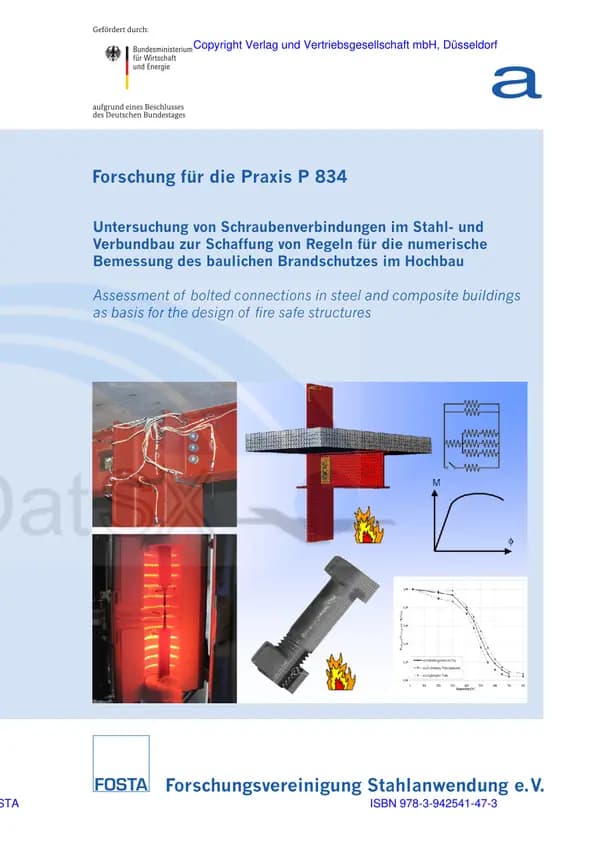
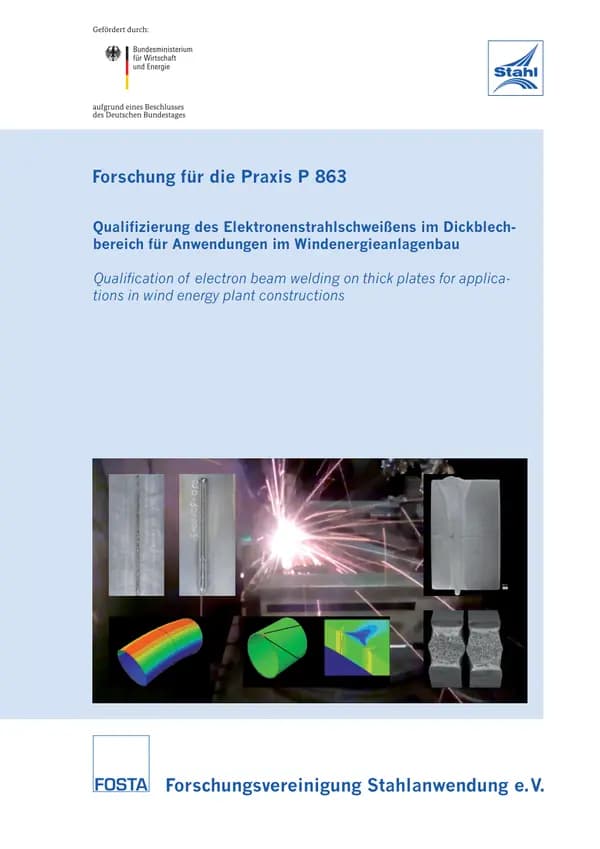
P 863 - Qualification of electron beam welding in thick sheet metal for applications in wind turbine construction
In line with the EU's climate and energy policy goals, the German government has set itself the target of increasing the proportion of renewable energies to 20% by 2020. To support this endeavour, new wind farms are to …
Content
- Authors
- U. Reisgen, S. Olschok, S. Ufer, W. Bleck, S. Münstermann, G. Golisch
- Publication
- 2016
In line with the EU's climate and energy policy goals, the German government has set itself the target of increasing the proportion of renewable energies to 20% by 2020. To support this endeavour, new wind farms are to be built in the North Sea, among other places. The construction of the wind farms poses a major challenge for steel construction, as the foundation structures anchored in the seabed at water depths of up to 50 metres are not only exposed to dynamic loads caused by the rotation of the wind turbine, but are also stressed by the waves and the tide. A heavy structure weighing up to 900 tonnes was therefore chosen.
Show full description
The joining of the individual pipe segments of the foundation structures is therefore extensive with up to 1230 metres of weld seam, applying the usual guidelines. The pipe segments of the foundation structures of such wind turbines are joined using the submerged arc welding (SAW) process in accordance with existing guidelines. In contrast to this welding process, electron beam welding (EB) offers high welding depths with high energy utilisation. The pipe segments of the foundation structures, which are up to 100 mm thick, can be joined in a single process step, which saves a great deal of time compared to submerged arc welding. This offers a major time advantage over submerged arc welding. As part of the project, the EB welding process is being optimised by developing an economical process window. Furthermore, the use of filler metals such as aluminium and nickel is being investigated to further increase the toughness of the weld seams, with aluminium in particular having a positive influence on the development of low-temperature toughness. In addition, the component safety of the foundation structures of the wind turbines is analysed using fracture mechanics concepts. The first step is to check whether the toughness guaranteed by the weld seams fulfils the requirements placed on the structure. In addition to the weld seams of structural steels of moderate strength, e.g. steel grade S355, the weld seams of high-strength grades (S460) are also tested here. The advantage of high-strength grades over conventionally used steels is that they can be designed with lower sheet thicknesses. The resulting material savings benefit a faster EB welding process. In addition to process optimisation, EB weld seam quality can also be improved. As well as improving the weld seam quality, the time required to produce the foundation structures is also reduced. The toughness guaranteed by the weld seams of the steel grades used serves as a stimulus to rethink the conventional design of the foundation structures based on a historically grown minimum toughness and a fixed material thickness. For economic reasons, it is also essential for the future design of foundation structures in wind turbines to establish the EB welding process and high-strength steels in the existing German and European guidelines. The IGF project 372 ZN of the FOSTA-Forschungsvereinigung Stahlanwendung e. V., Düsseldorf, was funded by the Federal Ministry for Economic Affairs and Energy via the AiF as part of the programme for the promotion of joint industrial research (IGF) on the basis of a resolution of the German Bundestag. The project was carried out at the Institute of Ferrous Metallurgy, RWTH Aachen University and the Institute of Welding and Joining Technology, RWTH Aachen University.
Zum Zoomen hovern
€30.00excl. VAT
Payment by card (Stripe) or invoice (DE, AT, CH). Download link by email: automatically after ordering by card, after order approval for invoice (valid for 30 days). Terms
P 863 - Qualification of electron beam welding in thick sheet metal for applications in wind turbine construction—
€30.00