P 862 - Further development of weld riveting for the connection of light metals and fibre-reinforced plastics to steel structures
The reduction of CO2 emissions from motor vehicles is intended to contribute to the reduction of CO2 emissions, which is reflected in current regulations and requirements. In addition to increasing the efficiency of …
Content
- Authors
- O. Hahn, G. Meschut, V. Janzen, F. Flüggen
- Publication
- 2015
The reduction of CO2 emissions from motor vehicles is intended to contribute to the reduction of CO2 emissions, which is reflected in current regulations and requirements. In addition to increasing the efficiency of drive components, reducing vehicle weight offers significant potential for lowering emissions. Mixed construction concepts have been developed to reduce the weight of the bodywork, the component with the greatest mass. The materials used primarily include high-strength and ultra-high-strength steels. Secondly, light metals such as aluminium or magnesium and fibre-reinforced and non-reinforced plastics are also used.
Show full description
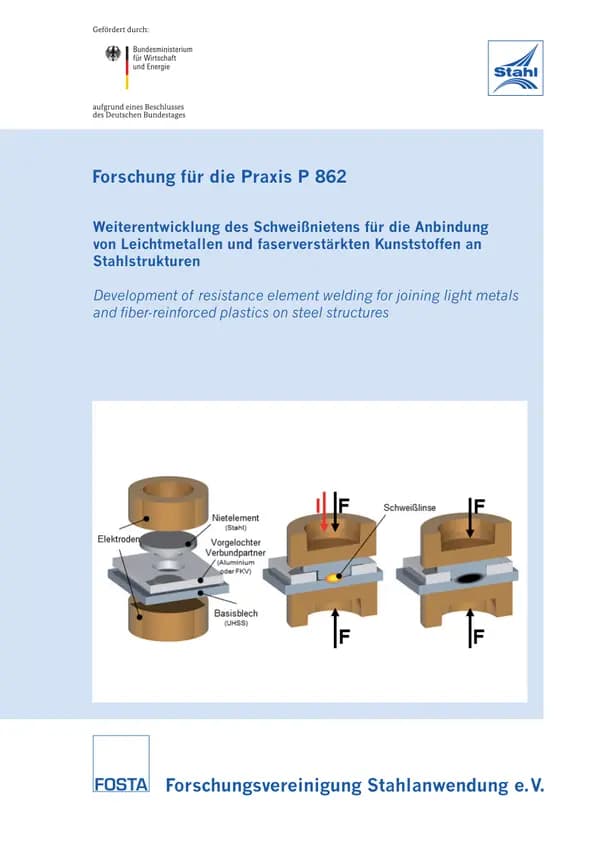
The effective use of stress-appropriate combinations of these materials requires the use of suitable joining techniques. Welded riveting offers a solution to these joining tasks. Here, a rivet-shaped steel element is inserted into the composite partner (e.g. aluminium) and joined to the underlying steel sheet using conventional resistance spot welding technology (WPS). With this joining process, a force-, form- and material-locking connection is realised, whereby high connection strengths can be achieved. For the use of this innovative The joining process must be further developed in order to use this innovative joining technology for joining mixed construction methods, such as those used in automotive engineering or aircraft construction. he aim of the research project was to qualify weld riveting as an economical joining process for joining light metals and fibre-reinforced plastics in combination with steel materials. In order to achieve this goal, influencing variables on the joining and welding process and on the formation of the joining element were analysed and measures for optimising the process parameters and the process sequence were derived. In addition, weld riveting was analysed in combination with adhesive bonding and the influencing variables occurring in this process were determined by varying the material combinations and recommendations for action were derived with regard to process control. Based on the results obtained, characteristic strength values were determined for different material combinations under quasi-static and cyclic loading and compared with the characteristic values of semi-tubular riveted joints. Corrosion tests were carried out due to the different materials in the joining zone and the resulting increased tendency to corrosion. Overall, the investigations showed that weld riveting is suitable for joining material combinations as part of the mixed construction concept and that the range of applications of the process is particularly wide. The IGF project 16806 N of the FOSTA-Forschungsvereinigung Stahlanwendung e. V., Düsseldorf, was funded via the AiF as part of the programme for the promotion of joint industrial research (IGF) by the Federal Ministry for Economic Affairs and Energy on the basis of a resolution of the German Bundestag. The project was carried out at the Laboratory for Materials and Joining Technology, University of Paderborn.
Zum Zoomen hovern
€30.00excl. VAT
Payment by card (Stripe) or invoice (DE, AT, CH). Download link by email: automatically after ordering by card, after order approval for invoice (valid for 30 days). Terms
P 862 - Further development of weld riveting for the connection of light metals and fibre-reinforced plastics to steel structures—
€30.00