The aim of the research project was, on the one hand, to develop a sustainability assessment method for steel structures of renewable energy plants that meets the requirements of plant, energy and construction …
The aim of the research project was, on the one hand, to develop a sustainability assessment method for steel structures of renewable energy plants that meets the requirements of plant, energy and construction technology. On the other hand, the objective included the development of criteria and indicators in the relevant sustainability categories for renewable energy sources and the provision of a guideline to enable a sustainability assessment based on the developed method. To this end, the system, energy and construction technologies of the five renewable energy sources wind, biomass, solar, water and geothermal energy were initially identified and compiled.
For each of these technologies, the current and future situation for Germany was assessed and considered in relation to the utilised and potential steel tonnages of the respective technologies. From this, the lead technologies of interest for Germany - onshore wind turbines, offshore wind turbines and biogas plants - were derived and defined as the focus of the project in consultation with the project support committee. Material and substance flows created for these technologies served as the basis for the development of the sustainability assessment method. The five sustainability categories of ecology, economy, sociology, technology and process were defined based on existing and proven assessment methods from building construction. Criteria transferable from building construction were identified for the respective categories and supplemented by other criteria and indicators widely used in the steel and renewable energy industries. From this total of over 200 criteria, compiled in a catalogue of criteria, 35 criteria were identified as decisive criteria for steel constructions for renewable energies. A profile was created for each criterion, consisting of a definition, affiliation to the sustainability category and data collection. The evaluation method developed makes it possible to view and analyse the individual results of the criteria for each sustainability category in a polar diagram for each category. In addition to the fact sheets and method descriptions, a user tool was developed to enable easy application of the developed sustainability assessment method. With the help of an easy-to-use input interface, the future user is provided with a tool for quickly and clearly determining the sustainability of the steel structure under consideration. Furthermore, the user tool makes it possible to compare different design variants so that not only the most sustainable design can be determined, but also optimisation potential can be filtered out. Sustainability assessments carried out for example applications provide further assistance for the application. The IGF project 16599 N of the Forschungsvereinigung Stahlanwendung e.V., Düsseldorf, was funded via the AiF within the framework of the programme for the promotion of joint industrial research (IGF) by the Federal Ministry for Economic Affairs and Energy on the basis of a resolution of the German Bundestag. The project was carried out at the Gottfried Wilhelm Leibniz University of Hanover by the Institute of Steel Construction, at the Ruhr University Bochum by the Chair of Energy Systems and Energy Economics and at the University of Duisburg-Essen by the Institute of Metal and Lightweight Construction.
Payment by card (Stripe) or invoice (DE, AT, CH). Download link by email: automatically after ordering by card, after order approval for invoice (valid for 30 days). Terms
Machine-translated title and description. The document itself is in German.
Digital download
Payment by card (Stripe) or invoice (DE, AT, CH). Download link by email: automatically after ordering by card, after order approval for invoice (valid for 30 days). Terms
Other parts and editions as well as neighbouring documents of the same series.

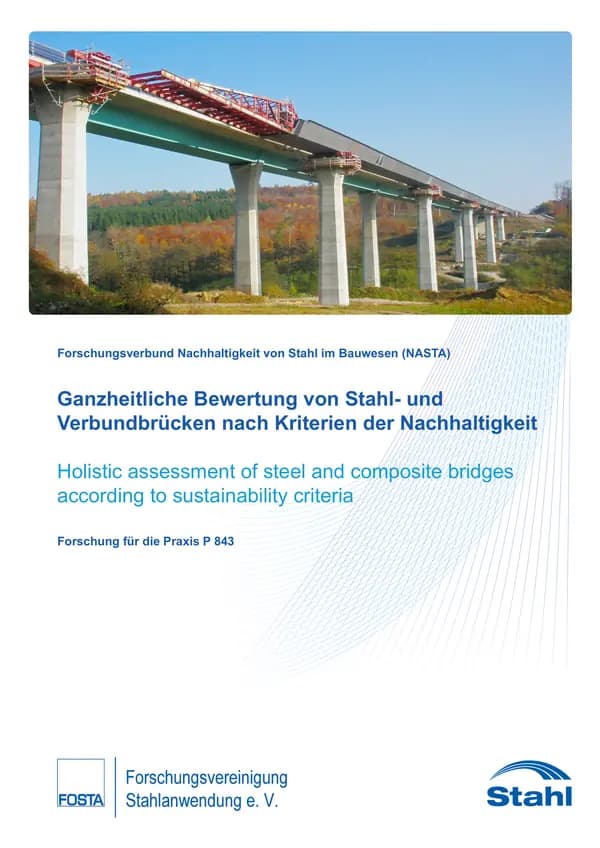
P 843 - Holistic assessment of steel and composite bridges according to sustainability criteria Bridges are essential infrastructure structures that are planned for a service life of more than 100 years. Nevertheless, the current evaluation practice (awarding practice) of bridges is mainly based on the manufacturing costs. One of the main aims of this research project was to move away from this towards a life cycle-orientated assessment for road bridges and thus also to work out the special possibilities of steel and composite bridges. By applying bottom-up analyses, detailed investigations were carried out on real structures of typical steel and composite bridges of different spans. The results of life cycle cost calculations, life cycle assessments and calculations of external effects are presented for three different types of motorway bridges and analysed in variants. The results of the investigations on the reference structures can be used to show which criteria play a particularly important or rather a subordinate role in supporting sustainable development. The ecological and economic aspects are analysed over the entire life cycle, whereby, unlike usual, the processes taking place on the construction site are also included in detail. As a special feature, the environmental impacts caused by external effects are also recorded realistically in the life cycle assessment. The maintenance strategies used in this research project are based on a component-specific description of the degradation behaviour of the bridges and their details. The fatigue stresses resulting from the traffic load can be of decisive importance for bridge structures. Here, the fatigue behaviour for cyclic longitudinal shear loading of an innovative composite joint was investigated using push-out tests. When analysing existing global and national assessment approaches, a distinction must be made between assessment systems and individual methods. Suitable calculation tools were selected and applied, particularly for external cost accounting. As an important project result is the determination and quantification of a strong location dependency of the calculated impacts and, above all, the external effects, only variant comparisons with identical calculation boundary conditions are carried out in the project. A location-independent comparison using standardised, fixed weighting factors and benchmarks for Germany as a whole is not recommended on the basis of the findings obtained. By analysing five reference structures and a total of ten different variants (different detailed designs, maintenance strategies and motorway situations), a comprehensive collection of examples is created, all of which are highly relevant to practice. The emphasis is placed on the quantitative presentation of results. The same life cycle approaches are used for all calculations and all input values are fully defined at component level. It can be shown on the basis of the variant analyses that manufacturing costs should not be used as the sole basis for decision-making for bridge structures. An evaluation should always be site-based in order to assess the strengths and weaknesses of bridge variants for economic, ecological and macroeconomic effects over the entire life cycle. The IGF project 353 ZN of FOSTA - Forschungsvereinigung Stahlanwendung e.V., Düsseldorf, was funded via the AiF within the framework of the programme for the promotion of joint industrial research (IGF) by the Federal Ministry for Economic Affairs and Energy on the basis of a resolution of the German Bundestag. The project was carried out at the Institute for Construction and Design at the University of Stuttgart, at the Research Centre for Steel, Wood and Stone at the Karlsruhe Institute of Technology, at the Chair of Metal Construction at the Technical University of Munich, at the Chair of Building Physics, Department of Holistic Balancing at the University of Stuttgart and by the Federal Highway Research Institute (BASt), Department of Bridge and Civil Engineering. Authors: U. Kuhlmann, P. Maier, T. Zinke, T. Ummenhofer, M. Pfaffinger, M. Mensinger, T. Beck, K. Lenz, S. Schneider, M. Fischer, H. Friedrich, R. Kaschner, J. Krieger Publication: 2016
available anytime
€40.00
excl. VAT

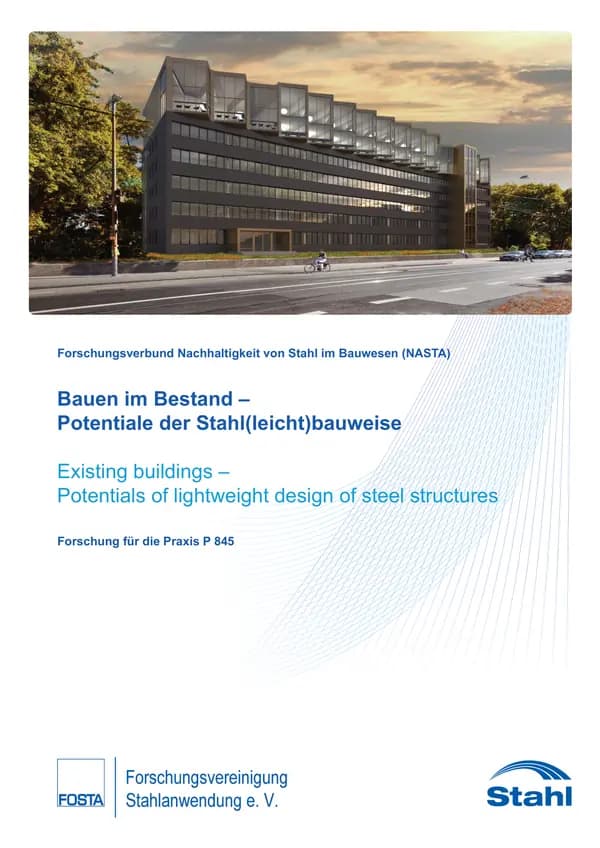
P 845 - Building in existing structures - potential of (lightweight) steel construction Construction in existing buildings generally describes the densification, modernisation and refurbishment of existing buildings. In the coming years, this will be a focal point in the construction sector. The holistic system of sustainability assessment provides a comprehensive basis for all stakeholders involved in order to master the tasks of long-term maintenance and renovation of existing buildings. In order to make optimum use of the advantages of (lightweight) steel construction, comprehensive basic principles, planning aids and evaluation criteria are required that do justice to the interdisciplinary construction tasks, taking into account urban planning, architectural and building physics aspects as well as structural design requirements, building operation aspects, property valuation aspects and cross-life cycle sustainability optimisation. In this research project, the foundations for "Building in Existing Contexts" were developed for each of the sub-disciplines mentioned. The focus here was particularly on the extension of existing buildings, especially in the form of additions in (lightweight) steel construction. This includes an architectural and structural analysis of already realised extension measures as well as an overview of historical building materials. In addition, the possibility of designing the façade in sandwich construction was analysed in terms of construction, details and modularity. The integration of latent heat storage for summer heat insulation was also analysed against the background of the constant reduction in heating energy and primary energy requirements. The summer heat insulation optimised in this way leads to a reduction in the cooling requirement in summer. Finally, the investigations focussed on the operational planning of construction sites for "building in existing buildings" in inner-city areas. The sustainability analyses based on these aspects serve as support in project development for existing building measures. To this end, assessment approaches and system boundary definitions for the three dimensions of economy, ecology and society were also developed for existing buildings. As a result, detailed life cycle assessment results for specific existing building projects are now available for the first time, which can be used to evaluate different demolition and new construction scenarios. The economic advantages of building in existing structures have also been demonstrated. The application of the respective assessment criteria is demonstrated using selected example buildings that were built in reinforced concrete frame construction between 1960 and 1970. All in all, the results of the research project provide planners with guidelines for the sustainable use of existing buildings, even at an early planning stage. The IGF project 16598 N of the Forschungsvereinigung Stahlanwendung e.V., Düsseldorf, was funded via the AiF within the framework of the programme for the promotion of joint industrial research (IGF) by the Federal Ministry for Economic Affairs and Energy on the basis of a resolution of the German Bundestag. The project was carried out at the Technical University of Dortmund by the Chair of Steel Construction, the Chair of Building Construction and the Chair of Construction Operations and Building Process Management, at the Karlsruhe Institute of Technology (KIT), Research Institute for Steel, Wood and Stone, at the Technical University of Braunschweig by the Institute for Machine Tools and Production Engineering, at the Institute for Dry and Lightweight Construction gGmbH and at the Technical University of Darmstadt by the Department of Structural Development and Building Physics. Authors: D. Ungermann, A. Patschin, A. Pätzold, E. Prechwinkel, P. Floerke, S. Weiß, M. Gralla, T. Brandt, T. Ummenhofer, M. Herrmann, T. Zinke, C. Herrmann, T. Dettmer, K. Tichelmann, B. Ziegler Publication: 2016
available anytime
€50.00
excl. VAT

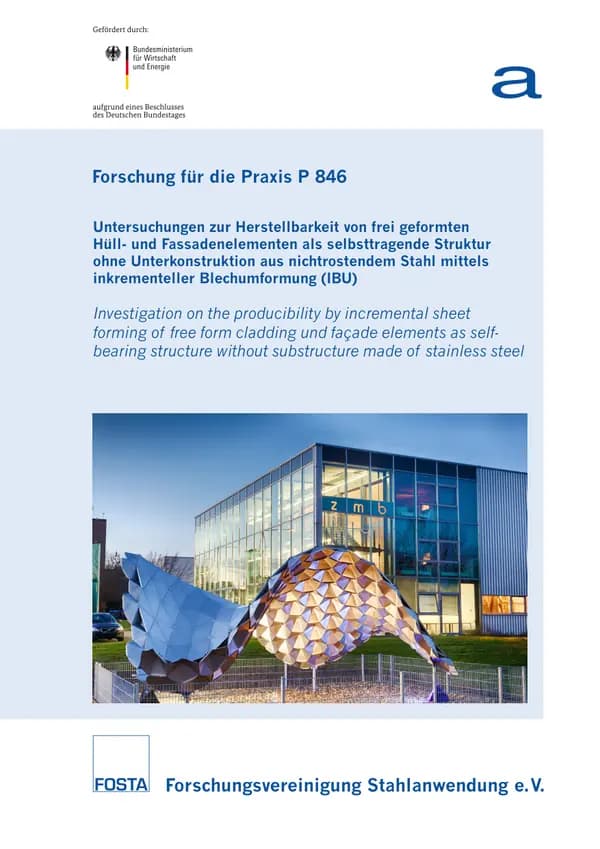
P 846 - Investigations into the manufacturability of free-form envelope and façade elements as self-supporting structures without substructure made of stainless steel by means of incremental sheet metal forming (IBU) The increased demand for individualised products in the construction industry over the last few decades is particularly evident in the expansion of the range of shapes, for example in free-form architecture. Due to the lack of mature and universally applicable building concepts, free-form façade and roof constructions are mostly realised as individual solutions with material-intensive substructures, whereby the envelope surfaces in some cases assume neither load-bearing nor functional tasks. In this context, the research report describes a new construction concept for self-supporting lightweight free-form structures, which offers the possibility of combining the load transfer as well as the function and design of the building envelope in a two-layer structure. The combination of tessellation and folding of an envelope surface, which in principle enables the construction of self-supporting structures made of sheet metal, was transferred to complex free-form geometries in the research project described. The flexible production chain developed on the basis of incremental sheet metal forming (IBU) is also suitable for the production of the required façade elements in the case of free-form designs, the geometric approximation of which inevitably results in a large number of individual components. A holistic optimisation of the building concept was made possible in particular by the fact that the entire process chain, from the initial design to production and final assembly, with all its interactions, was analysed and coordinated in close cooperation between architects, civil engineers and production technicians. In addition, the entire construction concept with all the details of the design elaboration and the production, joining and assembly technology could be anchored in a specially developed software tool for the planning phase. This software tool thus supports production-orientated planning and automates all the necessary steps in the design and detailing phase. A suitable joining and assembly concept was developed for the final assembly process, which utilises the self-supporting nature of the developed structures and enables the individual parts to be easily assembled into the overall form. As could be shown using the example of the realised sample building, the developed construction concept enables the realisation of self-supporting free-form structures, e.g. for the roof and façade area. The calculated realisation costs, which include both production and assembly, are less than 2700 €/m², which is quite competitive in view of the high geometric flexibility. The enormous lightweight construction potential of the building concept was confirmed by a surface weight of less than 16 kg/m². The approaches developed have thus opened up new possibilities for metallic construction methods in modern architecture and design. In addition, there is potential for metal processing companies to offer the flexible production of sheet metal parts by adapting the developed IBU-based production chain and thus expand their business areas. Overall, both the range of applications and the geometry flexibility for sheet steel components will be for sheet steel components, thus enabling increased sales of raw materials and semi-finished products. The IGF project 16603 N of the German Committee for Steel Construction DASt, was funded via the AiF as part of the programme for the promotion of joint industrial research and development (IGF) by the Federal Ministry for Economic Affairs and Energy on the basis of a resolution of the German Bundestag. The project was carried out by the Institute for Image Forming and the Chair of Load-bearing Structures at RWTH Aachen University. Technical support for the project was provided by FOSTA - Forschungsvereinigung Stahlanwendung e.V., Düsseldorf. Authors: G. Hirt, M. Bambach, D. Baily, M. Trautz, H.W. Heyden, R. Herkrath, T. Pofahl, G.D. Puppa Publication: 2014
available anytime
€40.00
excl. VAT

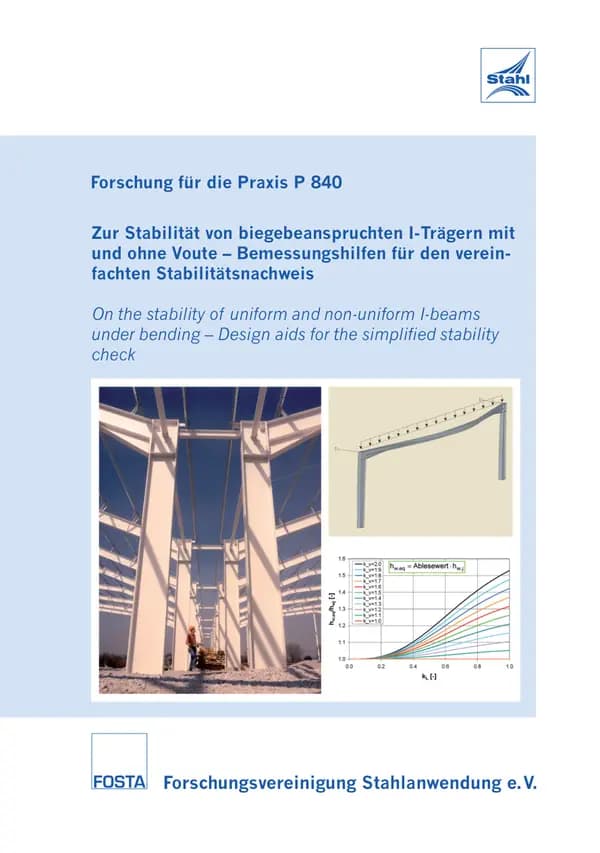
P 840 - On the stability of I-beams subjected to bending with and without haunch - Design aids for the simplified stability analysis Frame-type supporting structures made of steel are predominantly manufactured from open, I-shaped rolled sections, whereby the highly stressed frame corners are often approximated to the stress curve by haunching the sections. This construction method offers the economic advantage that a statically adapted, smaller profile can be used for the largest beam area. The current standardisation specifies verification formats for the verification of spatial stability, i.e. the lateral-torsional buckling verification, which are based on the determination of the ideal lateral-torsional buckling moment on a detached single member. The component load-bearing capacity is then determined with the aid of a load-bearing capacity curve defined by tests and numerical simulations. Numerous aids are given in the technical literature for the verification of parallel chord members, but the lateral-torsional buckling of haunched components is not satisfactorily recorded. As part of the FOSTA research project P 690, design aids for haunched components were developed, which provide the results of numerical and experimental investigations in a prepared form for application to the simplified stability analysis. In this report, these design aids are compiled in such a way that they can be used by engineers in daily practice as an aid for a quick and simple stability verification of I-beams subjected to bending with and without haunching. For this purpose, the results are structured in such a way that all the information required for the simplified stability check is quickly and easily available. The design aids include diagrams and formulae for calculating the ideal lateral-torsional buckling moment Mcr for components with variable cross-sections. Recommendations are given for selecting the load reduction curve. In addition, assistance is provided for the mathematical consideration of secondary components such as purlins, bracing and trapezoidal sheets, and rules are given for the removal of replacement members from the overall system. This report consists of the design aids, which are summarised in the appendix. The necessary background is explained in the text section. The application of the design aids is illustrated with the aid of flow charts and a design example. The research project was carried out at the Technical University of Dortmund by the Chair of Steel Construction with technical support and financial assistance from the Forschungsvereinigung Stahlanwendung e. V., Düsseldorf. Authors: D. Ungermann, I. Strohmann Publication: 2014
available anytime
€30.00
excl. VAT