
FOSTA
Driven by increasing demands on the weight and safety of new vehicles, thin sheets made of dual-phase steels are increasingly being used in automotive engineering. However, the high potential of these steel materials in …
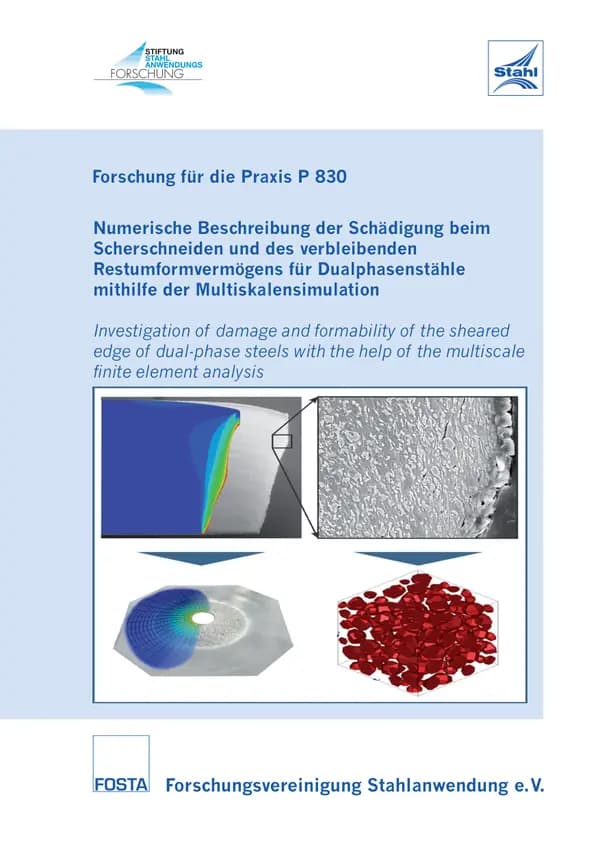
Driven by increasing demands on the weight and safety of new vehicles, thin sheets made of dual-phase steels are increasingly being used in automotive engineering. However, the high potential of these steel materials in terms of the strength and shape complexity of a component is currently only partially utilised. This is partly due to the low deformation capacity of shear-cut edges, which is attributable to damage in the form of pores between the ferrite and martensite in the cut edge area. When the edge is stretched, tensile stresses lead to the growth of these pores, their coalescence into microcracks and finally to edge cracking.
As there is currently no generally accepted method for determining the edge deformation capacity and taking this into account in the forming simulation, the design of forming processes often allows significantly smaller edge deformations than dual-phase steels can withstand without failure. The aim of the project was to develop a practicable way of taking into account the damage caused by shear cutting in thin sheets made of dual-phase steels in the numerical simulation of subsequent forming operations. The aim was to estimate the remaining deformation capacity of the cut edge area using standard simulation programmes. The focus was on two dual-phase steels with a strength of approx. 600 MPa and 780 MPa and a thickness of around 1.4 mm. The following approaches were developed and investigated in the project: an extended forming limit diagram, damage modelling using the Johnson-Cook damage model parameterised on the shear cutting process, damage modelling using the Johnson-Cook damage model parameterised on characterisation tests, damage modelling using the Gurson-Tvergaard-Needleman damage model parameterised on characterisation tests, micromechanical damage modelling using a representative volume element. The report presents an evaluation of these approaches with regard to their complexity on the one hand and their quality of failure prediction on the other hand and provides suggestions for future research work. The extended forming limit diagram is evaluated as a pragmatic approach that can be immediately implemented in practice. In order to generalise this approach, it is recommended that future research projects quantify the influence of pressure superposition in forming processes on the edge forming capacity and map it in characterisation tests. Micromechanical damage modelling is currently classified as less relevant for practical applications due to the high modelling effort involved. However, a further development of this approach appears promising for gaining a better understanding of the mechanical properties of dual-phase steels. The solution approaches, which are based on a transfer of the damage distribution of a shear shear cutting simulation to a forming simulation require good agreement between the experimental and numerical results of shear cutting. However, this could not be achieved in the project. There is still a need for research into the transfer of experimentally determined forming limits to the shear cutting simulation. The research project was carried out at the Institute of Forming Technology and Forming Machines, Leibniz Universität Hannover, with financial support from the Forschungsvereinigung Stahlanwendung e. V., Düsseldorf, with funds from the Stiftung Stahlanwendungsforschung, Essen.
Machine-translated title and description. The document itself is in German.
Payment by card (Stripe) or invoice (DE, AT, CH). Download link by email: automatically after ordering by card, after order approval for invoice (valid for 30 days). Terms
Digital download
Other parts and editions as well as neighbouring documents of the same series.
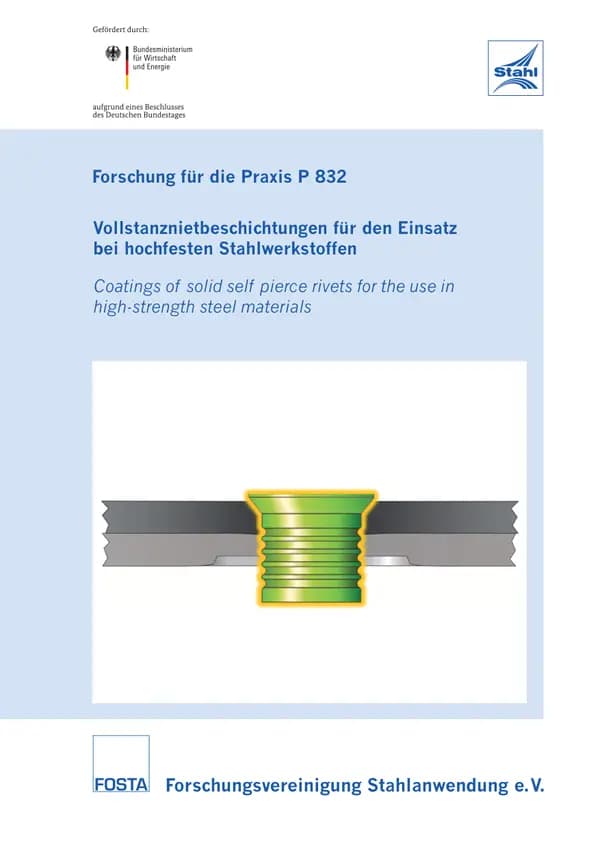
P 832 - Solid self-pierce rivet coatings for use with high-strength steel materials The aim of this research project was to develop a rivet element coating that serves as corrosion protection and at the same time as a hydrogen barrier. The basis for this was the galvanic zinc-nickel system. However, the fact that the current yield in this electrolyte is only approx. 50% is problematic, as this means that only 50% of the electrical energy used contributes to the formation of hydrogen. Two riveting materials were analysed in this research project. These are the cold heading steel 1.5515 and the chromium steel 1.4035, which has a chromium content of 13% by weight. This high chromium content leads to passivation of the material, which makes galvanic coating more difficult. By modifying the pre-treatment of the rivet elements, it was possible to achieve a significant improvement in coating adhesion. However, after loading with hydrogen, the chrome steel rivet exhibited brittle fracture behaviour under quasi-static shear stress and the porosity of the coating was also demonstrated in the corrosion tests. Further optimisation is therefore required for an electroplating process in an aqueous electrolyte. PVD coating systems, which have shown good adhesion, are also conceivable. In addition, a modified rivet geometry was developed for the chrome steel rivet, which has proven to be good in terms of stability in the setting process and affinity to hydrogen embrittlement. The coating of the cold heading steel rivet did not show any problems. The modified pre-treatment of the rivet elements can also be used here. In addition to the zinc-nickel coating, the Almac ® and zinc-lamella coating systems are also available. All coatings can be applied without any problems. In addition, the 1.5515 rivet shows no signs of failure in combination with hydrogen, which is why it is preferable to the chrome steel rivet if there is a risk of hydrogen diffusion into the auxiliary joining part. Also with regard to their corrosion-inhibiting The coatings on the cold heading steel rivet also showed no abnormalities in terms of their corrosion-inhibiting effect and can be rated as suitable for preventing corrosion on the rivet element. The IGF project 16495 N of the Forschungsvereinigung Stahlanwendung e.V. - FOSTA, Düsseldorf, was funded via the AiF within the framework of the programme for the promotion of joint industrial research (IGF) by the Federal Ministry for Economic Affairs and Energy on the basis of a resolution of the German Bundestag. The research project was carried out at the Laboratory for Materials and Joining Technology at Paderborn University and the Institute for Materials Science at Leibniz Universität Hannover. Authors: G. Meschut, O. Hahn, M. Bergau, H. J. Maier, M. Nicolaus Publication: 2015
available anytime
€30.00
excl. VAT
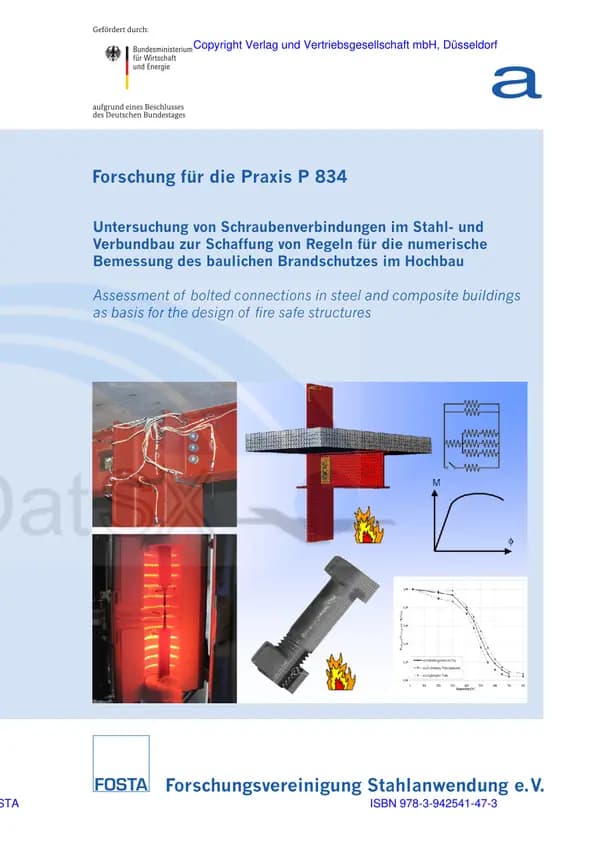
P 834 - Investigation of bolted connections in steel and composite construction for the creation of rules for the numerical design of structural fire protection in building construction In this research project, connections in steel and composite construction with high-strength bolts of strength class 10.9 are investigated in the event of fire. With the introduction of the component method, it is now possible to simulate entire structures at room temperature, taking into account the connection behaviour. This is not yet possible in the case of fire, as on the one hand there is no implementation of the component method or a comparable numerical model for the case of fire and on the other hand there are no validated material laws available for high-strength bolts in the case of fire. For this reason, material parameters for high-strength bolts of strength class 10.9 during and after a fire are initially developed on the basis of test series. This includes both the investigation of the pure bolt material by means of stationary and transient hot tensile tests and the investigation of bolt assemblies in tensile and shear tests. In the latter, not only the material but also the bolt geometry has a major influence on the behaviour. The tests show that the screws fail in the temperature range up to 420°C due to the usual thread stripping. In the temperature range from 420°C to 650°C, however, the screws fail due to a crack in the thread base. It can be shown that this crack is due to liquid metal induced stress corrosion cracking (LME). Above 650°C, the screws fail due to flank bending. As a result of the material investigations, validated material parameters will be available in future for modelling bolts within connection simulations, which take into account the various forms of failure at different temperatures. In addition, thermal and mechanical numerical models will be developed to describe the behaviour of head plate and flag plate connections in steel and composite construction. The models are validated by fire tests on two standard structural connections. Within the tests and the numerical models, a temperature field is taken into account, which is based on the unit temperature-time curve and a typical fire protection coating with an intumescent coating. A head plate connection in steel construction and a flag plate connection in composite construction are analysed. In the case of the flag plate connection, it is assumed that it is a hinged connection at room temperature. It is shown that a moment resistance can occur in the event of fire, provided that the premature failure of the continuous reinforcement is prevented. Finally, simplified spring models are developed for the two connection types on the basis of the component method, which can be used to determine the stiffness and load-bearing capacity of the connections in the event of fire. In summary, it will be possible in future to describe the behaviour of connections in the event of fire on the basis of validated bolt properties using finite element or spring models and to take this into account in structural calculations. The IGF project 16586 N of the Forschungsvereinigung Stahlanwendung e.V., Düsseldorf, was funded via the AiF within the framework of the programme for the promotion of joint industrial research (IGF) by the Federal Ministry for Economic Affairs and Energy on the basis of a resolution of the German Bundestag. The project was carried out at the Gottfried Wilhelm Leibniz University of Hanover by the Institute of Steel Construction and at the Technical University of Darmstadt by the Institute of Steel Construction and Mechanics of Materials. Publication: July 2014
available anytime
€60.00
excl. VAT
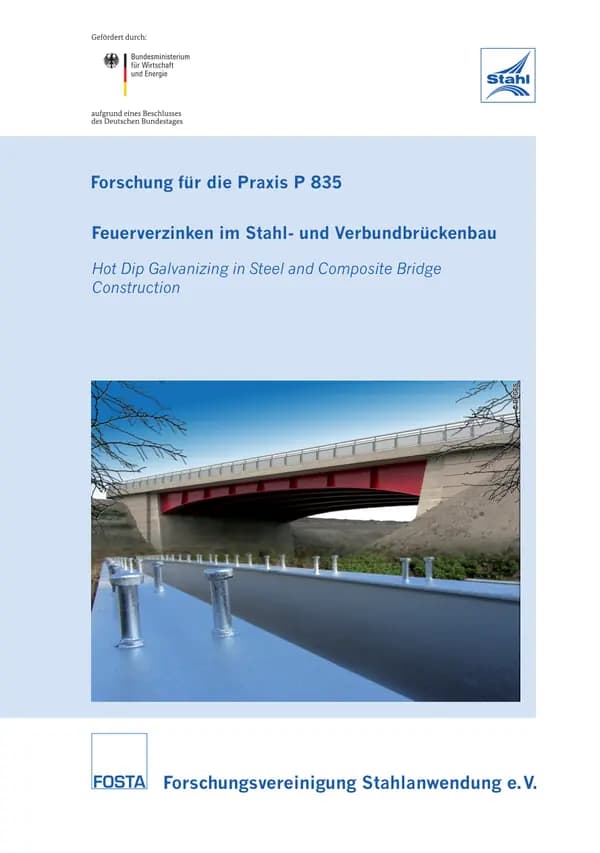
P 835 - Hot-dip galvanising in steel and composite bridge construction In Germany and Europe, steel and composite bridges are usually protected against corrosion by an organic coating. These coatings have a theoretical protection period of up to 25 years. In comparison, the batch galvanisation of steel components offers very durable and robust corrosion protection, which already has a large market share in structural steel engineering. Protection periods of 80 years and more are not uncommon. This means that maintenance and repair work can be significantly reduced. These ecological and economic advantages cannot yet be utilised for bridges in traffic route construction. Such bridges are exposed to cyclical loads that require verification against material fatigue in accordance with DIN EN 1993-2 and DIN EN 1994-2. As the influence of hot-dip galvanising on the fatigue strength of components under cyclic loads has not yet been sufficiently investigated, hot-dip galvanised components are not yet covered by the design standard. The aim of this research project is therefore to develop and provide the fundamental scientific and technical knowledge required for the basic application of hot-dip galvanising in steel and composite bridge construction. To this end, tests were carried out on the fatigue strength of notch details typical for bridge construction in the hot-dip galvanised condition, which were partially supplemented by comparative samples in the non-galvanised condition. Furthermore, it was necessary to provide proof of corrosion protection for hot-dip galvanising and its repair technology by means of thermally sprayed zinc coating on transport and installation damage for a target service life of 100 years. This was based on a literature review as well as various tests on the duration of protection, pre-treatment methods and design variants. As a result, it was found that hot-dip galvanising has a significant influence on fatigue strength, which also partially leads to a reduction in the detail categories for the verification against material fatigue. The causes of this could be identified in the formation of the zinc coating. At the same time, proof of a theoretical corrosion protection period of 100 years, i.e. the same length as the service life of the bridge, was provided both for the batch-galvanised components and for spray-galvanised repair areas at assembly welded joints. On this basis, design recommendations were drawn up for the user in the form of a brochure. The holistic consideration of the construction and maintenance costs shows the decisive advantages of hot-dip galvanising in the life cycle of bridge structures. The IGF project 351 ZBG of the Forschungsvereinigung Stahlanwendung e.V., Düsseldorf, was funded via the AiF within the framework of the programme for the promotion of joint industrial research and development (IGF) by the Federal Ministry for Economic Affairs and Energy on the basis of a resolution of the German Bundestag. The project was carried out at the Technical University of Dortmund by the Chair of Steel Construction, at the Technical University of Darmstadt by the State Materials Testing Institute Darmstadt, Department and Institute for Materials Science and the Institute for Corrosion Protection Dresden GmbH. Authors: D. Ungermann, D. Rademacher, M. Oechsner, R. Landgrebe, J. Adelmann, F. Simonsen, S. Friedrich, P. Lebelt Publication: 2014
available anytime
€70.00
excl. VAT
P 837 - Experimental investigation and simulation of the crash behaviour of mechanically joined joints Mechanical joining processes are increasingly being used in the realisation of innovative lightweight construction concepts to reduce fuel consumption and thus also CO2 emissions. Compared to thermal joining technology, mechanical joining technology offers the decisive advantage that it can also be used to realise mixed joints of different materials in a reliable process without reducing the positive material properties through thermal influence. Consequently, in addition to conventional joining methods such as resistance spot welding, a variety of mechanical joining techniques such as semi-tubular self-pierce riveting and direct bolting are used in automotive engineering. In recent years, the possible applications of these two mechanical joining techniques in automotive engineering have continued to develop. However, for the effective use of these joining techniques, especially in crash-relevant areas, there has so far been a lack of characteristic joint values that allow the load-bearing behaviour of these joints to be predicted. Mechanical joining processes are increasingly being used in the realisation of innovative lightweight construction concepts to reduce fuel consumption and therefore also CO2 emissions. Mechanical joining technology offers the decisive advantage over thermal joining technology that it can also be used to realise mixed joints of different materials in a reliable process without reducing the positive material properties through thermal influence [Hah94]. Consequently, in addition to conventional joining methods such as resistance spot welding, a variety of mechanical joining techniques such as semi-tubular self-pierce riveting and direct bolting are used in automotive engineering. In recent years, the possible applications of these two mechanical joining techniques in automotive engineering have continued to develop [Ban06]. However, for the effective use of these joining techniques, especially in crash-relevant areas, there has so far been a lack of characteristic joint values that allow the load-bearing behaviour of these joints to be predicted. In vehicle development, the crash simulation of entire vehicle structures plays an important role in the development process. The load-bearing behaviour of the entire vehicle structure is significantly influenced by its joints, whereby the joint areas must be taken into account in the crash simulation using simplified substitute models [Özd05]. Very detailed models of the joints cannot be used in the overall vehicle models that are used in the crash analysis, as these would lead to calculation times of several days or weeks and would not be realisable in the development schedule due to the large number of load cases and calculations for optimal structural design. As a result, simplified substitute models of the joints must be used, which reproduce the global deformation and failure behaviour under impact loading with sufficiently high accuracy but significantly less numerical effort. Against this background, corresponding calculation concepts have been developed in the past for resistance spot welding. These are based on experimentally determined force-deformation path curves, which have been determined on single-element samples as a function of the type of load (shear, head and peel tensile) [Özd05, See05, Som06]. Such a comprehensive characterisation of the crash behaviour of corresponding joints does not exist for mechanically joined joints. This is where the underlying research project comes in with its objective. Publication: 2010 Authors: Prof Hahn, Prof Gumbsch, Prof Iwainsky
available anytime
€30.00
excl. VAT
Payment by card (Stripe) or invoice (DE, AT, CH). Download link by email: automatically after ordering by card, after order approval for invoice (valid for 30 days). Terms