Spatially resolved truss constructions made of hollow steel sections are becoming increasingly popular due to their structural and design advantages, particularly in bridge construction. However, the construction of …
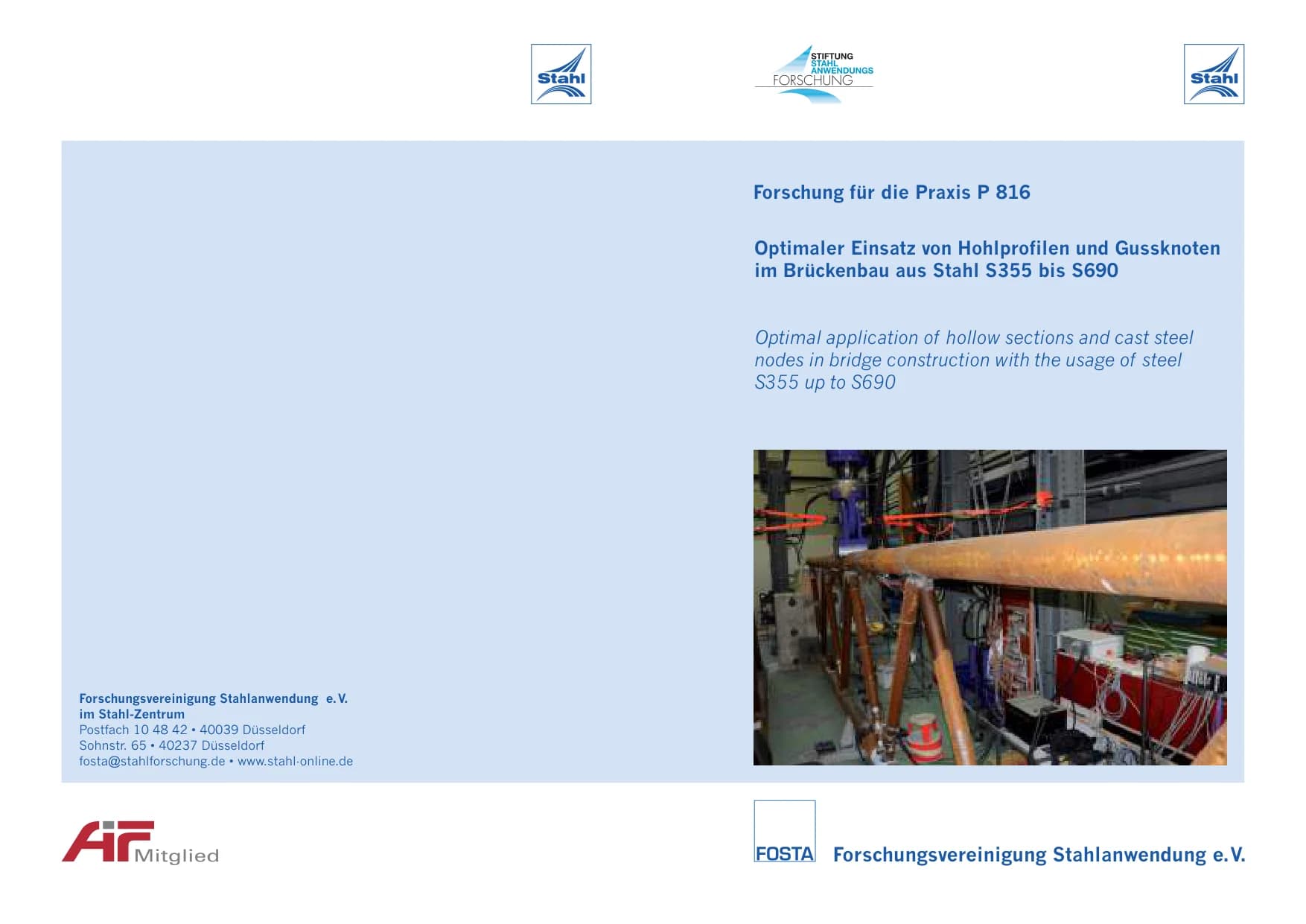
Spatially resolved truss constructions made of hollow steel sections are becoming increasingly popular due to their structural and design advantages, particularly in bridge construction. However, the construction of bridges made of hollow sections is made more difficult by the fact that the section dimensions used are outside the current design rules. These are essentially based on tests with smaller wall thicknesses and on research results from the offshore industry with significantly larger profile slendernesses. In order to increase the use of this construction method and to realise bridge structures with hollow steel sections more efficiently, design rules specifically tailored to this type of structure are required that include sections with large wall thicknesses and low slenderness.
In an initial research project on this problem, butt-jointed, single-sided welded connections and K-joints made of hot-rolled seamless hollow sections and cast steel components have already been investigated. In the present research project, this work was continued and supplemented by further materials up to steel grade S690 and wall thicknesses up to 40 mm. As a result, the design-relevant results already obtained for cast steel components and their connections to hollow steel sections could be placed on a broader statistical basis. In addition to the steel and cast steel connections at individual butt joints, butt joints in complete beams were also analysed. In addition, repair welds were carried out on components that had already failed, which ultimately made it possible to extend the service life. Due to the comparable material properties, the results obtained can also be transferred to pure steel-steel connections. FE investigations on the influence of wall thickness and misalignment were also carried out, as well as detailed residual stress measurements and welding simulations on K-nodes. Finally, an initial economic analysis was carried out for the different design variants. The discussion of the design effect and the influence of engineering and architectural aspects rounds off the overall assessment and shows the user options for a cost-efficient approach to planning. For practical application and for implementation in standards and guidelines, the investigated details were prepared in accordance with the notch catalogue of DIN EN 1993 and notch classes for typical bridge construction butt weld details of different design variants were developed for both bending and tensile loads. Notch class 71 proved to be decisive for all variants for butt joints under tensile stress. For butt joints under bending stress, the classification can be made into classes 100 or 112 depending on the design variant. Together with the economic feasibility studies carried out, an efficient and test-based selection of a suitable connection variant for the respective application can be made. The results obtained thus round off the previous research work and represent a necessary addition to it in terms of content for practical application. The research project was carried out at the Research Institute for Steel, Wood and Stone, Karlsruhe Institute of Technology KIT, KoRoH GmbH Kompetenzzentrum Rohre und Hohlprofile, Büro für Ingenieur-Architektur and ICOM Steel Structures, École Polytechnique Féderale de Lausanne EPFL with technical support and financial assistance from the Forschungsvereinigung Stahlanwendung e. V., Düsseldorf, with funds from the Stiftung Stahlanwendungsforschung, Essen.
Payment by card (Stripe) or invoice (DE, AT, CH). Download link by email: automatically after ordering by card, after order approval for invoice (valid for 30 days). Terms
Machine-translated title and description. The document itself is in German.
Digital download
Other parts and editions as well as neighbouring documents of the same series.

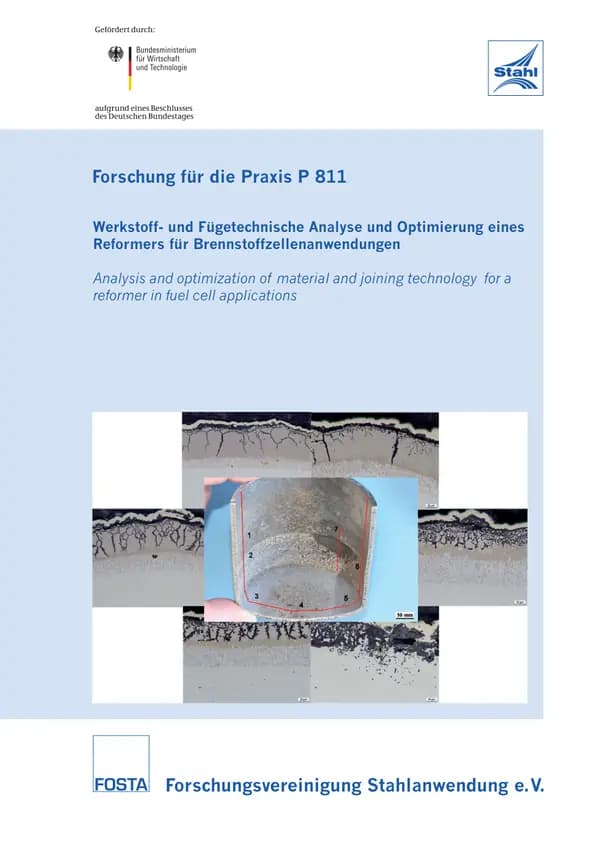
P 811 - Material and joining analysis and optimisation of a reformer for fuel cell applications The main objective of the research project was to develop a robust combustion chamber for use in a reformer reactor for fuel cell applications. In order to achieve this goal, it was necessary to analyse operating conditions and cases of damage to reformer reactors and to carry out corresponding investigations into possible joining and coating techniques. The aim of the project was to determine which combinations of selected materials, coatings and joining techniques can be used to achieve maximum robustness under the required operating conditions. The influence of the component geometry was also analysed in this regard. The analysis of the operating conditions basically revealed three types of stress: high temperature stress (creep), thermocyclic stress (fatigue) and chemical stress (corrosion). The investigations clearly showed that the atmosphere on the burner side in particular has a very aggressive effect on the combustion chamber material. In the further course of the project, numerous tensile test specimens were prepared according to a matrix of different base materials, joining methods and coating types. Half of these samples were also subjected to a 1,000-hour thermocyclic ageing test under corrosion conditions. Subsequently, a tensile test for each sample provided information on the remaining material strength. In this way, suitable and unsuitable combinations could be determined and possible damage caused by the joining and coating itself could also be analysed. In order to investigate the influence of geometry, the thermal stresses in the combustion chamber were visualised in a computer simulation using real temperature measurement data. The weak points in the original geometry known from experiments were confirmed by high thermal stress concentrations. By varying the shape of the combustion chamber accordingly, these stresses could be significantly minimised. The final stage of the project was the construction of the new reformer reactor, taking into account the knowledge gained during the course of the project. The material 1.4958 with a specially developed aluminium diffusion layer was a suitable material coating combination. The laser welding process proved to be the most suitable joining method. For an optimised component geometry, a curvature and a transition radius to the shell surface proved to be essential design modifications for the combustion chamber cover. Finally, the new reactor was subjected to a 1,000-hour thermocyclic test under real operating conditions and later analysed for damage. The aim of the project was achieved. The basic specific damage mechanisms were determined and effective countermeasures were identified. The follow-up examinations of the optimised combustion chamber after the endurance test showed both the general durability and effectiveness of the diffusion layer, as well as the protective effect that still needs to be improved, particularly in the highly stressed centre of the combustion chamber lid. Despite this potential for improvement, no deeper damage was detected within the base material and in the area of influence of the weld seam, which can be considered a great success. It was not possible to estimate the service life beyond the 1,000-hour cycle test in this project. In future, this would require the transient simulation of the thermal stresses that occur during heating and cooling processes. Furthermore, additional findings on the long-term strength behaviour of the joined material coating systems under the specific load combination must be developed. The economic analysis of these coating systems in comparison to nickel-based materials, for example, is a further task. The IGF project 16118 BG of FOSTA -Forschungsvereinigung Stahlanwendung e.V., Düsseldorf, was funded by the Federal Ministry of Economics and Technology via the AiF as part of the programme for the promotion of joint industrial research and development (IGF) on the basis of a resolution of the German Bundestag. The project was carried out at the Zentrum für Brennstoffzellen Technik gGmbH, Duisburg, at the Günther-Köhler-Institut für Fügetechnik und Werkstoffprüfung GmbH, Jena, and by the DECHEMA Gesellschaft für Chemische Technik und Biotechnologie e.V., Frankfurt/Main. Authors: A. Heinzel, O. Pasdag, M. Steffen, E. Firat, S. Sändig, T. Ebersbach, M. Schütze, A. Naji Publication: 2013
available anytime
€30.00
excl. VAT

P 810 - Bonding of mould-hardened components Publication: 2013 Authors: Prof. Dr.-Ing. K. Dilger, Dipl.-Ing. S. Kreling
available anytime
€30.00
excl. VAT
Payment by card (Stripe) or invoice (DE, AT, CH). Download link by email: automatically after ordering by card, after order approval for invoice (valid for 30 days). Terms