Welded round hollow section structures under fatigue loading are widely used in construction, mechanical engineering and plant engineering. Welded K-nodes made of round hollow sections, in which the chord and two …
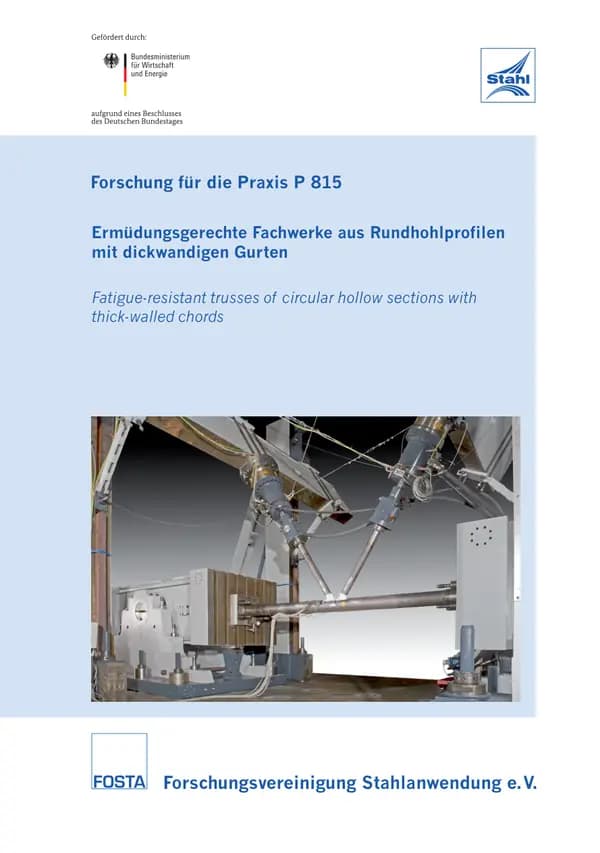
Welded round hollow section structures under fatigue loading are widely used in construction, mechanical engineering and plant engineering. Welded K-nodes made of round hollow sections, in which the chord and two adjoining struts form the shape of a horizontal "K", are particularly common and were therefore the subject of this research project. Recently, thick-walled constructions with a chord slenderness r0/t0 < 12 have been increasingly used, for the realisation of which there are still no corresponding rules. Since engineering offices and manufacturing companies do not generally have the economic resources to carry out their own series of cost-intensive vibration tests, there is a need to create easy-to-use design and dimensioning aids for welded thick-walled fatigue-stressed hollow section trusses.
This results in a great potential for cost savings, especially for small and medium-sized companies. The research project therefore dealt in detail with the fatigue behaviour of plane and spatial K-nodes in thick-walled hollow section trusses from a holistic perspective. The aim was to develop recommendations for the fatigue-compliant and at the same time economical realisation of such structures. The research report summarises the state of the art in science and technology with regard to the fatigue behaviour of thick-walled hollow section structures, from which the open questions to be clarified and the test programme of this research project were derived. Special recommendations for the planning and production of thick-walled hollow section structures were developed with regard to fatigue. With a view to practical requirements, a combination of butt and fillet welds was considered as a chord-strut connection. This design has both welding and economic advantages over the pure butt weld connection. To determine the fatigue strength of thick-walled hollow section constructions, a comprehensive test programme was carried out with node vibration tests under strut loading, under chord loading and under combined loading of chord and struts. A large-scale beam vibration test was also carried out. Particular attention was paid to the aspect of the influence of size on fatigue behaviour in the lumped vibration tests. On the other hand, the focus was on investigating the influence of weld seam post-treatment using higher-frequency hammering processes, which are now available industrially, on fatigue strength. These investigations were supplemented by several small test series, which provide important information for the evaluation of post-treated hollow section constructions and for the evaluation of repair welds. The IGF project 325 ZBG of the Forschungsvereinigung Stahlanwendung e.V., Düsseldorf, was funded via the AiF within the framework of the programme for the promotion of joint industrial research and development (IGF) by the Federal Ministry for Economic Affairs and Energy on the basis of a resolution of the German Bundestag. The project was carried out at the University of Stuttgart by the Institute for Construction and Design, at the University of the Federal Armed Forces Munich by the Institute for Structural Engineering - Steel Construction, at Munich University of Applied Sciences by the Laboratory for Steel and Light Metal Construction and at Schweißtechnische Lehr- und Versuchsanstalt Halle GmbH.
Payment by card (Stripe) or invoice (DE, AT, CH). Download link by email: automatically after ordering by card, after order approval for invoice (valid for 30 days). Terms
Machine-translated title and description. The document itself is in German.
Digital download
Other parts and editions as well as neighbouring documents of the same series.

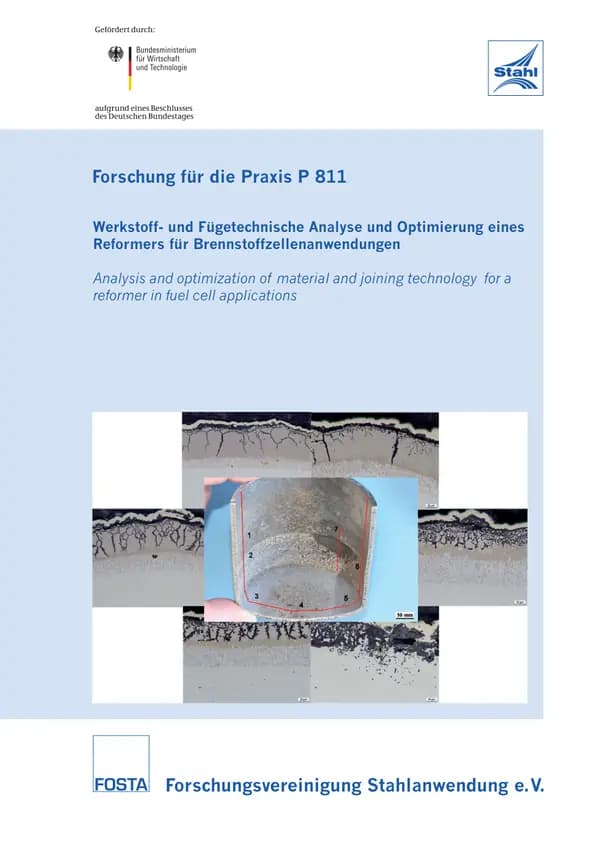
P 811 - Material and joining analysis and optimisation of a reformer for fuel cell applications The main objective of the research project was to develop a robust combustion chamber for use in a reformer reactor for fuel cell applications. In order to achieve this goal, it was necessary to analyse operating conditions and cases of damage to reformer reactors and to carry out corresponding investigations into possible joining and coating techniques. The aim of the project was to determine which combinations of selected materials, coatings and joining techniques can be used to achieve maximum robustness under the required operating conditions. The influence of the component geometry was also analysed in this regard. The analysis of the operating conditions basically revealed three types of stress: high temperature stress (creep), thermocyclic stress (fatigue) and chemical stress (corrosion). The investigations clearly showed that the atmosphere on the burner side in particular has a very aggressive effect on the combustion chamber material. In the further course of the project, numerous tensile test specimens were prepared according to a matrix of different base materials, joining methods and coating types. Half of these samples were also subjected to a 1,000-hour thermocyclic ageing test under corrosion conditions. Subsequently, a tensile test for each sample provided information on the remaining material strength. In this way, suitable and unsuitable combinations could be determined and possible damage caused by the joining and coating itself could also be analysed. In order to investigate the influence of geometry, the thermal stresses in the combustion chamber were visualised in a computer simulation using real temperature measurement data. The weak points in the original geometry known from experiments were confirmed by high thermal stress concentrations. By varying the shape of the combustion chamber accordingly, these stresses could be significantly minimised. The final stage of the project was the construction of the new reformer reactor, taking into account the knowledge gained during the course of the project. The material 1.4958 with a specially developed aluminium diffusion layer was a suitable material coating combination. The laser welding process proved to be the most suitable joining method. For an optimised component geometry, a curvature and a transition radius to the shell surface proved to be essential design modifications for the combustion chamber cover. Finally, the new reactor was subjected to a 1,000-hour thermocyclic test under real operating conditions and later analysed for damage. The aim of the project was achieved. The basic specific damage mechanisms were determined and effective countermeasures were identified. The follow-up examinations of the optimised combustion chamber after the endurance test showed both the general durability and effectiveness of the diffusion layer, as well as the protective effect that still needs to be improved, particularly in the highly stressed centre of the combustion chamber lid. Despite this potential for improvement, no deeper damage was detected within the base material and in the area of influence of the weld seam, which can be considered a great success. It was not possible to estimate the service life beyond the 1,000-hour cycle test in this project. In future, this would require the transient simulation of the thermal stresses that occur during heating and cooling processes. Furthermore, additional findings on the long-term strength behaviour of the joined material coating systems under the specific load combination must be developed. The economic analysis of these coating systems in comparison to nickel-based materials, for example, is a further task. The IGF project 16118 BG of FOSTA -Forschungsvereinigung Stahlanwendung e.V., Düsseldorf, was funded by the Federal Ministry of Economics and Technology via the AiF as part of the programme for the promotion of joint industrial research and development (IGF) on the basis of a resolution of the German Bundestag. The project was carried out at the Zentrum für Brennstoffzellen Technik gGmbH, Duisburg, at the Günther-Köhler-Institut für Fügetechnik und Werkstoffprüfung GmbH, Jena, and by the DECHEMA Gesellschaft für Chemische Technik und Biotechnologie e.V., Frankfurt/Main. Authors: A. Heinzel, O. Pasdag, M. Steffen, E. Firat, S. Sändig, T. Ebersbach, M. Schütze, A. Naji Publication: 2013
available anytime
€30.00
excl. VAT

P 810 - Bonding of mould-hardened components Publication: 2013 Authors: Prof. Dr.-Ing. K. Dilger, Dipl.-Ing. S. Kreling
available anytime
€30.00
excl. VAT
Payment by card (Stripe) or invoice (DE, AT, CH). Download link by email: automatically after ordering by card, after order approval for invoice (valid for 30 days). Terms