
P 806 - Characterisation and equivalent modelling of the fracture behaviour of spot-welded joints made of ultra-high-strength steels for crash simulation, taking into account the effect of the joint on the component behaviour
In automotive engineering, high-strength and ultra-high-strength steels are increasingly being used in thin sheet thicknesses for reasons of lightweight construction and to increase passive safety while at the same time …
Content
- Publication
- October 2020
- Authors
- Prof. Dr P. Gumbsch, Dr.-Ing. S. Sommer, Dipl.-Ing. S. Burget, Prof. Dr.-Ing. habil. E. Roos, Dipl.-Ing. H.-J. Wink, Dipl.-Ing. D. Krätschmer, Prof. Dr.-Ing. O. Hahn, Prof. Dr.-Ing. G. Meschut, Dipl.-Wirt.-Ing. F. Klokkers, Dipl.-Ing. D. Hein
In automotive engineering, high-strength and ultra-high-strength steels are increasingly being used in thin sheet thicknesses for reasons of lightweight construction and to increase passive safety while at the same time conserving resources. Press-hardened components made of 22MnB5 with tensile strengths of up to 1500 MPa are already established in automotive engineering, and steel development is currently moving towards even higher press-hardening grades. Lightweight steel construction still has a great deal of development potential here to further increase energy efficiency. Currently and in the future, the established and highly automatable resistance spot welding process will be used to join individual components made of high-strength steels to form a load-bearing lightweight structure.
Show full description
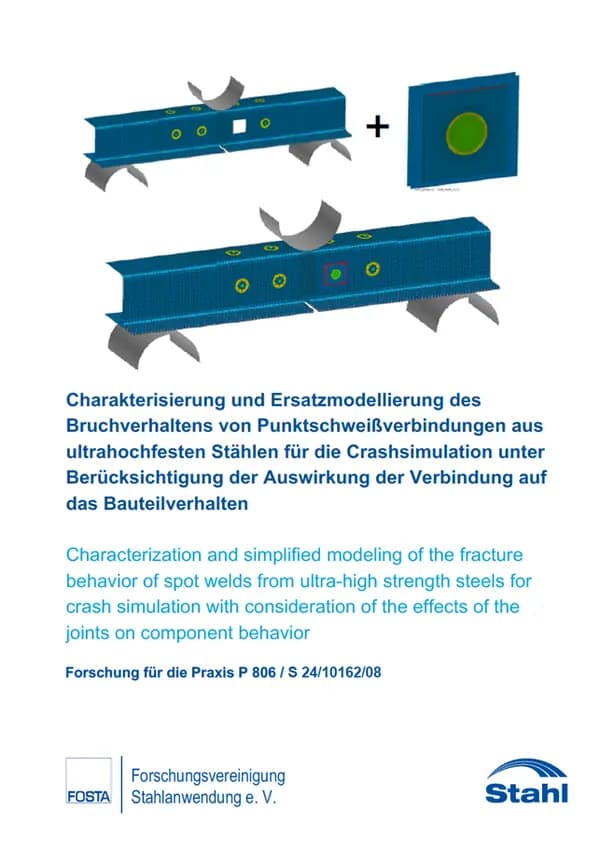
The heat input during welding results in softening zones around the welding points of these hardened steels due to tempering effects. In order to predict the deformation behaviour of structures made of these materials, it must be possible to describe the influence of this softening zone in the simulation models. As part of the research project, spot-welded joints in the press-hardened, ultra-high-strength steel 22MnB5 were comprehensively characterised. In addition to load-dependent load capacity determination using the LWF-KS-2 testing technique, this also includes characterisation of the surrounding softening zone using specially designed specimens that contain the relevant property gradient. A substitute model for the crash simulation was thus developed that simulates both the load-bearing capacity of the joint and the formation of cracks in the surrounding softening zone. This substitute model was validated by simulating a specially designed sample component test in which an overload situation with crack formation in the softening zone occurs. The results of this research project will significantly expand the application possibilities and acceptance of press-hardened steels, as a comprehensive calculation method for spot-welded joints in this class of steel is now available for crash simulation. This means that spot-welded press-hardened steel components can be safely designed as early as the design phase.
Zum Zoomen hovern
€30.00excl. VAT
Payment by card (Stripe) or invoice (DE, AT, CH). Download link by email: automatically after ordering by card, after order approval for invoice (valid for 30 days). Terms
P 806 - Characterisation and equivalent modelling of the fracture behaviour of spot-welded joints made of ultra-high-strength steels for crash simulation, taking into account the effect of the joint on the component behaviour—
€30.00