
P 805 - Use of induction heating and determination of the corresponding process windows for press hardening
Heating in the press hardening process usually takes place in a roller hearth furnace. The main disadvantages of this heating method are high investment costs and a huge amount of space required. This increases further …
Content
- Authors
- T. Tröster, J. Niewel, R. Salomon
- Publication
- 2014
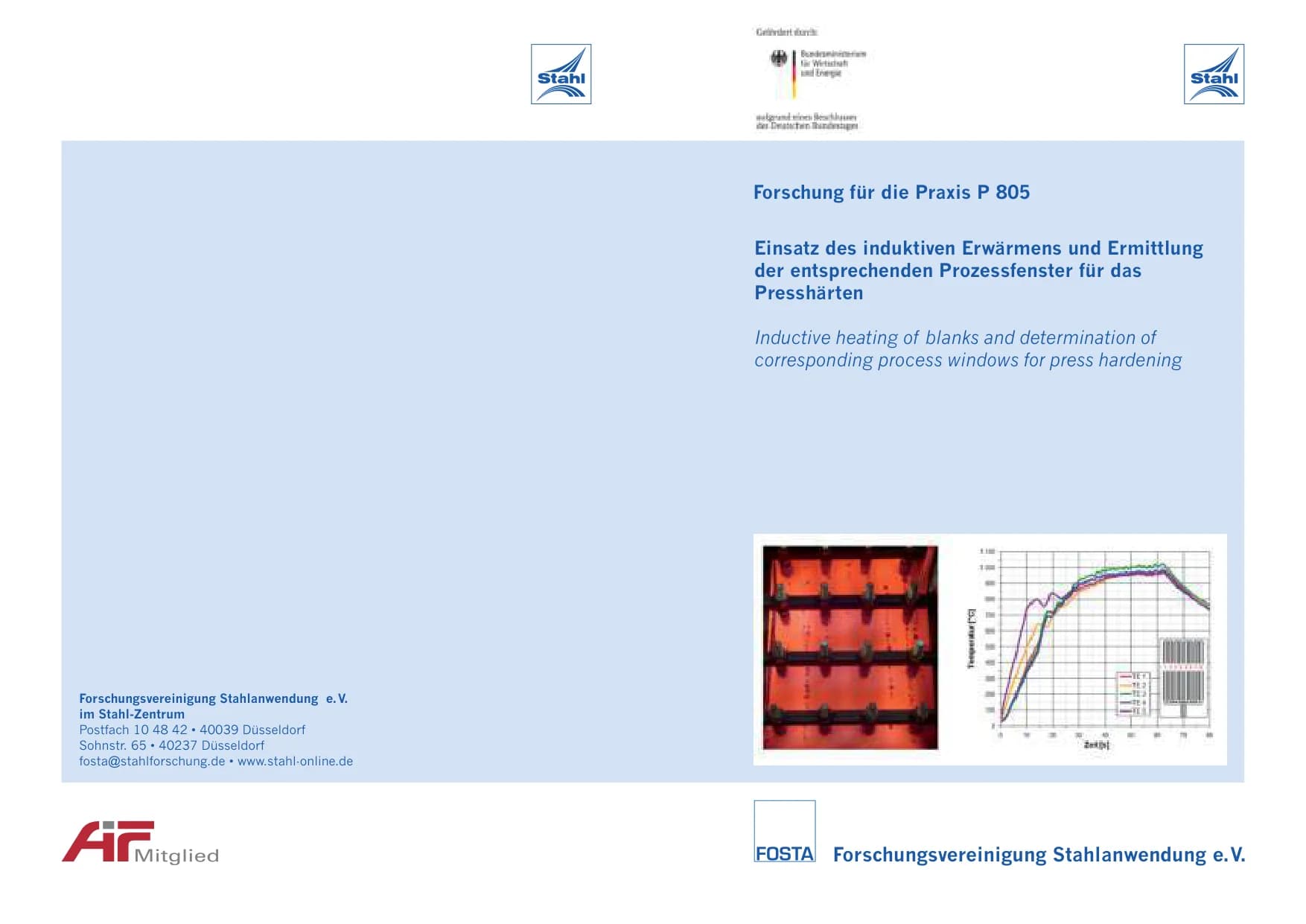
Heating in the press hardening process usually takes place in a roller hearth furnace. The main disadvantages of this heating method are high investment costs and a huge amount of space required. This increases further due to decreasing cycle times and long heating times of the blanks. As part of the research project, an innovative heating process was to be developed as an alternative to the conventional oven process for press hardening. The objectives of the research project were to set up an induction system for the homogeneous heating of a rectangular blank, to determine the process windows of the new heating technology based on this and finally to evaluate the economic efficiency of induction heating in comparison to roller-hearth heating.
Show full description
The homogeneous heating of the blank was achieved using a meandering inductor and an oscillating, translational movement of the blank. The temperature difference within the entire blank could be reduced to approx. 40 K, so that no significant differences in the selected mechanical properties could be determined after press hardening. Furthermore, to determine the limits of the new rapid heating process, a process window was determined by varying the heating temperatures and holding times. It was shown that by heating the material used, 22MnB5, to 900 °C within 20s without additional holding time, mechanical properties comparable to those of the conventional furnace method can be achieved. A final economic analysis showed that induction heating leads to lower production costs. However, it should be noted that the proportion of heating costs in the total component costs is relatively low. The IGF project 16319 N of FOSTA - Forschungsvereinigung Stahlanwendung e.V., Düsseldorf, was funded via the AiF within the framework of the programme for the promotion of joint industrial research and development (IGF) by the Federal Ministry for Economic Affairs and Energy on the basis of a resolution of the German Bundestag. The project was carried out at the Chair of Lightweight Automotive Engineering at Paderborn University.
Machine-translated title and description. The document itself is in German.
Zum Zoomen hovern
€30.00excl. VAT
Payment by card (Stripe) or invoice (DE, AT, CH). Download link by email: automatically after ordering by card, after order approval for invoice (valid for 30 days). Terms
P 805 - Use of induction heating and determination of the corresponding process windows for press hardening—
€30.00