
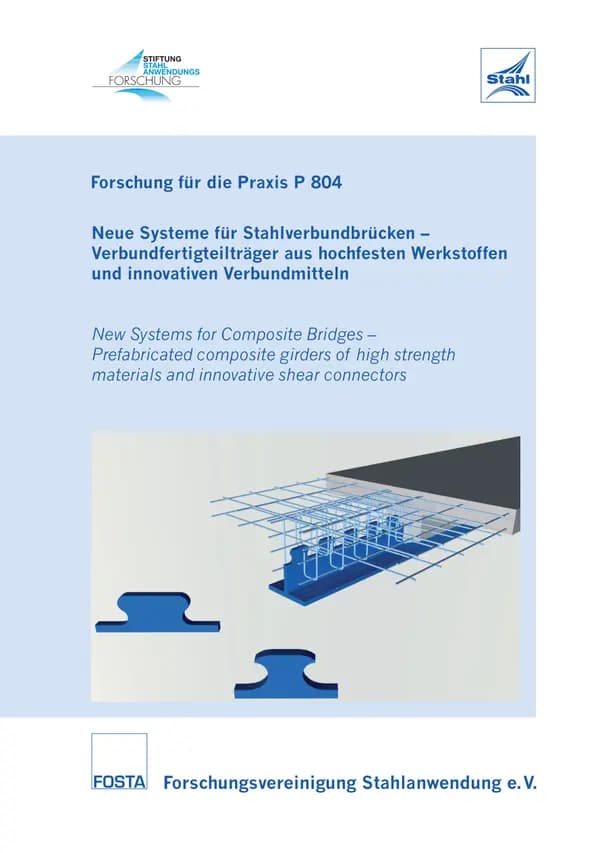
P 804 - New systems for steel composite bridges - Composite prefabricated girders made of high-strength materials and innovative composite materials
Prefabricated composite bridge systems are being used more and more frequently for small and medium spans. The safe transfer of high shear forces in the composite joint under static and non-static loads can be …
Content
- Authors
- M. Feldmann, M. Gündel, M. Kopp, J. Hegger, J. Gallwoszus, S. Heinemeyer, G. Seidl, O. Hoyer
- Publication
- 2014
Prefabricated composite bridge systems are being used more and more frequently for small and medium spans. The safe transfer of high shear forces in the composite joint under static and non-static loads can be efficiently achieved using composite dowel bars. The advantages lie in particular in the high load-bearing capacity, the sufficient deformation capacity and the simple use in steel profiles without top flanges. However, application is difficult due to the lack of standardised regulations. The main objective of the research project was to prepare a company-neutral general building authority approval (AbZ) for composite dowel bars.
Show full description
In preparation for the experimental investigations, the static and design requirements for the composite materials in prefabricated composite bridge systems were defined on the basis of three selected practical examples. Open questions were identified on the basis of a summary of the latest research results from static and cyclic shear and beam tests, numerical simulations and design concepts and transferred into a test matrix with 18 static and 6 cyclic shear tests and 4 cyclic beam tests. The static shear tests prove that the failure modes "punching out" and "steel failure" can be categorised as ductile with sufficient restraint by stirrups. In the case of plate girder cross-sections with composite dowel bars as external reinforcement, the load-bearing capacity can be significantly increased and good deformation capacity can be achieved using strapping stirrups. Without stirrups, a very brittle behaviour occurs. In the case of parallel composite dowel bars, the influence of spacing must be taken into account in the punching criterion, as the punching cones influence each other and the load-bearing capacity is reduced. Without shear reinforcement, a minimum spacing must be defined, as ductility is negatively affected as the spacing decreases. The stress concentration factors required for the design of the steel strip according to the structural stress concept were determined by means of strain measurements on the steel teeth in the cyclic shear tests and beam tests. Both the stresses from the transfer of longitudinal shear forces and from the global bending load-bearing effect were taken into account. The measurement results show good agreement with FE calculations. It was also shown that concrete fatigue in the form of cyclic punching out can occur under high top loads and that damage to the bond joint can also occur. The assumption of a rigid bond joint is therefore no longer justified and higher loads may result. A statistically validated design concept was developed on the basis of a detailed database, supplemented by the results and findings of our own tests and numerical analyses. The design concept includes the static failure types of shearing, punching out including the influence of spacing, vertical splitting and steel failure as well as steel fatigue, concrete fatigue and ensuring a rigid bond joint under cyclic loads. The research project was carried out by the Chair of Steel Construction and Light Metal Construction and the Chair of Solid Construction at the Rheinisch-Westfälisch Technische Hochschule Aachen, as well as SSF Ingenieure AG, Munich, with technical support and financial support from the Forschungsvereinigung Stahlanwendung e. V., Düsseldorf, with funds from the Stiftung Stahlanwendungsforschung, Essen.
Zum Zoomen hovern
€40.00excl. VAT
Payment by card (Stripe) or invoice (DE, AT, CH). Download link by email: automatically after ordering by card, after order approval for invoice (valid for 30 days). Terms
P 804 - New systems for steel composite bridges - Composite prefabricated girders made of high-strength materials and innovative composite materials—
€40.00