
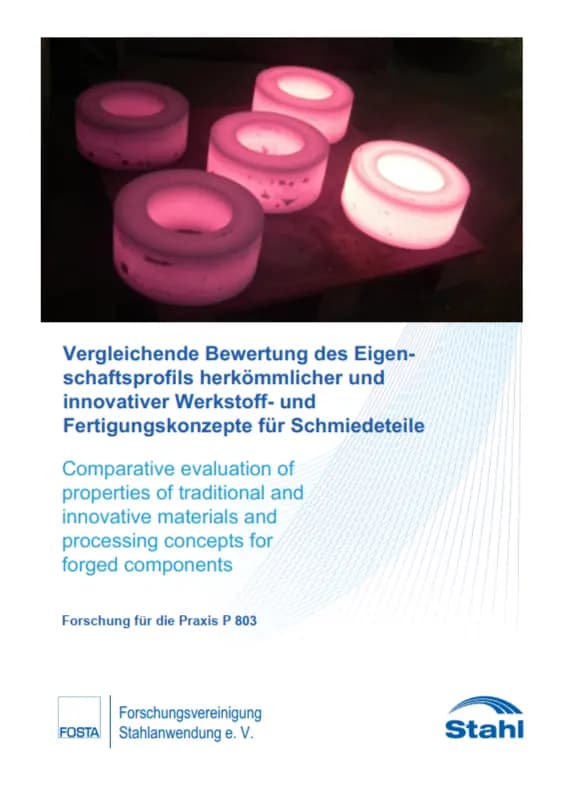
P 803 - Comparative evaluation of the property profile of conventional and innovative material and manufacturing concepts for forgings
The aim of the research project was to verify the performance of precipitation-hardened case-hardening steels and a precipitation-hardened bainitic steel with new alloying concepts for forgings in direct comparison with …
Content
- Publication
- 2017
- Authors
- Dr.-Ing. Kaiser, Dr.-Ing. D. Schwerdt
The aim of the research project was to verify the performance of precipitation-hardened case-hardening steels and a precipitation-hardened bainitic steel with new alloying concepts for forgings in direct comparison with previously used steels. The conventional reference materials used for the case-hardening steels were 20MnCr5 (WS1), 15CrNi6 (WS3), 18CrNiMo7-6 (WS4) with controlled sulphur content and 18CrNiMo7-6 with ultra-low sulphur content (WS5) as well as the two modified variants 20CrMo5mod (WS2) and 26MnCrNiMo6-5-4mod (WS6) - both containing the microalloying elements V, Ti and Nb - were used. The modified bainitic steel was analysed in comparison with the classic quenched and tempered steel 42CrMo4 and the conventional AFP steel 38MnVS6. The fundamental mechanical properties as well as fatigue strength and fracture toughness values were determined for all materials.
Show full description
The high-strength case-hardening steel 26MnCrNiMo6-5-4mod has a core strength of 1750 MPa, which is significantly higher than the 1400 MPa formulated in the application, albeit with only acceptable toughness properties. As expected, the fatigue strength in the smooth, blind-hardened condition is greater than that of the reference case-hardening steels. In the notched, case-hardened condition, the fatigue strengths of all the case-hardening steels analysed lie within a scatter band. This is attributed to the same properties of the surface layer for all case-hardening steels. In the case of the case-hardened fork shackles and the gear wheels, the numbers of cycles at break and the fatigue strengths of all the steels analysed were in a common scatter band, just as with the notched samples. In contrast, the fatigue strength of the WS6 26MnCrNiMo6-5-4mod is significantly higher than that of the reference steel 18CrNiMo7-6 in the case-hardened and additionally shot-peened gear shafts. The alloy concept used here to adjust the strength properties is economically less favourable than in the case-hardening steels based on MnCr, CrMo or CrNi, although it is comparable to that of 18CrNiMo7-6. The target yield strength of > 800 MPa steel was not achieved for the bainitic steel. The bainite exhibits acceptable toughness properties. The smooth samples of the modified bainite tend to exhibit better fatigue strength than the reference heat-treatable steel 42CrMo4, and the notched samples even exhibit significantly better fatigue strength. The component tests using the track lever as an example, on the other hand, showed a lower fracture fatigue strength for the modified bainitic material compared to the reference material. The bainitic steel 12CrMnMoV7-5mod is economically more favourable compared to the conventional quenched and tempered steel when used for components. This is mainly due to the lack of tempering treatment, i.e. controlled cooling without subsequent reheating. One aim of further research activities is to clarify the microstructural cause of the good fatigue strength and to improve the toughness properties of the bainite, resulting in characteristic values that designers can use to design specific components made from the new materials in the mechanical and plant engineering, vehicle construction, drive technology and power generation sectors.
Zum Zoomen hovern
€40.00excl. VAT
Payment by card (Stripe) or invoice (DE, AT, CH). Download link by email: automatically after ordering by card, after order approval for invoice (valid for 30 days). Terms
P 803 - Comparative evaluation of the property profile of conventional and innovative material and manufacturing concepts for forgings—
€40.00