
P 802 - Investigations on the fatigue strength of resistance spot welded joints made of high-strength multiphase steels under consideration of production-specific influences
Under the harsh conditions in automotive body-in-white production, welding-related imperfections such as cracks cannot always be avoided during resistance spot welding of high-strength steels. Knowledge of the influence …
Content
- Authors
- M. Rethmeier, G. Weber, H. Gaul, S. Brauser
- Publication
- 2011
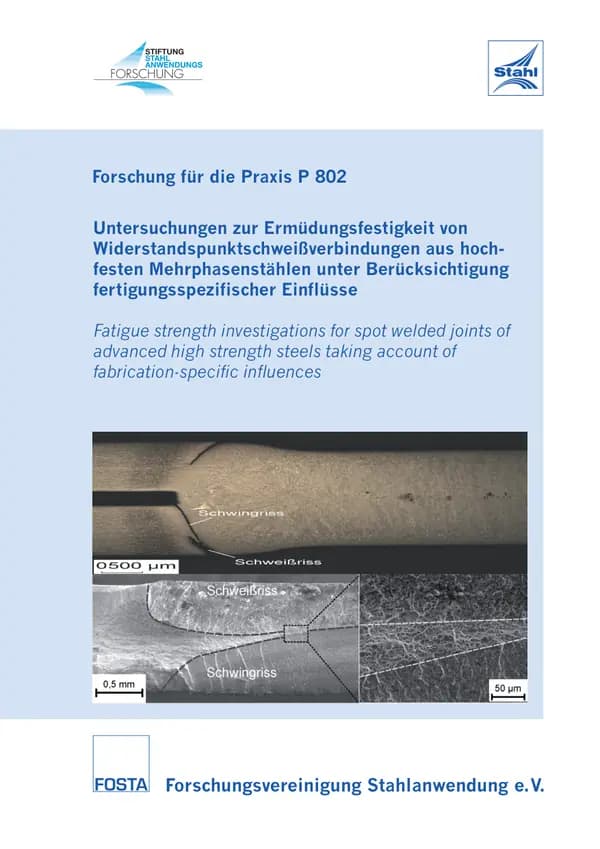
Under the harsh conditions in automotive body-in-white production, welding-related imperfections such as cracks cannot always be avoided during resistance spot welding of high-strength steels. Knowledge of the influence of such cracks is of considerable importance for safe design. The influence of such imperfections on the fatigue strength of high-strength steels was therefore investigated as part of this research project. Various methods were analysed for the targeted production of cracks and, based on the results, four methods for the production of weld cracks were applied. By cooling the joint during the welding process, surface cracks could be produced in the area of the electrode indentation.
Show full description
By using a special specimen geometry and welding sequence (so-called 4-spot specimen), cracks could also be specifically produced in the heat-affected zone (HAZ). In addition to these welding cracks produced in the real welding process, simulated welding cracks were also produced and analysed. For example, spark erosion was used to create crack-like surface notches in the HAZ. As cracks inside the spot-welded joint can only be produced to a limited extent using welding technology, sawn internal notches were also simulated. The influence of the cracks on the fatigue strength was analysed by comparing the stiffness curves of crack-free reference samples and welded samples with weld cracks of the above-mentioned shape. A sample stiffness drop of 30 % was defined as the failure criterion. The results of the tests on specimens with surface cracks in the electrode indentation and in the HAZ show that both the stiffness curve (crack propagation) and the failure cycles are not negatively affected. For specimens with cracks in the HAZ, it could be demonstrated that the fatigue cracks can both connect with the welding cracks and cross them. It is noteworthy that despite this direct interaction between the welding crack and the fatigue crack, no change in the fatigue strength could be determined. Using fractographic methods, it was also demonstrated that the location of the crack initiation is also not influenced by the welding crack. For the simulated external cracks (eroded) with different geometries as well as for the internal cracks in the area of the HAZ, no significant influence on the fatigue strength could be proven on the basis of the stiffness curves, despite direct interaction between the weld crack and the fatigue crack. The research project was carried out at the Federal Institute for Materials Testing and Research (BAM), Berlin, with technical support and financial assistance from the Forschungsvereinigung Stahlanwendung e. V., Düsseldorf, with funds from the Stiftung Stahlanwendungsforschung, Essen.
Zum Zoomen hovern
€30.00excl. VAT
Payment by card (Stripe) or invoice (DE, AT, CH). Download link by email: automatically after ordering by card, after order approval for invoice (valid for 30 days). Terms
P 802 - Investigations on the fatigue strength of resistance spot welded joints made of high-strength multiphase steels under consideration of production-specific influences—
€30.00