Structural bonding technology with high-strength steel sheets is playing an increasingly important role in automotive engineering. Calculation and simulation methods for the design of bonded lightweight structures are …
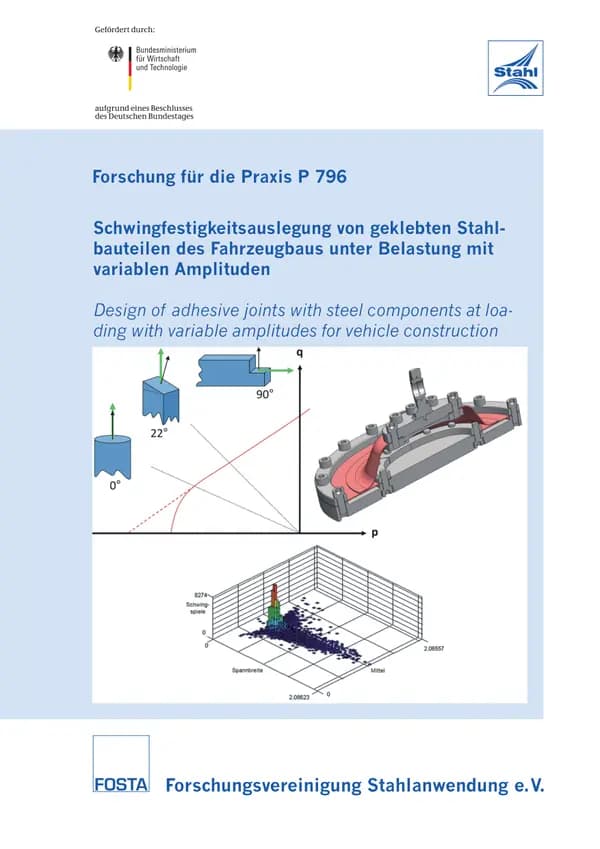
Structural bonding technology with high-strength steel sheets is playing an increasingly important role in automotive engineering. Calculation and simulation methods for the design of bonded lightweight structures are indispensable for new developments. This applies in particular to fatigue strength analyses. Most analytical or numerical approaches assume that the bonded joint fails cohesively in the adhesive and not along the interface between the bonded part and the adhesive. Based on this assumption, two different approaches to lifetime estimation were considered: A first approach uses the local stress state in the highly stressed areas of the joint and compares the local stresses with experimentally measured Wöhler curves.
The local stress state is determined using finite element analysis. Linear elastic material behaviour is used for the adhesive. The service life is estimated using post-processing software, which maps the local stress state in each element, or in a selected area, to a service life based on the experimental data. The second approach uses material models that accumulate the damage caused by creep and vibration. The accumulation is transient, cycle by cycle. Both approaches use the same experimental data. The first approach allows a fast calculation, but requires experience and various experiments for calibration and validation and final estimation of the reliability of the fatigue life estimate. The second approach still requires calculation times that are in the order of magnitude of the experimental times. The calculation times can be reduced with a proposed equivalent load concept. Real structures are normally not loaded with constant amplitudes as used to measure the Wöhler curves. Therefore, the fatigue behaviour of bonded joints was also investigated under loading with variable amplitudes. Damage accumulation was analysed on the basis of the Palmgren-Miner hypothesis. Experiments with a toughened and a non-toughened adhesive have shown that the fundamental database required to estimate the service life can depend on the type of adhesive. The IGF project 307 ZN of FOSTA - Forschungsvereinigung Stahlanwendung e.V., Düsseldorf, was carried out at the Institute of Mechanics (IfM), University of Kassel, in the Department of System Reliability and Machine Acoustics (SzM), Technical University of Darmstadt and at the Fraunhofer Institute for Manufacturing Technology and Applied Materials Research (IFAM), Bremen, and was funded by the Federal Ministry of Economics and Technology via the AiF as part of the programme for the promotion of joint industrial research and development (IGF) on the basis of a resolution of the German Bundestag.
Payment by card (Stripe) or invoice (DE, AT, CH). Download link by email: automatically after ordering by card, after order approval for invoice (valid for 30 days). Terms
Machine-translated title and description. The document itself is in German.
Digital download
Payment by card (Stripe) or invoice (DE, AT, CH). Download link by email: automatically after ordering by card, after order approval for invoice (valid for 30 days). Terms
Other parts and editions as well as neighbouring documents of the same series.

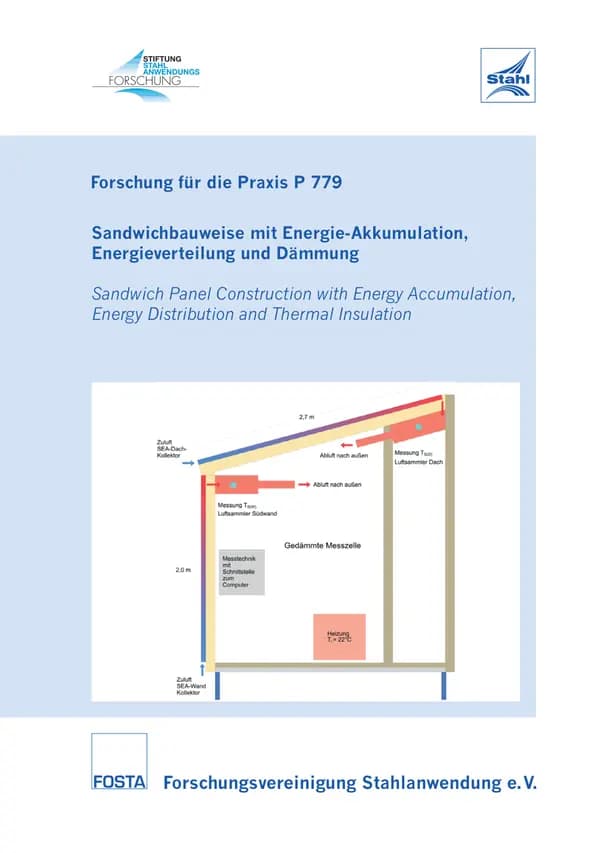
P 779 - Sandwich construction with energy accumulation, energy distribution and insulation By bonding trapezoidal sheets to the metal cover layer of industrially manufactured sandwich elements with a rigid polyurethane foam core, a solar collector is created that can be used to generate energy on façades and roof surfaces in the form of heated air from solar radiation. This sandwich construction method with energy accumulation, energy distribution and insulation can be abbreviated as "SEA". Against this background, the aim of this research project was to use the SEA collector described above to determine the amount of energy that can be practically generated for an entire year. For this purpose, a measuring cell was built into which 2.0 - 4.7 m long SEA collectors were integrated on the south façade and on the roof. The measuring cell contained an air collector with a connected fan for each SEA collector, which was able to generate an air volume flow of 10 to 170 m³/h. The measuring cell was unshaded. The measuring cell was unshaded and exposed to solar radiation and natural weather conditions for one year. The measurements provided fundamental information about the operating parameters of the SEA collector. The initially predicted energy gains were significantly exceeded. The SEA collectors achieved energy yields of approx. 160 kWh/(m² a). The efficiency curve for the SEA collector was determined from the measured values in order to be able to calculate the average energy yield to be expected for any location and orientation. In a typical industrial hall, direct utilisation of the heated air as fresh air reduces the energy loss by 15%; indirect utilisation is possible as an alternative or in addition. It has also been shown that the collector's already good energy yield can be significantly improved by increasing the air flow velocity. The SEA collector combines a simple, cost-effective design with standard sandwich elements and trapezoidal profiles. It can be used for large wall and roof areas in industrial halls. This creates the basis for a new lightweight steel construction principle for sandwich construction and contributes to increasing the energy efficiency of industrial buildings in different climatic regions. The research project was carried out by the Forschungsinstitut für Wärmeschutz e.V., Munich and Engineering R. Koschade, Deggendorf with technical support and financial assistance from the Forschungsvereinigung Stahlanwendung e. V., Düsseldorf, with funds from the Stiftung Stahlanwendungsforschung, Essen. Authors: J. Cammerer, M.H. Spitzner, S. Wagener, W. Brunner, R. Koschade, D. Greiner, M. Koschade Publication: 2014
available anytime
€30.00
excl. VAT

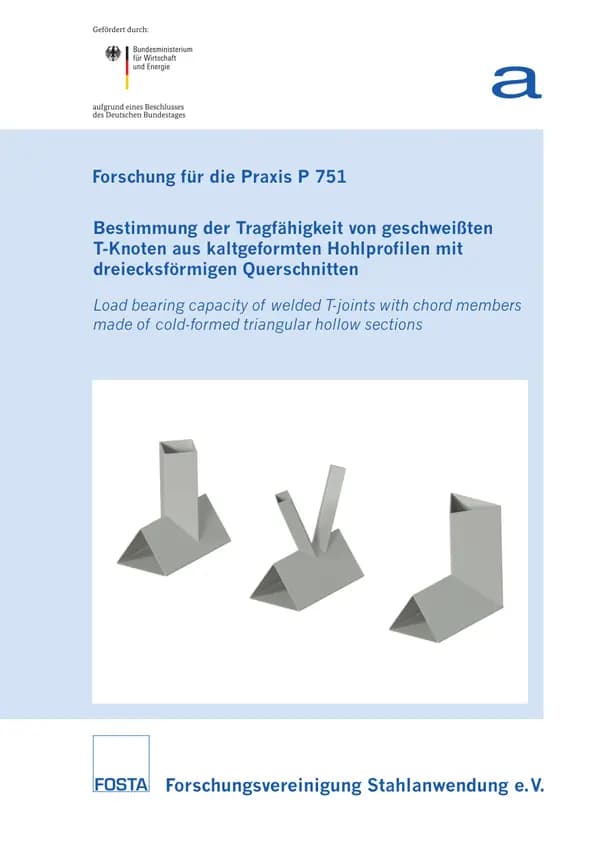
P 751 - Determination of the load-bearing capacity of welded T-joints made of cold-formed hollow sections with triangular cross-sections This research project investigates the load-bearing behaviour of T-nodes with chords made of triangular hollow sections and struts made of rectangular (RHP) and triangular hollow sections. In addition to the node load-bearing capacity, architectural and economic aspects are also considered. Triangular Hollow Sections (THS) are newly developed cross-sections for which findings on load-bearing behaviour could previously only be based on so-called "Bird Beak" and "Diamond Bird Beak" nodes. Although these have a geometric similarity, the chord profile is not a triangular, but a square hollow profile rotated by 45° around the longitudinal axis. The experimental, numerical and analytical investigations for the new THS T-nodes are defined on the basis of experimental and numerical investigations carried out in the 1990s on these node shapes and on the basis of the procedure that led to the design regulations of DIN EN 1993-1-8 for T-nodes made of rectangular hollow sections. A numerical model for THS T-nodes is developed for the parameter studies and validated by means of preliminary tests and experimental investigations of hollow section nodes made of RHP. A parameter study is then carried out based on this model. The numerical investigations are used to determine the maximum node resistances on the one hand and node resistances based on a deformation criterion on the other. The generally recognised deformation criterion for hollow section nodes, which limits the node resistance at a maximum indentation of 3% of the belt width b0 or diameter d0, is not applicable to T-nodes made of THS belts. Therefore, the numerical results are additionally analysed for a reasonable deformation criterion and finally a maximum indentation of 1% of the belt profile width b0 is proposed as a deformation criterion. Two analytical models are given for T-nodes with THS chords and RHP struts. For struts with flanges parallel to the longitudinal axis of the chord, the nodal resistance is determined using a yield line model. For nodes with struts rotated by 45° around the longitudinal axis of the strut, the nodal resistance is determined on the basis of a model of the effective width, which is also used in DIN EN 1993-1-8. In addition, the numerically and analytically determined nodal resistances are compared. In addition to the numerical and analytical investigations, experimental investigations are also carried out. These are analysed with regard to the node resistance, the deformations and the observed failure modes. Hall structures with two different trusses and a Vierendeel system are analysed in detail in order to investigate the aesthetic and economic aspects of structures made of triangular hollow section cross-sections. The design is carried out for cross-sections made of structural steel S355 as well as a higher-strength steel S460. On the basis of these measurements, the economic efficiency is evaluated using the three cost categories of material consumption, welding and cutting work. It is shown that the use of THS profiles can bring economic advantages. The IGF project 15379 N of the Forschungsvereinigung Stahlanwendung e.V., Düsseldorf, was funded by the Federal Ministry for Economic Affairs and Energy via the AiF as part of the programme for the promotion of joint industrial research (IGF) on the basis of a resolution of the German Bundestag. The project was carried out at the Technical University of Dortmund by the Chair of Steel Construction, at the Karlsruhe Institute of Technology (KIT), Research Centre for Steel, Wood and Stone and at the Technical University of Dortmund by the Chair of Design and Industrial Construction. Authors: D. Ungermann, B. Brune, P. Dissel, S. Herion, O. Fleischer, W.A. Noebel, O. Schmidt Publication: 2014
available anytime
€40.00
excl. VAT