In order to extend the range of applications and to ensure faster and safer processing of heat-treatable steels, a process has been developed that combines induction hardening and laser welding in a single process. This …
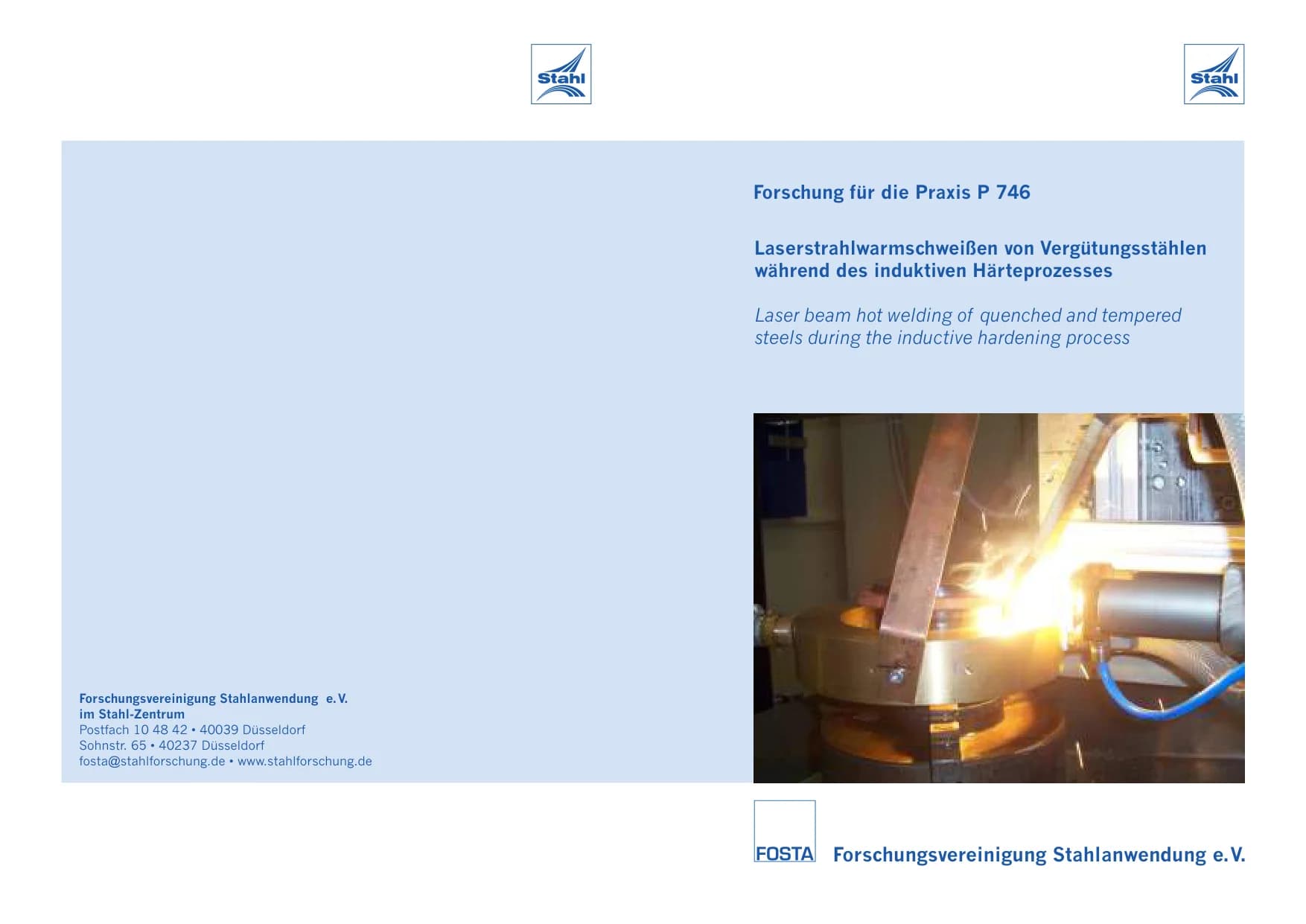
In order to extend the range of applications and to ensure faster and safer processing of heat-treatable steels, a process has been developed that combines induction hardening and laser welding in a single process. This combination makes it possible to weld in the area of the component that has been inductively heated to austenitising temperature, so that any stresses that may arise during welding do not occur. Hot welding" reduces the risk of cold cracking in the area of the weld seam and prevents softening of the base material. Once the welding process is complete, the surface of the component can also be heated to a temperature above 900 °C (> Ac3) using the inductor in the feed.
A trailing spray quenches the weld seam and the entire inductively heated area. This results in a homogeneous hardness distribution in these areas. To investigate the process, a combined hardening welding process was first designed with the aid of FEM simulations and by selecting a suitable sample geometry. The test technology required for the process was developed and set up. As part of the investigations, samples were produced by systematically varying the process parameters, which were validated with regard to their hardness, microstructure and optical properties. The results of the practical tests were compared with the simulation results so that the numerical model could be adapted. It was shown that this method makes it possible to significantly shorten the process duration when processing heat-treatable steels and to simplify the process sequence. The weld seams produced using this method exhibit a homogeneous distribution of hardness in the area of the weld seam and the HAZ. In these two areas of the test piece, metallographic analyses were able to demonstrate a martensitic microstructure. With the help of the simulation, a very precise prediction of the process can be made. The research project was carried out at the Laser Zentrum Hannover e. V. and the Institute of Electroprocess Technology, Leibniz Universität Hannover with technical support and financial assistance from the Forschungsvereinigung Stahlanwendung e. V., Düsseldorf, with funds from the Stiftung Stahlanwendungsforschung, Essen.

Payment by card (Stripe) or invoice (DE, AT, CH). Download link by email: automatically after ordering by card, after order approval for invoice (valid for 30 days). Terms
Machine-translated title and description. The document itself is in German.
Digital download
Other parts and editions as well as neighbouring documents of the same series.

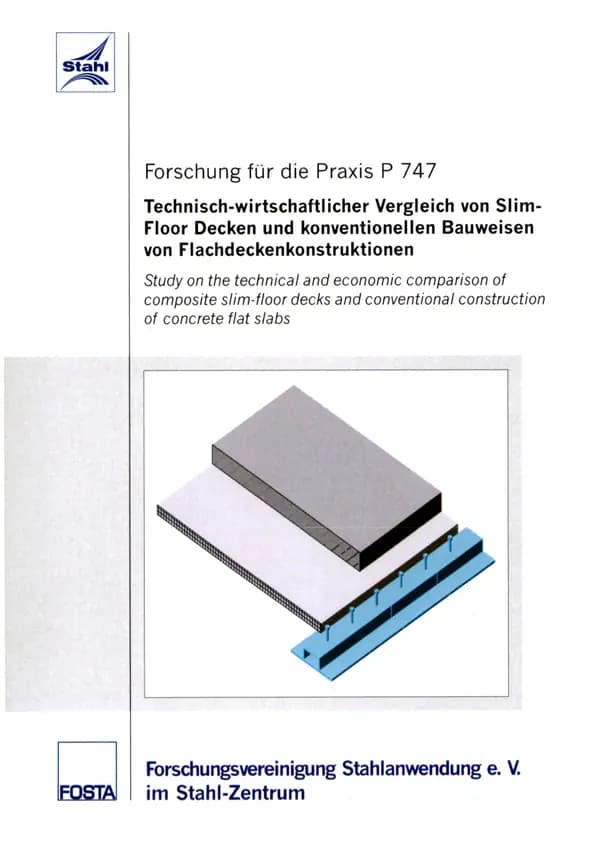
P747 - Technical and economic comparison of Slim-Floor ceilings and conventional construction methods for flat ceiling constructions Flat slabs offer many advantages over beamed floor systems due to the free floor plan design, reduced storey heights, simple and fast formwork and easier routing of installation lines. The flat ceilings can be constructed in reinforced concrete or in reinforced concrete composite construction (slim-floor ceilings). However, slim-floor ceilings in composite construction currently only play a minor role in Germany. The aim of the study is therefore to compare the cost-effectiveness of slim-floor ceilings with conventional reinforced concrete flat slabs. In addition to a mass and cost analysis, the construction times are also compared using various flat slab systems and the advantages of the individual construction methods are worked out. Publication: 2008 Authors: Prof. Dr.-Ing. U. Kuhlmann, Dipl.-Ing. G. Hauf, Dr.-Ing. N. Sauerborn
available anytime
€20.00
excl. VAT

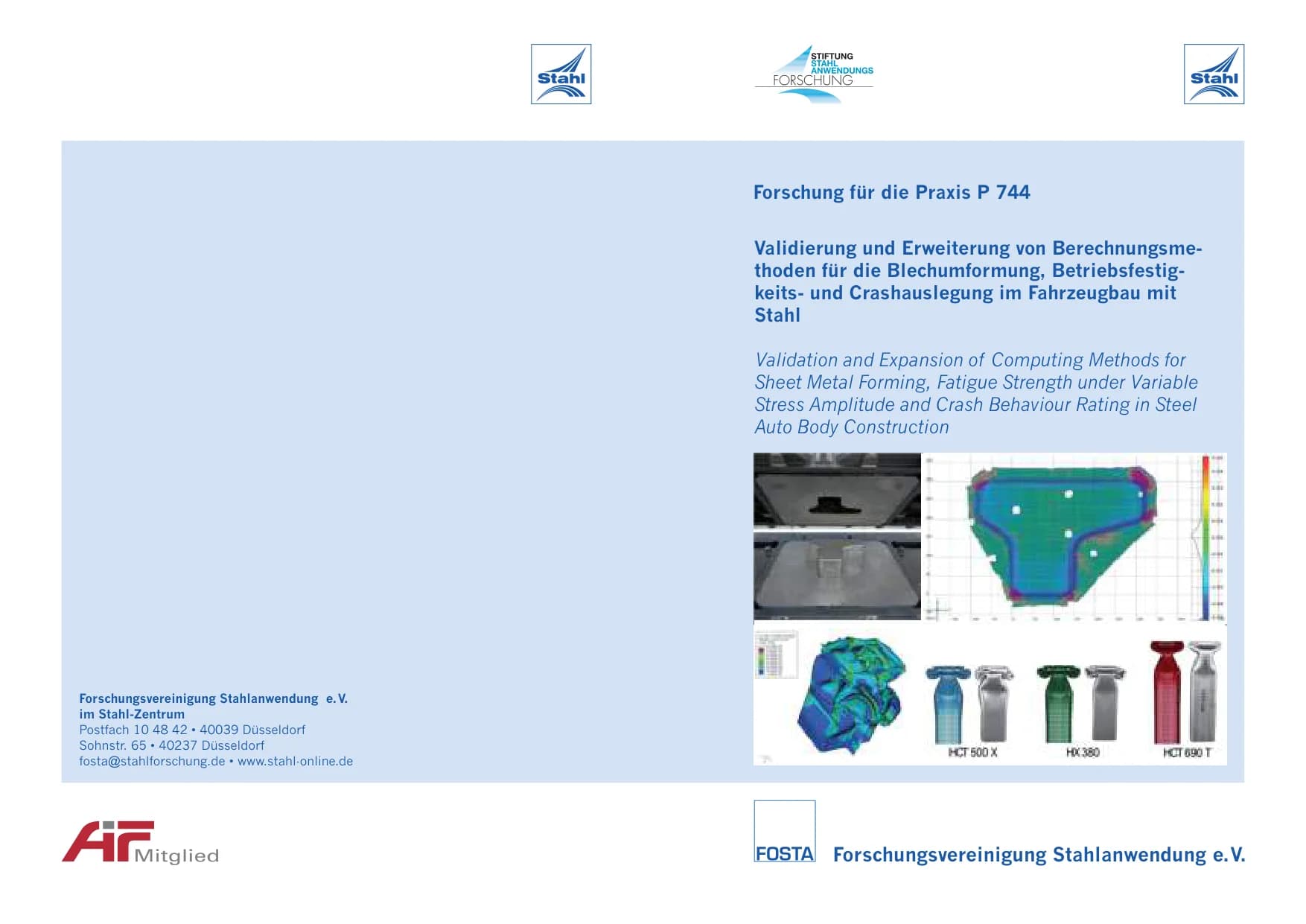
P 744 - Validation and extension of calculation methods for sheet metal forming, fatigue strength and crash design in vehicle construction with steel This report is the logical conclusion of the two previous research projects, which were carried out in close cooperation between steel manufacturers, research centres and automobile manufacturers. The two previous projects focussed on determining the characteristic values of current thin sheet grades and formulating a mathematical model for describing flow curves. The latter serves to shorten development times in automotive engineering. In addition to the characterisation of thin sheet grades, the documentation guideline (PuD, now SEP 1240) was developed, which regulates standardised test execution, evaluation and data provision. The main aim of this project was to validate and extend the models developed for calculating plastic and cyclic characteristic values and to develop guidelines for the use of suitable parameter sets, taking into account the categorisation of steel grades into steel families. To determine the elastic/plastic characteristic values in the tensile test, the modulus of elasticity was determined in the as-delivered condition, after pre-deformation and after pre-deformation and heat treatment W170. The directional dependence of the modulus of elasticity is maintained with pre-deformation. In most cases, the modulus of elasticity decreases considerably from a pre-deformation of 2%. The heat treatment completely cancels out the drop in the modulus of elasticity after pre-deformation. The directional dependence of the as-delivered condition is restored after the W170 treatment. For some steels, even higher values than in the initial state are achieved with 10% pre-forming. In addition to the assessment of formability and springback, a procedure for the systematic creation of material characteristics for the simulation was to be established. It was found that the micro-alloyed steels can be best modelled with the combination of flow curve approximation according to Estrin-Mecking and flow location curve according to Hill48 , while the best results for other steels were achieved with the flow location curve according to Barlat89 . On the basis of this investigation, no general recommendation should be made regarding the modelling of a specific steel grade or type. Dynamic tensile tests were carried out at room temperature to validate the model from the second characteristic value project. As expected, all materials show a positive strain rate dependency. In addition to the classic tensile test, bulge tests, shear tensile tests and layer compression tests were carried out to investigate the material behaviour at high elongation. The comparison of the different test types shows that, with the exception of the material S460MC, the greatest degrees of deformation are always achieved in the bulge test. The stress level in the shear tensile test is always higher for all material classes, whereas the hardening behaviour behaviour is described approximately the same in both test types. For high-strength materials, on the other hand, the stress level is correct, but the hardening behaviour is no longer consistent. The same behaviour is observed in the layer compression tests. In order to apply the developed model and the model extension, quasi-static family parameters were determined, with which it is possible to predict the behaviour of materials that were not used to determine the calculation parameters. It turned out that such a prediction and thus also a reduction of experiments and thus also of costs is possible, even if the results of a family fitting are, as expected, less accurate than those of the individual fitting. The prediction accuracy for a purely quasi-static load is significantly better than for the dynamic tensile test. Overall, the prediction accuracy is higher for single-phase steels. For model validation for steels with retained austenite, an intensive literature search was carried out and models were presented that use a Kocks- Mecking approach. As part of the project, it was shown that this can be excellently combined with the model found, thus improving the accuracy of the respective calculation. The procedure described below was used for the cyclical characteristic values in the sense of developing mechanism-orientated estimation procedures. As no measured crack size values are recorded when carrying out LCF tests in accordance with SEP 1240, damage models that carry out an assessment on this basis are ruled out a priori. Using the method proposed by Heitmann, it was possible to derive a damage parameter from experimentally determined Manson-Coffin parameters, which can be used to estimate the number of failure cycles. It was shown how this can be used to estimate the elastic and plastic components of the strain-strain curves of (unknown) materials. However, the prediction quality of this model is lower than that of other models such as Wagener's, as the crack propagation parameters are not based on previously unavailable test results, but had to be estimated from models. Furthermore, it was investigated whether a possible residual austenite transformation of TRIP steels due to cyclic deformation can be detected. For this purpose, the retained austenite content was measured radiographically in deformed and undeformed sample areas and as a function of the set strain amplitude. For the materials analysed here and the stress amplitudes applied in the room temperature and slightly elevated range, the differences were within the measurement uncertainties of the measurement method. At -40 °C, however, almost complete residual austenite transformation could be demonstrated. This research project was carried out at the Federal Institute for Materials Research and Testing (BAM), Berlin, the Institute of Ferrous Metallurgy at RWTH Aachen University (IEHK), Aachen, the Institute of Mechanical Plant Engineering and Structural Durability at Clausthal University of Technology (IMAB), Clausthal, the Fraunhofer Institute for Structural Durability and System Reliability (LBF), Darmstadt and the VDEh Steel Institute, Düsseldorf, with technical support and financial assistance from the Forschungsvereinigung Stahlanwendung e. V., Düsseldorf, with funds from the Steel Application Research Foundation, Essen. Authors: C.P. Bork, B. Reichert, R. Wagener, K. Dahmen, R. Masendorf, A. Geffert, J. Gerlach, M. Menne, E. Till Publication: 2013
available anytime
€50.00
excl. VAT

P 749 - Development of the basis for a tool for the sustainability assessment of technical solutions in steel construction Authors: M. Feldmann, M. Kuhnhenne, G. Sedlacek Publication: 2008
available anytime
€18.00
excl. VAT

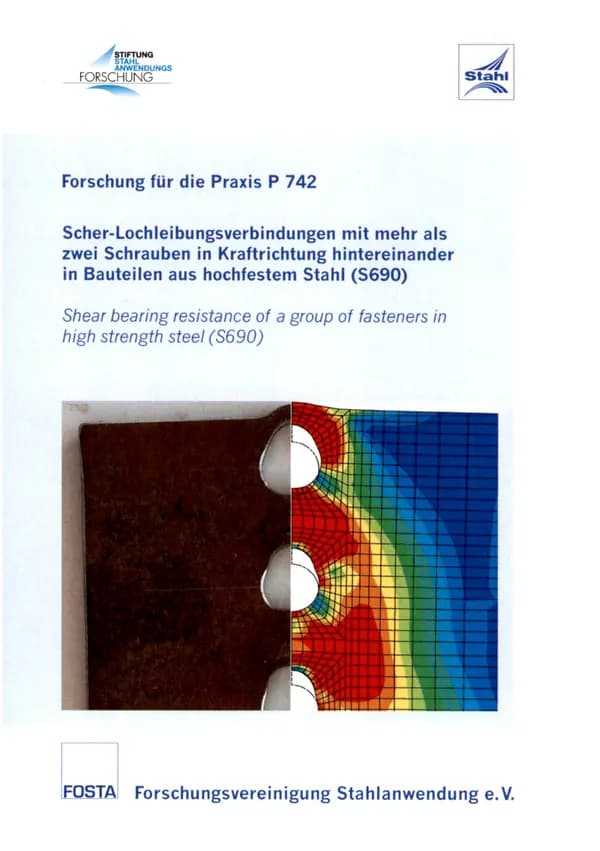
P 742 - Shear-hole soffit connections with more than two bolts in series in the direction of force in components made of high-strength steel (S 690) The design rules for the shear and bearing capacity of bolt groups according to Eurocode 3, Part 1-8 are based on theoretical investigations and extensive tests on bolted connections with plates made of common structural steels S235 and S355. Due to the high ductility of these steel grades, bolted joints subjected to shear loads achieve a plastic distribution of the bolt forces in the ultimate limit state. The lower ductility of high-strength structural steel compared to conventional structural steels raises the question of whether the plates have sufficient deformation capacity and whether a plastic distribution of the bolt forces can be achieved. In order to answer this question, a total of 17 ultimate load tests were carried out on shear-loaded bolted connections with three bolts in succession in the direction of force as part of the research project. In accordance with Eurocode 3, Part 1-12, which contains additional rules for the use of steel grades up to S700, plates made of structural steel grade S690 were used for the tests. The test results show that the connection load-bearing capacities determined in accordance with Eurocode 3, Part 1-8 include additional safety factors. In tests with shearing of the bolts as the decisive failure mechanism, the experimentally determined bearing loads agree very well with the connection bearing capacities according to Eurocode 3, Part 1-8, regardless of the edge and hole spacing. With perforated soffits as the decisive failure mechanism, the test results only agree well with the connection load-bearing capacities determined in accordance with Eurocode 3, Part 1-8 for large edge and hole spacings. For small edge and hole spacings, the design rules are conservative and provide up to 27% lower connection load-bearing capacities. Based on the test results and numerical investigations carried out in parallel using the finite element (FE) method, a proposal for the modification of the design rules for the ultimate limit state bearing capacity was developed, which allows the existing bearing capacity reserves to be utilised. The modified design approach was then verified with the aid of FE parameter studies on shear-stressed bolted connections with three bolts in the direction of force one behind the other. Finally, further questions were asked about bolt force distribution in shear-loaded bolted connections with more than three bolts in succession in the direction of force as well as about "unbalanced bolt patterns" and the Authors: D. Ungermann, S. Schneider Publication: 2010
available anytime
€30.00
excl. VAT
Payment by card (Stripe) or invoice (DE, AT, CH). Download link by email: automatically after ordering by card, after order approval for invoice (valid for 30 days). Terms