The aim of the research project is to improve the level of protection for vehicle occupants in the event of an accident between a vehicle and a road barrier. Through the interdisciplinary co-operation between vehicle …
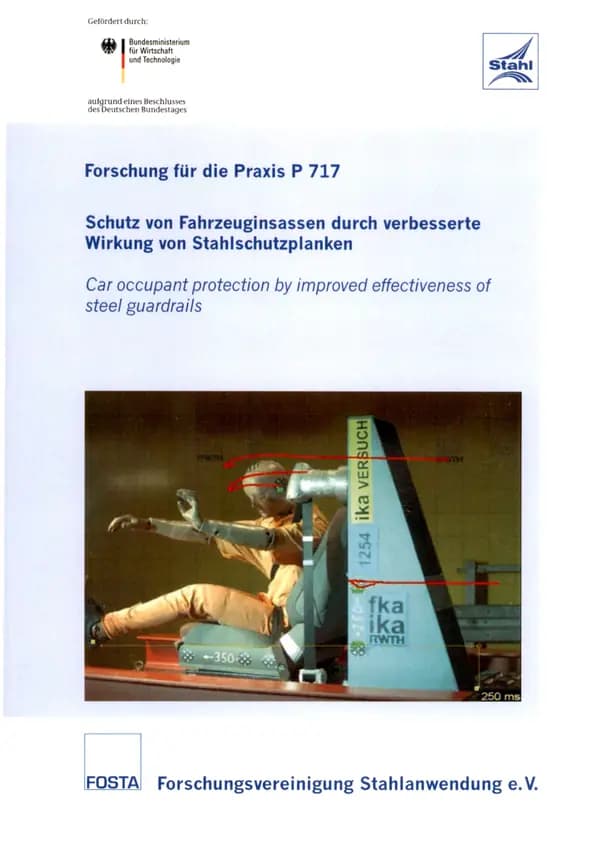
The aim of the research project is to improve the level of protection for vehicle occupants in the event of an accident between a vehicle and a road barrier. Through the interdisciplinary co-operation between vehicle technology (ika) and steel construction (Stb), it is possible to investigate how the vehicle accelerations occurring in a car collision are related to the expected risk of injury to the occupants. The injuries resulting from an accident can then be reduced by means of a suitable design. The evaluation of the current classification criteria used for impact severity in accordance with EN 1317 is at the centre of the research project.
While correlation studies on injury severity already exist for the HIC criterion used in the automotive industry (evaluation of accelerations at the (dummy) head), comparable studies are not known for the main parameter used in EN 1317, ASI (evaluation of accelerations at the vehicle's centre of gravity). Therefore, both simulations and sled tests are carried out here with various dummy models (US-SID and Hybrid II) with and without vehicle bodywork. A multi-body dynamics programme and a finite element programme are used for the simulations. To improve the prediction quality, these are extended by a more precise representation of the vehicle-road interaction and by the implementation of an occupant dummy including belt system. Compared to real crash tests, the good reproducibility of both the simulation results and the sled tests is crucial. The experimental investigations in the sled test show a polynomial (or exponential) correlation between the ASI and the HIC with a high coefficient of determination. It is significant that all sled tests with a configuration for a rigid restraint system lead to a breakage of the side disc through the dummy head. Overall, the results of the tests and the simulations demonstrate the significantly higher occupant load in the event of a vehicle impact with comparatively rigid restraint systems compared to the more flexible steel restraint systems. The simulations also provide valuable preliminary work for the reinforcement of the vehicle restraint system "Simple distance guardrail with 2.0 metre post spacing (EDSP 2.0)" used as standard to date for the area of application with the required containment level H2 according to EN 1317. In further impact simulations, accompanied by drop tower tests, it can also be shown that the use of higher-strength steel can increase the resource efficiency and thus the sustainability of steel crash barriers. The IGF project 14823 N of FOSTA - Forschungsvereinigung Stahlanwendung e. V., Düsseldorf, was carried out at the Chair and Institute for Steel Construction and Light Metal Construction, RWTH Aachen University and the Institute for Motor Vehicles Aachen, RWTH Aachen University and was funded by the Federal Ministry of Economics and Technology via the AiF as part of the programme for the promotion of joint industrial research and development (IGF) on the basis of a resolution of the German Bundestag.
Payment by card (Stripe) or invoice (DE, AT, CH). Download link by email: automatically after ordering by card, after order approval for invoice (valid for 30 days). Terms
Machine-translated title and description. The document itself is in German.
Digital download
Other parts and editions as well as neighbouring documents of the same series.

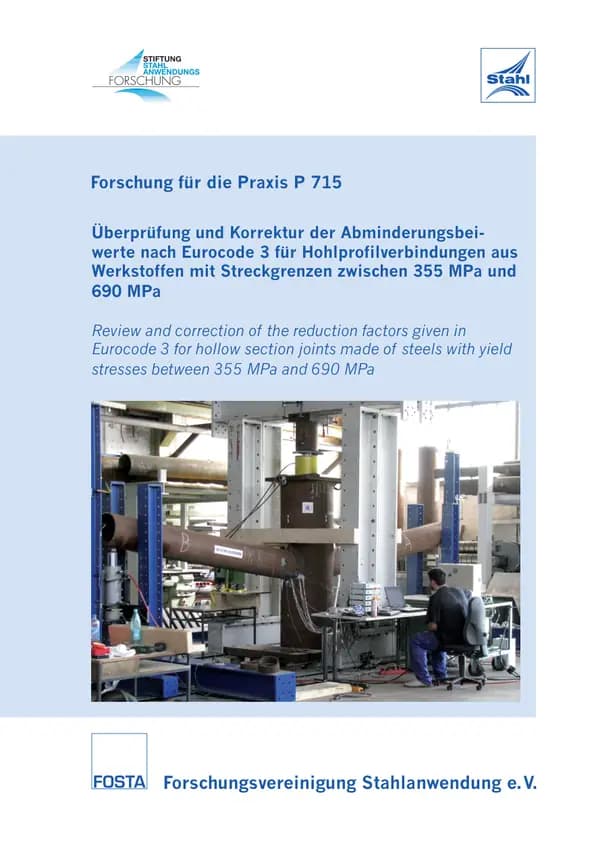
P 715 - Verification and correction of reduction coefficients according to Eurocode 3 for hollow section connections made of materials with yield strengths between 355 MPa and 690 Mpa The design of hollow section connections made of high-strength fine-grain structural steel in accordance with DIN EN 1993-1-8 is carried out in the same way as for normal-strength general structural steel with a maximum yield strength of 355 MPa and additional consideration of a reduction factor. For structural steels with a yield strength of 355 < fy < 460 MPa, the design values of the tensile strength must be reduced by α = 0.9 and for structural steels with a yield strength of 460 < fy < 700 MPa by α = 0.8. As part of this research project, these reduction factors were checked and the influence of the geometric parameters 2γ (chord slenderness), τ (wall thickness ratio) and β (width ratio) on the reduction was investigated. The experimental investigations were carried out on X-nodes made of hollow sections with a circular cross-section (KHP) made of fine-grained structural steel S460 and S690. The specimens were subjected to tension and compression as well as bending in the joint plane (IPB). The geometric influences on the reduction coefficient were investigated using FE analyses. The two failure modes of chord plasticising and punching were considered. The node load-bearing capacities for belt plasticising were determined using the 3% deformation criterion. A separate numerical model was developed for the punching shear failure mode, which can be used to simulate the formation of cracks in the belt cross-section. However, complex experimental investigations are required to determine the input parameters of this model, e.g. to take into account the multi-axiality of the tension, but these could not be carried out as part of this project. It was therefore not possible to check the reduction factors for the failure case of punching shear. The results of the experimental investigations to date indicate that it may be possible to dispense with joint verifications if the belt slenderness and the wall thickness ratio do not exceed certain limit values. The verification of the connection would then already be included in the verifications of DIN EN 1993-1-1. The current lower limit for chord slenderness (d0/t0 ≥ 10) for the application of EN 1993-1-8 could then also be omitted. However, further investigations are required for this. As the statistical analyses are only of limited significance due to the small number of test data, no final recommendation for a change in the coefficients can currently be made on the basis of the results obtained. However, it was confirmed that the reduction coefficients according to DIN EN 1993-1-8 and DIN EN 1993-1-12 are always on the safe side for all analysed cross-sections of cross-section classes 1 and 2. The research project was carried out by the Research Centre for Steel, Wood and Stone at the Karlsruhe Institute of Technology (KIT) and the Laboratory for Steel and Light Metal Construction at Munich University of Applied Sciences, Faculty of Civil Engineering, with technical support and financial assistance from the Forschungsvereinigung Stahlanwendung e. V., Düsseldorf, with funds from the Stiftung Stahlanwendungsforschung, Essen. Authors: R. Puthli, S. Herion, O. Fleischer, Ö. Bucak, I. Engelhardt, A. Fischl Publication: 2014
available anytime
€50.00
excl. VAT

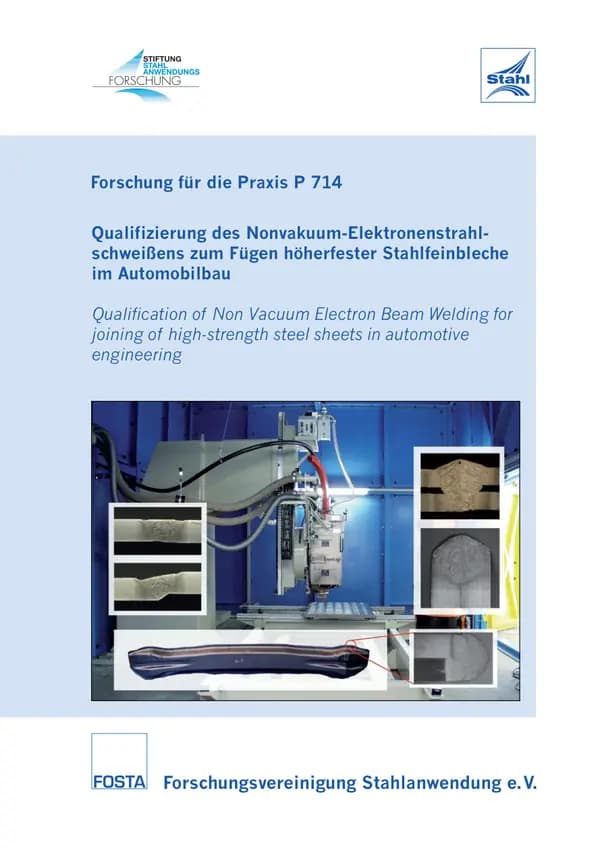
In research project P714, building on the fundamental investigations of project P611 on the weldability of various coated sheet steel grades, non-vacuum electron beam welding (NVEBW) was qualified for use in sheet steel processing, particularly in car body production, under near-industrial conditions. The higher-strength, galvanised steel sheet grades HX420LAD+Z, HXT600X+Z, HXT700T+Z and BTR165 with sheet thicknesses between 0.8 and 2 mm were the focus of the investigations. Firstly, the process tolerances for NVEBW were determined as a function of different seam geometries, steel sheet grades and sheet thicknesses. In particular, the gap bridging capability, the tolerance to positional deviations and the edge offset were analysed. A particularly good gap-bridging capability was demonstrated for the NVEB welding of lap seams and flanged seams. In the case of I-seams, the gap bridgeability is highly dependent on the material. The process tolerances determined with regard to positional deviation and edge misalignment can be rated as large. The use of filler materials can further improve the gap bridging capability. In the tests with oblique beam incidence with an angle of inclination of 15°, a reduction in the edge notch depth was observed for the materials HXT600X+Z and HXT700T+Z at a welding speed of 12 m/min. In the NVEBW of beaded seams made of HXT600X+Z and HXT700T+Z, a reduction in the humping and the edge notch depth, i.e. an overall stabilisation of the weld fusion, was observed with a beam inclination angle of 15°. Fatigue strength tests on NDEB-welded H-specimens for the four materials investigated show similar load cycle levels with comparable force amplitudes. The suitability of NVEB as a joining technology has been conclusively demonstrated by means of component welds and crash tests. The crash properties of NVEB-welded and spot-welded bumpers from Benteler Automobiltechnik GmbH have been tested. The crash tests show comparably good crash properties for both the original bumpers and the NVEB-welded bumpers. In addition to the cycle time, the vehicle weight is particularly important with regard to CO2 emissions and fuel consumption. In this context, the weight of the NVEBW bumper was reduced from 4.95 kg to 4.30 kg by adapting the joint geometry to the welding process. The tests carried out confirm the excellent suitability of the NVEBW for processing coated steel sheet in car body construction. This is not only due to economic advantages such as a high welding speed and a high degree of efficiency. The investigations also show the advantages necessary for practical use, such as high process reliability and the flexibility of the process. FOSTA Research Association for Steel Application e. V. Publication: 2012 Authors: Dr.-Ing. K. Lau, Dipl.-Ing. R. Konya, Dr.-Ing. T. Hassel
available anytime
€25.50
excl. VAT

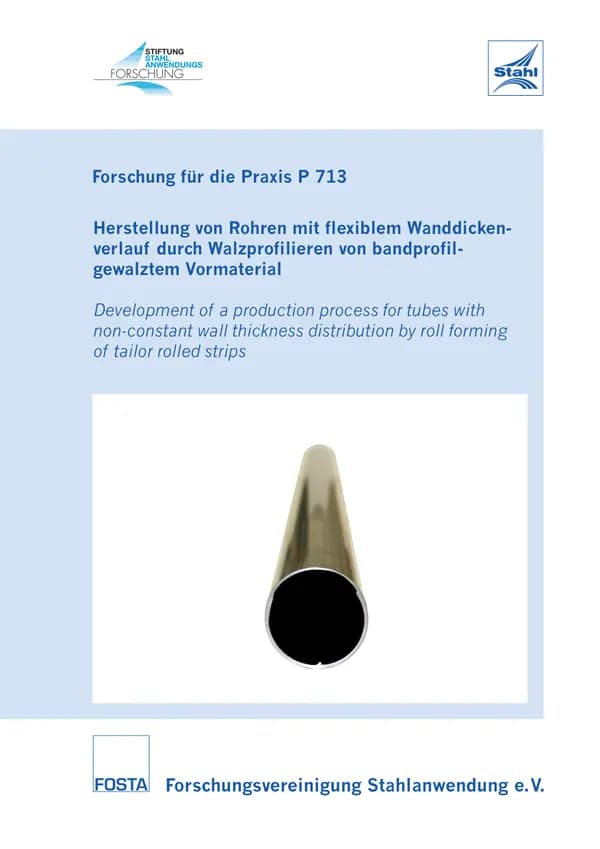
P 713 - Production of tubes with flexible wall thickness by roll forming of strip-rolled pre-material In today's commercially available tailored tubes, the diameter and possibly also the wall thickness vary along the longitudinal axis of the tube. This project was the first to demonstrate that the combination of strip profile rolling and roll forming can be used to economically produce tubes with varying wall thicknesses in the circumferential direction in a continuous process. Even as a straight tube, this makes it possible to tap into previously unrealised lightweight construction potential. In addition, it was shown that this new class of tubes can be further processed into geometrically sophisticated lightweight structures after annealing treatment, e.g. by hydroforming. The basis for the successful realisation of the demonstrator tubes was created through extensive simulation studies of the process chain, so that validated simulation models are now also available for the development of further profile variants. Based on a consideration of the area moment of inertia, three cross-sections for circular tubes with varying wall thicknesses were determined, which have a particularly favourable ratio of bending stiffness to weight. For the roll forming of the pipe geometry selected as a demonstrator, a 186 mm wide strip is required as the starting material, the thickness of which had to be reduced from 2.5 mm to 1.5 mm in the centre area over a width of approx. 50 mm by means of strip profile rolling. Based on the basic principles of strip profile rolling known at the beginning of the project, the influences of the process, geometry and material parameters on the formation of the cross-section were first investigated in a comprehensive parameter study with numerical simulation (FEM) and an optimised roller geometry and rolling strategy was developed. This rolling strategy was implemented on an industrial scale on a roll forming line, on which around 120 metres of Tailor Rolled Strip (TRS) were produced in three passes with a total of 25 passes for further processing. The various conceivable forming strategies for roll forming the TRS were also evaluated and optimised with the help of extensive FEM simulations. The pre-hardening from the strip profile rolling was taken into account on the basis of a measured hardness distribution and the entire moulding process was mapped as an FEM model. Based on this preliminary work, the pipes were successfully moulded and closed using HF welding, whereby the roundness and shape deviations were slightly higher than those of a reference pipe with a constant wall thickness. Bursting tests using hydroforming with free expansion showed that the tailored tubes produced in this way can be formed by hydroforming after recrystallising annealing and even exhibit slightly better formability than a reference tube in which the difference in wall thickness was produced by milling. The process combination of strip profile rolling with subsequent roll forming can be carried out on highly productive roll forming lines. This means that a high level of cost-effectiveness can be expected in particular if as few passes as possible are required to produce the TRS. This is always the case when the TRS has one or more narrow grooves. Wide or particularly deep grooves, on the other hand, are considered costly. FOSTA Research Association for Steel Application e. V. Publication: 2010 Authors: Prof. Dr.-Ing. P. Groche, Dipl.-Ing. M. Mirtsch, Prof. Dr.-Ing. G. Hirt
available anytime
€30.00
excl. VAT

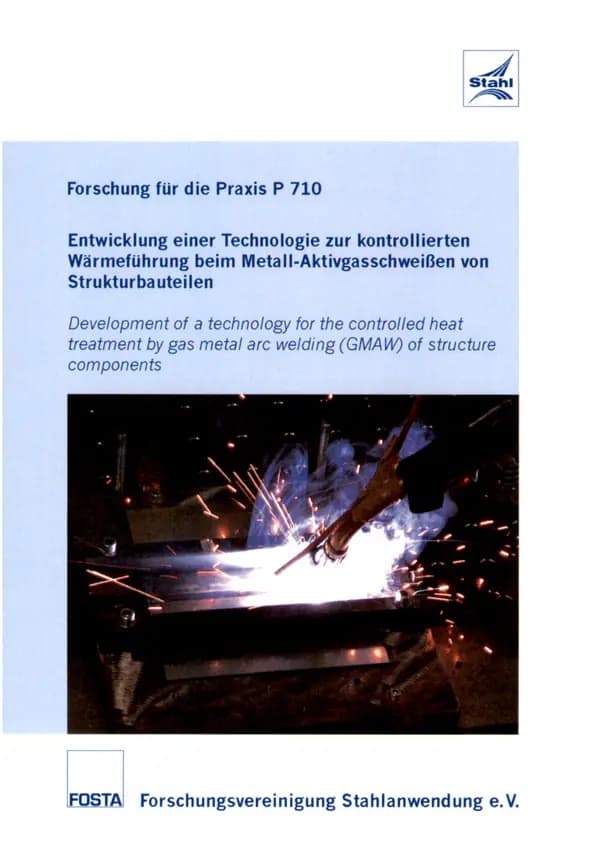
P 710 - Development of a technology for controlled heat conduction in metal active gas welding of structural components The effective utilisation of the newly developed high-strength steels HCT690T+Z100 (1.0947), HCT780X+Z100 (1.0943), HDT1200M (1.0965) and 22MnB5+AS (1.5528) requires suitable joining technologies. The aim of this work was to transfer the properties of the base materials to the joining properties. To this end, fusion welding processes with controlled energy control were investigated in combination with specially developed filler materials. The compositions of the filler materials are adjusted in such a way that they largely correspond to the composition of the base materials, taking the welding technology into account. In addition, comparative analyses were carried out between the four newly developed cored wires and three commercially available solid wires. Seamless cored wires were used in the investigations. They were designed as metal powder types for use under mixed gas. They are ideally suited for fully mechanical and automated processes. The wires were processed using modern welding technology equipment. Both direct current and alternating current machines were used. With the exception of one solid wire, it was possible to weld all filler materials reproducibly under alternating current conditions. By balancing positive and negative polarity, alternating current technology offers excellent possibilities for controlling the energy input into the base material over a wide range. This ensures a basis for defined energy control. The possibilities of process-integrated energy management were also assessed. The newly developed short-time heat treatment is particularly suitable for joints on the HCT690T+Z100. The applicability of two different systems was presented and their impact on the joint properties was demonstrated. A significant reduction in the hardness of the weld metal and the heat-affected zone was demonstrated. This result was confirmed by the realised impact tensile tests. The sample was only destroyed at a significantly higher energy than was recorded for untreated samples. The energy supplied as a result of the bonding process was recorded using highly accurate current-voltage-time measurements. Systematic measurements of the cooling times were also carried out. Only the combination of filler material and processing technology made it possible to produce joints that largely corresponded to the base material properties. The reactions to quasi-static, cyclic and impact loading of the manufactured samples served as assessment criteria. Corrosive and metallographic tests were also used. All test results were summarised in a database. The user is guided by a menu from the task to the welding instruction. In addition, information is provided on the joint properties, the fracture position, the joining parameters and the results of the metallographic tests. The work contains a welding time-temperature transformation diagram for HCT780X+Z100 (1.0943) - on the basis of which the theoretical considerations for assessing the heat-affected zone are based. The applicability of commercially available software packages for AC processes can also be established with good agreement. FOSTA - Forschungsvereinigung Stahlanwendung e. V. Publication: 2009 Authors: Dipl.-Ing. J. Vester, Dr.- Ing. H. Heinemann, Dipl.-lng.(FH) T. Ebersbach, Dipl.-Ing. A. Panthel,
available anytime
€20.00
excl. VAT
Payment by card (Stripe) or invoice (DE, AT, CH). Download link by email: automatically after ordering by card, after order approval for invoice (valid for 30 days). Terms