
P 709 - Press hardening of Tailor Welded Blanks
The production technology of press hardening or mould hardening is nowadays a standard process in the automotive industry for the realisation of safety-relevant structural components. In the direct press hardening …
Content
- Authors
- M. Merklein, M. Geiger, C. Kerausch, J. Lechler
- Publication
- 2010
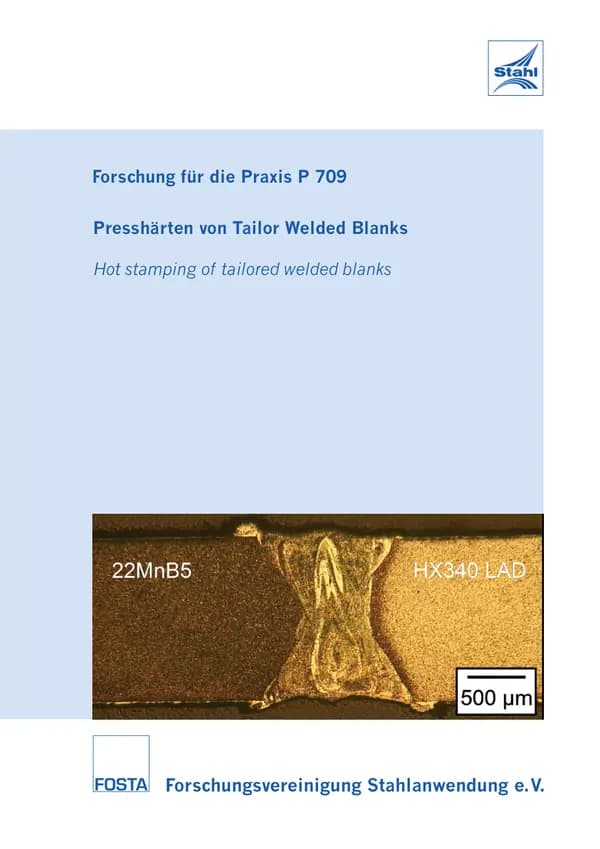
The production technology of press hardening or mould hardening is nowadays a standard process in the automotive industry for the realisation of safety-relevant structural components. In the direct press hardening process, the boron-manganese steel 22MnB5 (1.5528) is hot-formed and tempered in a single process step after prior austenitisation. This makes it possible to produce geometrically complex components with a tensile strength of over 1500 MPa. The aim of the research project was to fundamentally investigate the technology of press hardening of laser-welded Tailor Welded Blanks (TWB) with regard to the realisation of functionally optimised structural components with customised mechanical properties.
Show full description
In this context, the first step was to select a suitable joining partner for the press-hardenable boron-manganese steel 22MnB5 on the basis of its transformation and deformation behaviour under near-process conditions. With regard to the development of a process control strategy for the press hardening of TWBs using the finite element simulation method, a comprehensive characterisation and description of the mechanical properties of the partner material and the weld seam as well as the analysis of the effect of the position of the weld seam in the initial blank on the forming behaviour of laser-welded Tailor Welded Blanks under near-process conditions represented a major focus of the project. As part of the research project, the micro-alloyed steel material HX340LAD+AS150 (1.0933) was selected as a suitable partner material based on the results of the experimental investigations. After mould hardening, this covers both the desired strength range for the yield strength Rp0.2 between 350 and 500 MPa and for the tensile strength Rm between 500 and 650 MPa and also meets the target value corridor for the residual elongation at break of A50 > 13%. Investigations into the plastic forming behaviour of the micro-alloyed steel at elevated temperatures have shown that it is characterised by a noticeable temperature and strain rate dependence and has comparable forming limits of approximately δ1 = 0.4 for the plane strain range as the boron-manganese steel 22MnB5. Hardness measurements and metallographic investigations in the transverse direction across the weld seam have shown that the Al/Si coating leads to the formation of hard and brittle intermetallic phases in the seam area both in the initial and hardened state. No effects of the Al/Si coating on the moulding capacity after hardening could be determined in the experiments. FE-based and experimental investigations into the forming behaviour of press-hardenable Tailor Welded Blanks using so-called mini-B-pillar geometries have shown that no crack initiation could be detected in the seam area for any of the weld seam layers considered, even if the weld seam runs directly through the crack-critical area. The validation of the results under near-series conditions was carried out by press hardening laser-welded Tailor Welded Blank B-pillars at Audi AG in prototype construction. The research project was carried out at the Chair of Production Technology, Friedrich-Alexander University Erlangen-Nuremberg, with expert supervision and financial support from the Forschungsvereinigung Stahlanwendung e. V., Düsseldorf, with funds from the Stiftung Stahlanwendungsforschung, Essen.
Zum Zoomen hovern
€30.00excl. VAT
Payment by card (Stripe) or invoice (DE, AT, CH). Download link by email: automatically after ordering by card, after order approval for invoice (valid for 30 days). Terms
P 709 - Press hardening of Tailor Welded Blanks—
€30.00