
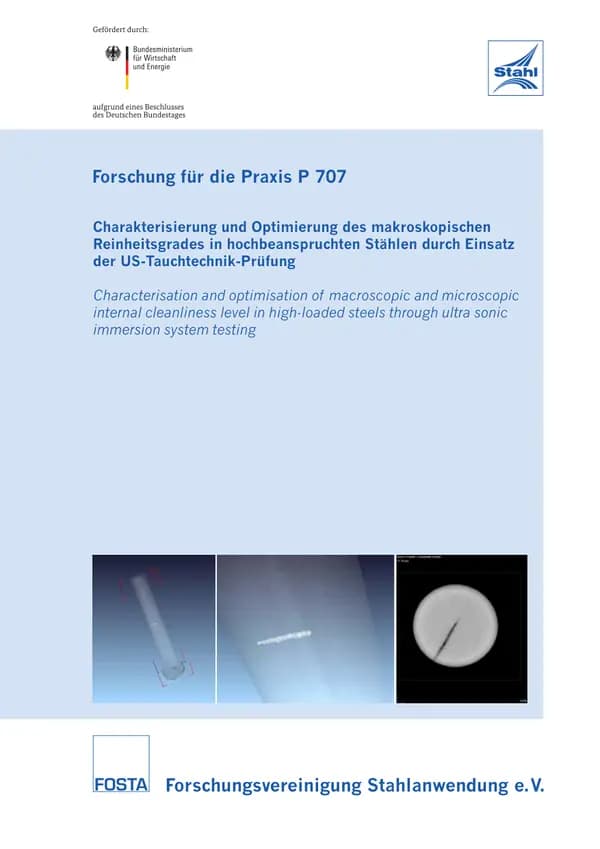
P 707 - Characterisation and optimisation of the macroscopic degree of cleanliness in highly stressed steels using the US immersion technique
Inclusions in steel components are one of the most common causes of failure under cyclic loading. In order to minimise the risk of inclusions, the requirements for the degree of cleanliness of steels have steadily …
Content
- Publication
- 2015
- Authors
- Univ.-Prof. Dr.-Ing. W. Bleck
P707 - Characterisation and optimisation of the macroscopic degree of cleanliness in highly stressed steels by using the US immersion technique test Inclusions in steel components are one of the most common causes of failure under cyclic loading. In order to minimise the risk of inclusions, the requirements for the degree of cleanliness of steels have steadily increased in recent years. One way of checking the macroscopic degree of purity is ultrasonic immersion technology. With a minimum detectable comparative defect size of 0.3 mm KSR, it represents a significant improvement compared to continuous testing (minimum detectable comparative defect size 0.7 mm KSR); however, it can also only be used to assess the macroscopic degree of purity.
Show full description
The microscopic degree of purity can be described using light-optical methods. Statistical investigations in accordance with ASTM E 2283 03, which were carried out as part of this project, have shown that the occurrence of globular oxides with a diameter greater than 30 metres is extremely unlikely. This means that no statements can be made about the frequency of occurrence of inclusions with a diameter between 30 ?m and 0.3 mm KSR (corresponding to approx. 100 ?m inclusion size). This is particularly critical, as inclusions of 30 ?m or more can lead to failure in components subject to high pressure loads. Nevertheless, inclusions with diameters between 30 m and 100 m represent a particular risk, as they cannot be detected using either US testing technology or statistics. In this project, it could be shown that this range can definitely not be covered with the currently available techniques. The inclusions found using ultrasound could be identified as entrained slag during the investigations. A correlation of the rare macroscopic inclusions with the production route with a subsequent comparison of the different steels was rejected due to the limited data available. The microscopic inclusions, on the other hand, could be categorised into two groups. Elongated manganese sulphides and globular aluminium oxides. The first group is caused by the high sulphur content, while the second group is a result of the deoxidation process. After consultation with the PbA, it was decided to investigate the effect of individual inclusions on the mechanical properties in more detail. A new method of target preparation was developed for this purpose. By combining the results of the US immersion technique investigations and 3D X-ray tomography, it was possible to prepare micro tensile specimens containing defined inclusions. The shape of the inclusions could be recorded in three dimensions in this way. By comparing defect-free samples and samples with inclusions, it was possible to identify trends in the mode of action of inclusions. For example, a slag inclusion in a tensile sample leads to an increase in strength values and a reduction in elongation at break. When analysing the cyclic mechanical properties, it was not possible to prove a clear correlation due to the small number of samples. Using FE simulations in ABAQUS, it was possible to show that the inclusion volume cannot be the only decisive factor for assessing the degree of purity. Parameters such as shape, distribution and especially the combination of both parameters also influence the mechanical properties to a high degree. In future, 3D data of inclusions obtained by X-ray tomography can be incorporated directly into the FE simulation. This procedure offers the possibility of developing new approaches for damage models. FOSTA Research Association for Steel Application e.V.
Zum Zoomen hovern
€20.00excl. VAT
Payment by card (Stripe) or invoice (DE, AT, CH). Download link by email: automatically after ordering by card, after order approval for invoice (valid for 30 days). Terms
P 707 - Characterisation and optimisation of the macroscopic degree of cleanliness in highly stressed steels using the US immersion technique—
€20.00