
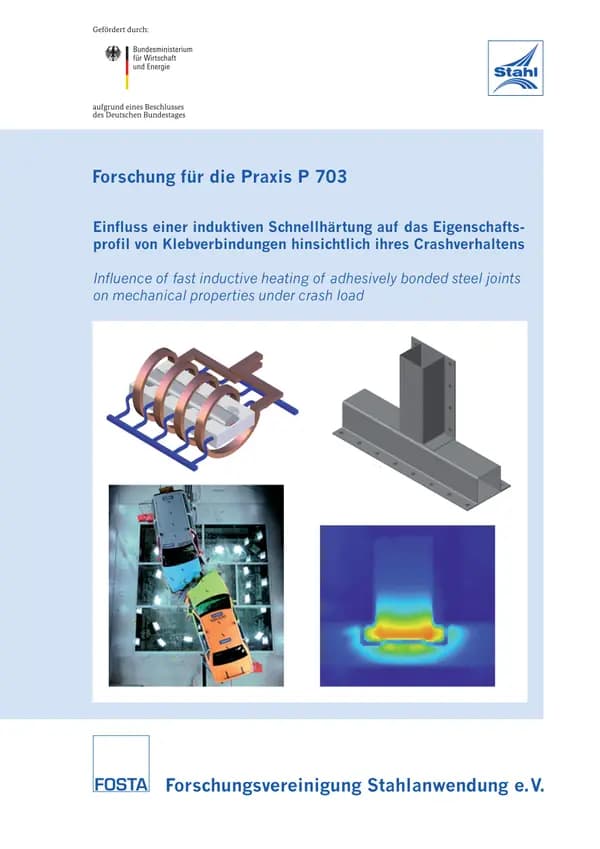
P 703 - Influence of inductive rapid curing on the property profile of bonded joints with regard to their crash behaviour
The aim of the research project was to determine the influence of inductively accelerated adhesive pre-curing on the bond properties - especially under impact load. Inductively accelerated adhesive curing is becoming …
Content
- Authors
- O. Hahn, H. C. Schmale
- Publication
- 2015
The aim of the research project was to determine the influence of inductively accelerated adhesive pre-curing on the bond properties - especially under impact load. Inductively accelerated adhesive curing is becoming increasingly important in industrial manufacturing processes as it contributes to process time reduction. It enables a fast handling strength of bonded components immediately after bonding and increases the wash-out resistance of bonded seams in subsequent painting and cleaning processes. Four epoxy resin adhesives on a one- and two-component basis were used in the investigations, which were previously selected using impact test methods.
Show full description
Investigations into the reaction kinetic behaviour of the pure adhesive substance show that the curing behaviour of the adhesives depends on the heating rate. Analyses of the viscoelastic material behaviour show a change in the glass transition area and the adhesive stiffness for the induction-cured samples compared to conventionally oven-cured samples. The curing temperature and the heating rate were identified as process-critical parameters for inductive fast curing. Lower curing temperatures and heating rates were found to be advantageous. Further investigations on bonded joints, e.g. using the thick tensile shear test at increased slip rates, generally show lower maximum bearable shear stresses and fracture slip for inductively cured joints, so that inductive rapid curing leads to a reduction in the crash performance of the adhesives. Tests on bonded thin sheet metal joints with a low-alloy deep-drawing steel and a high-strength dual-phase steel also show that the effects of inductive rapid curing can be differentiated in the mechanical joint properties with different material strengths and surfaces. Impact tests were carried out on component-like T-joints in order to verify the comparability of the results from the previous investigations on simple test specimens. The results showed good agreement. With the knowledge gained in this project, both a quantitative and qualitative assessment of the crash behaviour of inductively pre-cured bonded joints can be made. The IGF project 14477 N of the FOSTA-Forschungsvereinigung Stahlanwendung e. V., Düsseldorf, was funded via the AiF as part of the programme for the promotion of joint industrial research (IGF) by the Federal Ministry for Economic Affairs and Energy on the basis of a resolution of the German Bundestag. The project was carried out at the Laboratory for Materials and Joining Technology, University of Paderborn.
Zum Zoomen hovern
€30.00excl. VAT
Payment by card (Stripe) or invoice (DE, AT, CH). Download link by email: automatically after ordering by card, after order approval for invoice (valid for 30 days). Terms
P 703 - Influence of inductive rapid curing on the property profile of bonded joints with regard to their crash behaviour—
€30.00