
P 702 -Extending the service life of existing and new welded steel structures
In recent years, the significance of the service life of structures has gained in importance alongside the optimisation of the construction weight to reduce manufacturing costs. Highly stressed weld seam details are …
Content
- Authors
- T. Ummenhofer, S. Herion, J. Hrabowsky, S. Rack, I. Weich, G. Telljohann, S. Dannemeyer, H. Strohbach, H. Eslami-Chalandar, A. K. Kern, D. Pinkernell, M. Smida, U. Rahlf, B. Senk
- Publication
- 2011
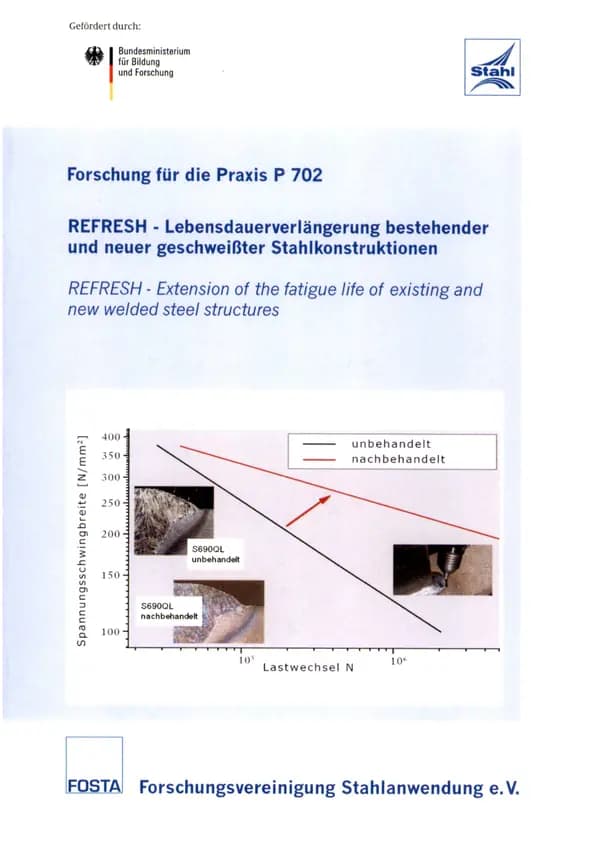
P 702 - REFRESH - Extending the service life of existing and new welded steel structures In recent years, the significance of the service life of structures has gained in importance alongside the optimisation of the construction weight to reduce manufacturing costs. Highly stressed weld seam details are decisive for the service life of cyclically stressed welded steel structures. By increasing the fatigue strength of these notch details, the service life of the overall structure can be extended. This can be achieved by post-treatment of the weld seams using various methods. While grinding the weld seams is the only method used in the construction industry to date, other sectors are already successfully using strengthening methods such as shot peening.
Show full description
A large number of publications show the positive effect of specifically utilised weld post-treatment methods. Recent studies confirm the particular effect of higher-frequency hammering processes. A prerequisite for the widespread introduction of service life-extending measures, particularly in the construction industry, is that, in addition to the pure application of methods for extending the service life of existing and new steel structures, methods for calculating and quantifying the achievable effects as well as corresponding quality assurance systems must be provided. The possible applications, effects and limitations of the methods must be recognised as the state of the art on the basis of comprehensive, statistically verified studies and become part of corresponding guidelines. As part of this research project, extensive investigations were carried out into the mode of action and effectiveness of higher-frequency hammering methods. The results of the experimental investigations show that the positive effect of the higher-frequency hammering processes, HiFIT and UIT, is based on the residual compressive stresses and surface layer hardening generated by the plastic deformation of the seam transition. The crack initiation phase is extended and the crack propagation phase is delayed by crack closure effects, so that the experimentally determined fatigue strength is increased by 80 to 100 per cent compared to an untreated weld seam. The same improvement is achieved with pre-damaged but macrocrack-free weld seams. The devices have been optimised for maximum effectiveness, process reliability and practical applicability. The device settings required to achieve process reliability were analysed and defined and a quality assurance concept was developed. This concept requires the creation and certification of process instructions, the organisation of user training courses and tests and the performance of quality controls. The further development of a micro-magnetic measuring system provides a measuring system for testing the use of certified higher-frequency hammering processes for components that deviate from the standard application. Various design concepts were developed based on local concepts for the precise calculation of the service life, verified on the basis of experimental results and finally analysed. As a result, a simplified design concept was developed that enables engineers to design components conservatively. The result of the project is a holistic concept that both ensures quality requirements and provides design specifications. Based on the analysed HiFIT and UIT procedures, a certification procedure was developed. This certification procedure is now available for other procedures in addition to HiFIT and UIT. National and international committees are currently working on implementing the results in guidelines. In future, it will not only be possible to apply these procedures, but also to take them into account in the design within the defined limits. This research and development project no. 02PB2103 was funded by the Federal Ministry of Education and Research (BMBF) as part of the "Research for the production of tomorrow" programme and supervised by the Karlsruhe Project Management Agency (PTKA). The FOS-TA initiated and led the industrial working group. Responsibility for the content of this publication lies with the authors: Versuchsanstalt für Stahl, Holz und Steine, Karlsruher Institut für Technologie (KIT), Karlsruhe; Ingenieursozietät Peil, Ummenhofer und Partner, Karlsruhe; DYNATEC Gesellschaft für CAE und Dynamik mbH, Braunschweig; Kranbau Köthen GmbH, Köthen; LKT Klebtechnik GmbH, Aachen; MAN B&W Diesel Gruppe, Augsburg; Maurer Söhne GmbH & Co. KG, Munich; REpower System AG, Hamburg; Schachtbau Nordhausen GmbH, Nordhausen. This project also received EU-REKA status
Zum Zoomen hovern
€70.00excl. VAT
Payment by card (Stripe) or invoice (DE, AT, CH). Download link by email: automatically after ordering by card, after order approval for invoice (valid for 30 days). Terms
P 702 -Extending the service life of existing and new welded steel structures—
€70.00