Frame-type supporting structures made of steel are predominantly manufactured from open, I-shaped rolled sections, whereby the highly stressed frame corners are often approximated to the stress curve by haunching the …
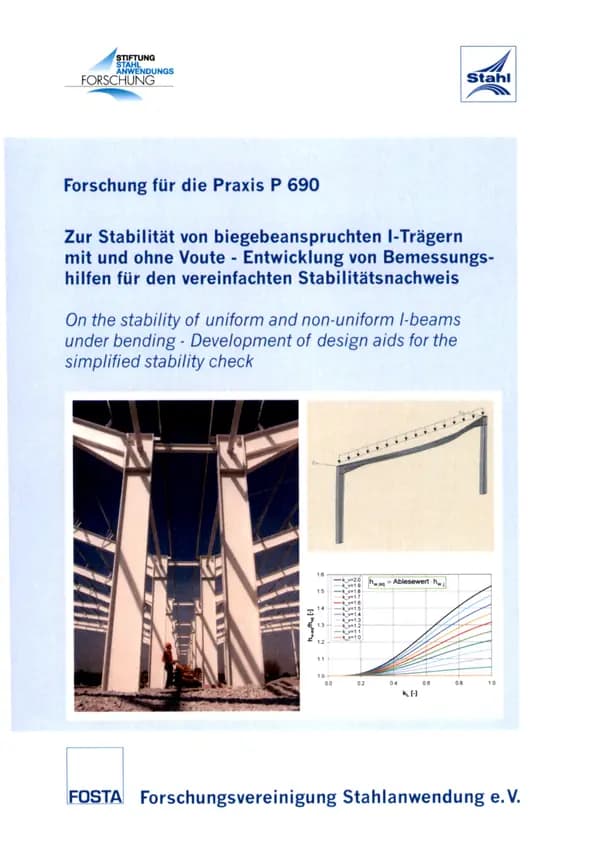
Frame-type supporting structures made of steel are predominantly manufactured from open, I-shaped rolled sections, whereby the highly stressed frame corners are often approximated to the stress curve by haunching the sections. This construction method offers the economic advantage that a statically adapted profile can be used for the largest beam area. The current standardisation specifies verification formats for the verification of spatial stability, i.e. the lateral-torsional buckling verification, which are based on the determination of the ideal lateral-torsional buckling moment on a detached equivalent member. The component load-bearing capacity is then determined with the aid of a load-bearing capacity curve defined by tests and numerical simulations.
Numerous aids are given in the technical literature for the verification of parallel chord members, but the lateral-torsional buckling of haunched components is not satisfactorily recorded. In the present research project, the variables that influence the stability behaviour of haunched I-beams were determined by theoretical, experimental and numerical investigations. Subsequently, the fundamentals for the creation of design aids were developed, with the help of which the verification of bending-stressed components with and without haunches can be carried out in the form of a manual calculation based on the equivalent member method. As a result, easy-to-use design aids for determining the ideal lateral-torsional buckling moment are provided both as graphical diagrams and as formulae. Furthermore, rules are given for the removal of replacement bars from the overall system. In a further step, conditions were derived for the required stiffness and the arrangement of secondary load-bearing members, compliance with which can rule out lateral-torsional buckling failure. In daily practice, these enable the engineer to dispense with a complex lateral-torsional buckling analysis on the one hand and to fully utilise the cross-sectional load-bearing capacity on the other. The design aids developed as part of the research project provide the results of the precise numerical simulation calculations in a format suitable for application to the equivalent member method. This enables the verification of lateral-torsional buckling based on the numerical experimental results without the need for complex FEM analyses.
Payment by card (Stripe) or invoice (DE, AT, CH). Download link by email: automatically after ordering by card, after order approval for invoice (valid for 30 days). Terms
Machine-translated title and description. The document itself is in German.
Digital download
Other parts and editions as well as neighbouring documents of the same series.

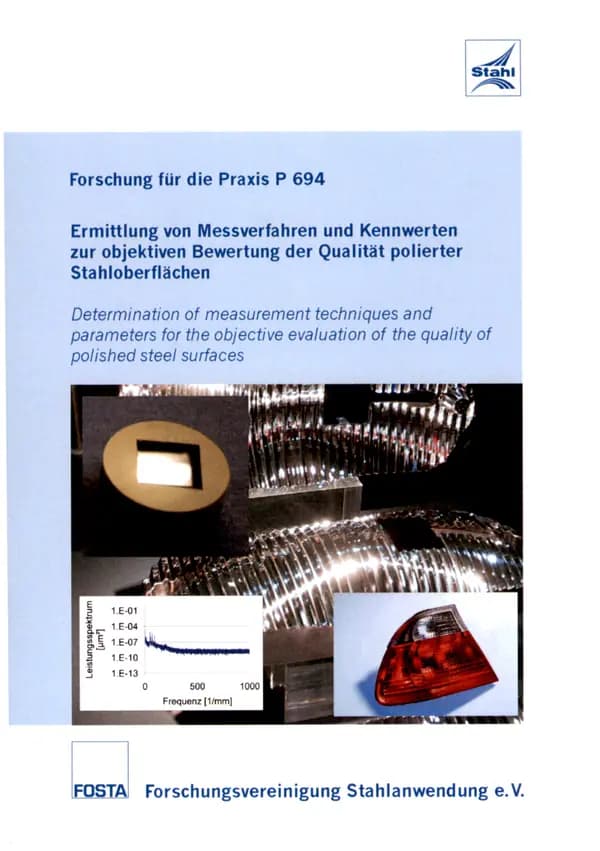
P 694 - Determination of measuring methods and characteristic values for the objective evaluation of the quality of polished steel surfaces Polishability as an application-relevant property of steel is an essential requirement with increasing importance, especially with regard to its use as mould steel. The demands on the quality of the products and, as a result, on the surface quality of the tools have increased considerably. It is currently extremely difficult to assess the polishability or polishing result because this has so far only been done subjectively and therefore visually. To date, it has not been possible to develop a procedure that provides generally valid, objective criteria for assessing polishing quality. As part of the work presented here, metrologically accessible identification parameters for an objective evaluation of the polishing result were developed and tested on the basis of machine- and hand-polished plastic mould steels. These show a good reproduction of the results of the visual assessments carried out and the experience of the polishability of different steel grades. Due to the required measurement accuracy and the associated frequency of measurement errors, the method described cannot yet be recommended as a standardised measurement method. However, individual tests are possible, taking into account existing shortcomings. With this, essential findings have been developed which, with an increase in the reproducible accuracy of surface profile measurement systems and their verification, provide steel manufacturers and, above all, steel users with a basis for standardising the definition of the polishability of steels, suggesting or selecting steel materials according to the required areas of application and objectively evaluating the polishing results achieved with regard to the material properties and the polishing process. Furthermore, the measuring method and the parameters offer an opportunity to investigate the correlations between material properties and polishability and thus to optimise the materials. The research project was carried out at the VDEh-Betriebsforschungsinstitut GmbH with technical support and financial assistance from the Forschungsvereinigung Stahlanwendung e. V., Düsseldorf, with funds from the Stiftung Stahlanwendungsforschung, Essen. Authors: O. Deutscher, H. J. Wieland Publication: 2009
available anytime
€20.00
excl. VAT

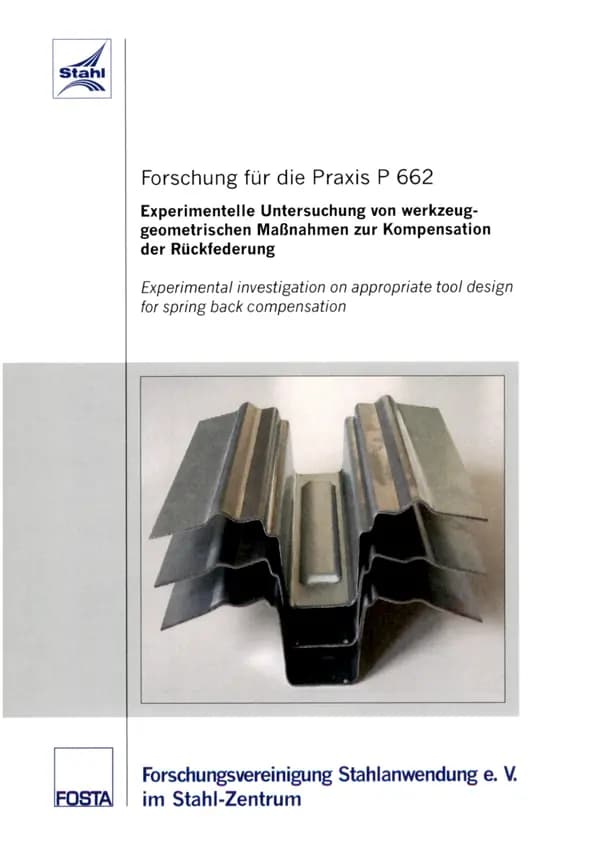
P 662 - Experimental investigation of mould geometry measures for springback compensation The demand for greater accuracy of car body parts is accompanied by increasing geometric and material complexity of the components. The complexity of the workpieces and the behaviour of high-strength multiphase steels (e.g. TRIP steels) make it difficult to predict the springback numerically and to control it reliably. Targeted geometric design of the active mould parts and the component geometry during the The aim is to achieve a reduction and compensation of springback through targeted geometric design of the active mould parts and the component geometry during the main forming process. The investigations in this research project focussed on the high-strength sheet metal material HCT690T, which was provided by three different manufacturers. The behaviour was examined, evaluated and validated on real demonstrator components using realistic model tests, taking into account the influencing variables. Based on an analysis of the state of the art, an evaluation of the workpiece and tool geometry measures was carried out and relevant geometries were specifically examined in the model tests. For the model tests, 2 test tools with geometric features similar to structural supports were used. These were a straight U-profile and a curved top-hat profile. The relevant geometries analysed were die steps, die radii, base fields/combining and drawing bars. The influence of hold-down force, lubrication and blank geometry were also analysed. The investigation of this large number of influencing variables required the use of statistical test planning methods. Following the experimental tests, the components were geometrically measured using optical measuring methods and the influence on the springback behaviour was determined in comparison with the target geometry. After an evaluation of the springback-reducing measures, the results were transferred to the demonstrator component, which in this case was a reinforcement part of a strut brace. Within this component, different geometric variants were analysed and assessed with regard to their springback. The material tests on the HCT690T were able to show the change in the modulus of elasticity with increasing pre-strain of the tensile specimen. For multiphase materials, this can be seen as one of the main causes of the increasing springback problem. Within the model tests, matrix steps, drawing bars and base fields proved to be an effective means of reducing springback in straight components. For curved profiles, the mould radii proved to be the most effective way of reducing springback. In the tests on the demonstrator component, the limited transferability of the results from the model tests could be proven and thus an improvement in springback could be achieved. Authors: R. Neugebauer, T. Lieber Publication: 2008
available anytime
€30.00
excl. VAT

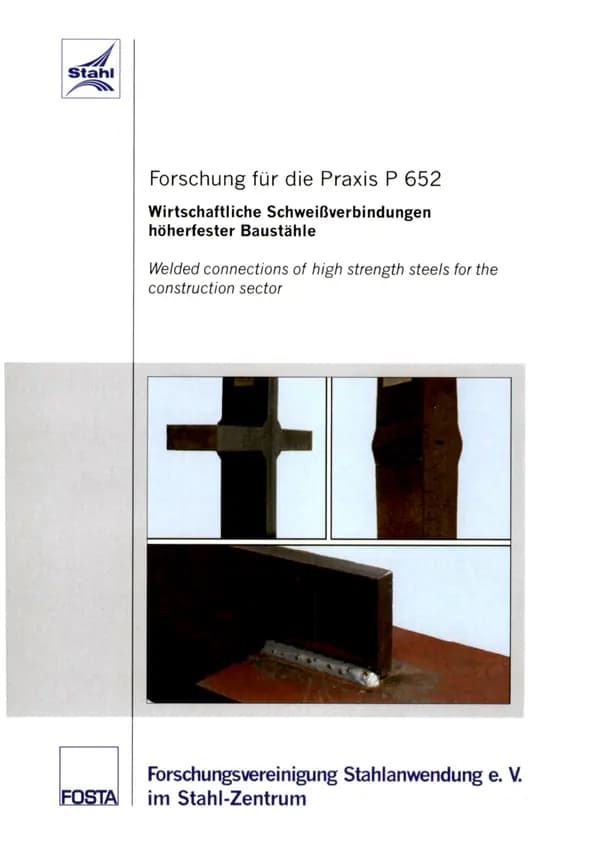
P 652 - Economical welded joints of high-strength structural steels Developments in steel construction are tending towards ever slimmer and lighter constructions made of structural steels with higher strength. The steel industry has developed steels for this purpose which, in addition to their higher strength, also have good welding properties and high toughness. However, the material saving potential of higher strength structural steels of strength classes S460 and S690 can only be insufficiently utilised in welded components due to the current standards. The aim of the research project was therefore to develop modern design, dimensioning and processing principles for welded joints of higher-strength structural steels in order to utilise higher-strength structural steels economically and at the same time conserve resources. To this end, extensive experimental and numerical investigations were carried out on the load-bearing capacity and brittle fracture resistance of non-through-welded plate, cross and butt joints made of high-strength structural steels of steel grades S460M/ML and S690Q/QL with plate thicknesses of 15, 20 and 50 mm. The focus was on investigating the influence of the combination of different strength ratios between base material and filler material (so-called mixed and mismatch joints) of MAG welded joints. A total of 326 tests were carried out to determine the load-bearing capacity at room temperature and 41 tests to determine the risk of brittle fracture at low temperatures (-40°C). Numerical welding simulations and residual stress measurements were used to determine the strength differences and residual stress states that occur locally during welding. These results support the evaluation of the load-bearing and fracture behaviour of the welded joints. On the basis of the investigations carried out, recommendations for the design of welded joints made of higher-strength structural steels with regard to load-bearing capacity and brittle fracture resistance could be derived, which, for example, lead to an increase in load-bearing capacity of 20% for steel grade S460M, while the existing normative load-bearing capacities could essentially be confirmed for steel grade S690Q. These recommendations are supplemented by information on requirements for proper production, e.g. with regard to the selection of suitable welding consumables and welding process parameters. The results of the research project thus contribute significantly to the optimised use of higher-strength structural steels in welded steel and plant engineering structures, in which, in addition to savings in material consumption, advantages can also be achieved through faster production as a result of reduced welding volume and lower assembly weights. The research results are being implemented as part of the revision of the design standards for steel structures. Authors: U. Kuhlmann, H. P. Günter, C. Rasche, F. Werner, J. Hildebrand, I. Wudtke, M. Vormwald, T. Beier, C. Versch, G. Köhler, H. Heinemann Publication: 2008
available anytime
€50.00
excl. VAT

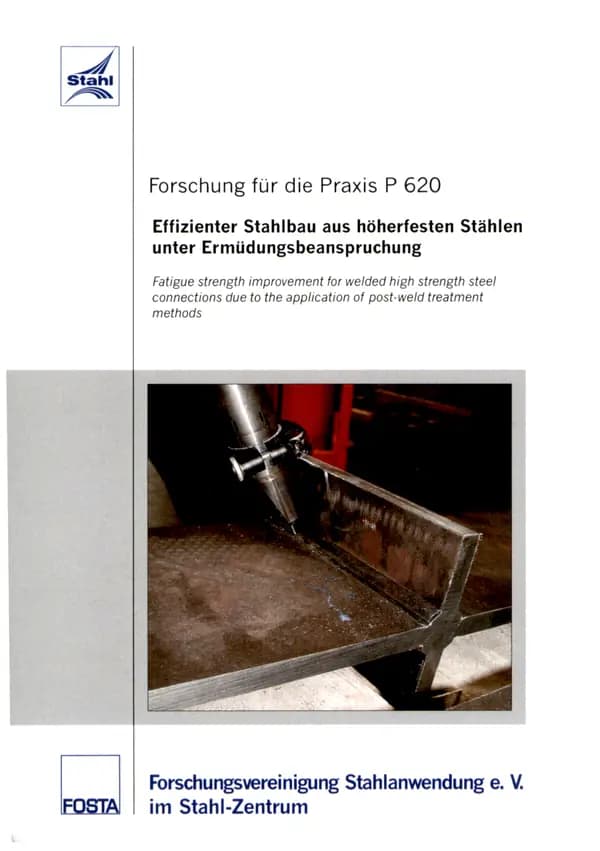
P 620 - Efficient steel construction from high-strength steels under fatigue loading The assessment of the fatigue strength of welded joints in the current standards in bridge construction is limited to the notch drop and the stress range and is independent of the yield strength. The use of higher-strength steels in welded structures therefore often offers no advantages in the case of high fatigue stresses. It is possible to effectively improve the fatigue strength of welded structures, especially those made of high-strength steels, by using post-weld treatment processes. In the construction industry, however, the use of weld post-treatment methods is still very limited, as the currently valid standards and the future European standards do not yet offer the possibility of utilising the advantages of these methods in structural design. The focus of this research project is on improving the fatigue strength of welded joints made of high-strength steels through the use of weld post-treatment processes. As part of a parameter study in composite road bridge construction, it was shown that an effective application of high-strength steels can be achieved through the locally limited use of post-treatment processes on critical construction details. Within the scope of this research project, the post-treatment processes TIG melting and the hitherto little-known post-treatment process "Ultrasonic Impact Treatment" (UIT) were used. Extensive experimental investigations on small and large test specimens demonstrated the effectiveness of both processes for improving fatigue strength on the construction detail of the welded-on transverse stiffener. The UIT process proved to be more effective for the higher-strength steel grade S690. In some cases, the improvement in fatigue strength was so high that the fracture initiation points shifted into the base material. In experimental tests on beams, the effectiveness of the UIT treatment was also demonstrated in components and at high medium stresses. Based on a systematic evaluation of existing test series, the existing regulations for the assessment of fatigue safety for the construction detail of the transverse stiffener left in the welded state and the existing recommendations for the application of the TIG fusion post-treatment process were confirmed. In addition, a design proposal based on the nominal stress concept for the application of the UIT process to the structural detail of the transverse stiffener was derived on the basis of the company's own experimental and numerical investigations. The results of this research project offer the possibility of using higher-strength structural steels in fatigue-stressed welded structures by means of a locally limited This results in a significant improvement in the marketability of welded structures. This results in a significant improvement in the market opportunities for steel construction compared to other construction methods. RESEARCH ASSOCIATION FOR STEEL APPLICATION e.V. Publication: 2006 Authors: Prof. Dr.-Ing. U. Kuhlmann, Dr.-Ing. A. Dürr, Prof. Dr.-Ing. Bergmann
available anytime
€40.00
excl. VAT
Payment by card (Stripe) or invoice (DE, AT, CH). Download link by email: automatically after ordering by card, after order approval for invoice (valid for 30 days). Terms