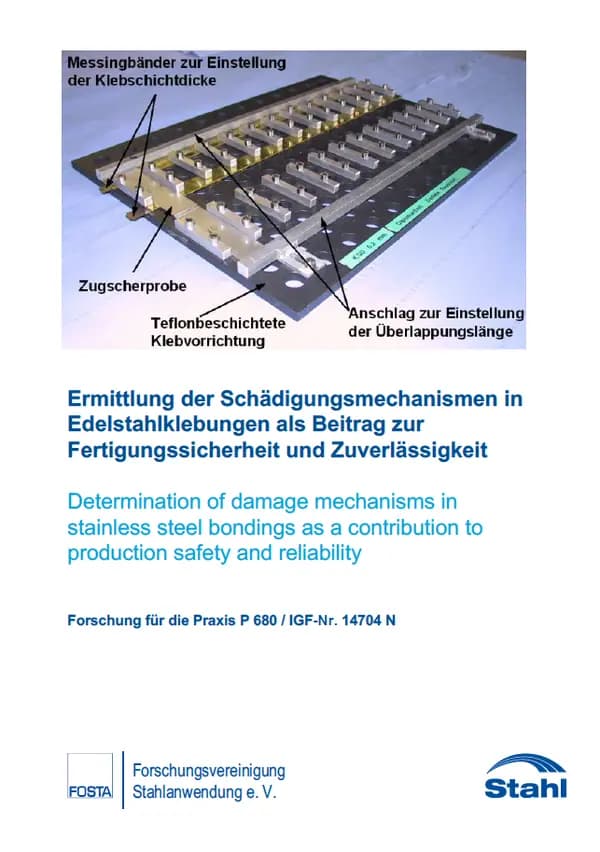
The aim of the project was to "Determine the damage mechanisms in stainless steel bonds as a contribution to production safety and reliability". It thus directly follows on from the topic of the previous project …
The aim of the project was to "Determine the damage mechanisms in stainless steel bonds as a contribution to production safety and reliability". It thus directly follows on from the topic of the previous project "Bondability of stainless steel in automotive engineering". The focus was on investigating the ageing resistance of bonds made of stainless steel materials with heat-curing epoxy resin adhesives (dicyandiamide as hardener) and on differentiating the influencing variables on the ageing progress. A new test scheme was developed to investigate the stochastic localised adhesive failure of stainless steel bonds that occurred in the previous project.
In the event of locally occurring changes in the adhesive strength of individual tensile shear specimens, it enables the substrates to be assigned to the exact removal position (platinum number and position on the panel). In the event of deviating mechanical behaviour of individual test specimens, the surrounding areas can thus be made accessible for targeted surface analysis measurements to clarify the cause. However, the stochastically occurring delamination of individual samples observed in previous investigations (e.g. P 553) was not reproduced in this project. Only one sample (i.e. 1 ‰ of the total sample quantity) showed a macroscopically adhesive fracture pattern, whereby the residual strength was still 80 % of the sample average. The fracture surface analysis showed a disturbed cross-linking in the boundary layer between substrate and adhesive. Against this background, it is assumed that the process reliability of adhesive bonding of materials made of corrosion-resistant steel materials is given if the cross-linking conditions are optimised. Regardless of the epoxy adhesive system investigated, two different damage mechanisms were identified. On the one hand, physical and chemical-structural changes in the adhesive polymer are observed under warm and humid ageing conditions. Secondly, ageing conditions at moderate temperatures and exposure to moisture in the presence of chloride ions lead to adhesive-stimulated corrosion of the substrate at the polymer-metal interface.
Payment by card (Stripe) or invoice (DE, AT, CH). Download link by email: automatically after ordering by card, after order approval for invoice (valid for 30 days). Terms
Machine-translated title and description. The document itself is in German.
Digital download
Payment by card (Stripe) or invoice (DE, AT, CH). Download link by email: automatically after ordering by card, after order approval for invoice (valid for 30 days). Terms
Other parts and editions as well as neighbouring documents of the same series.

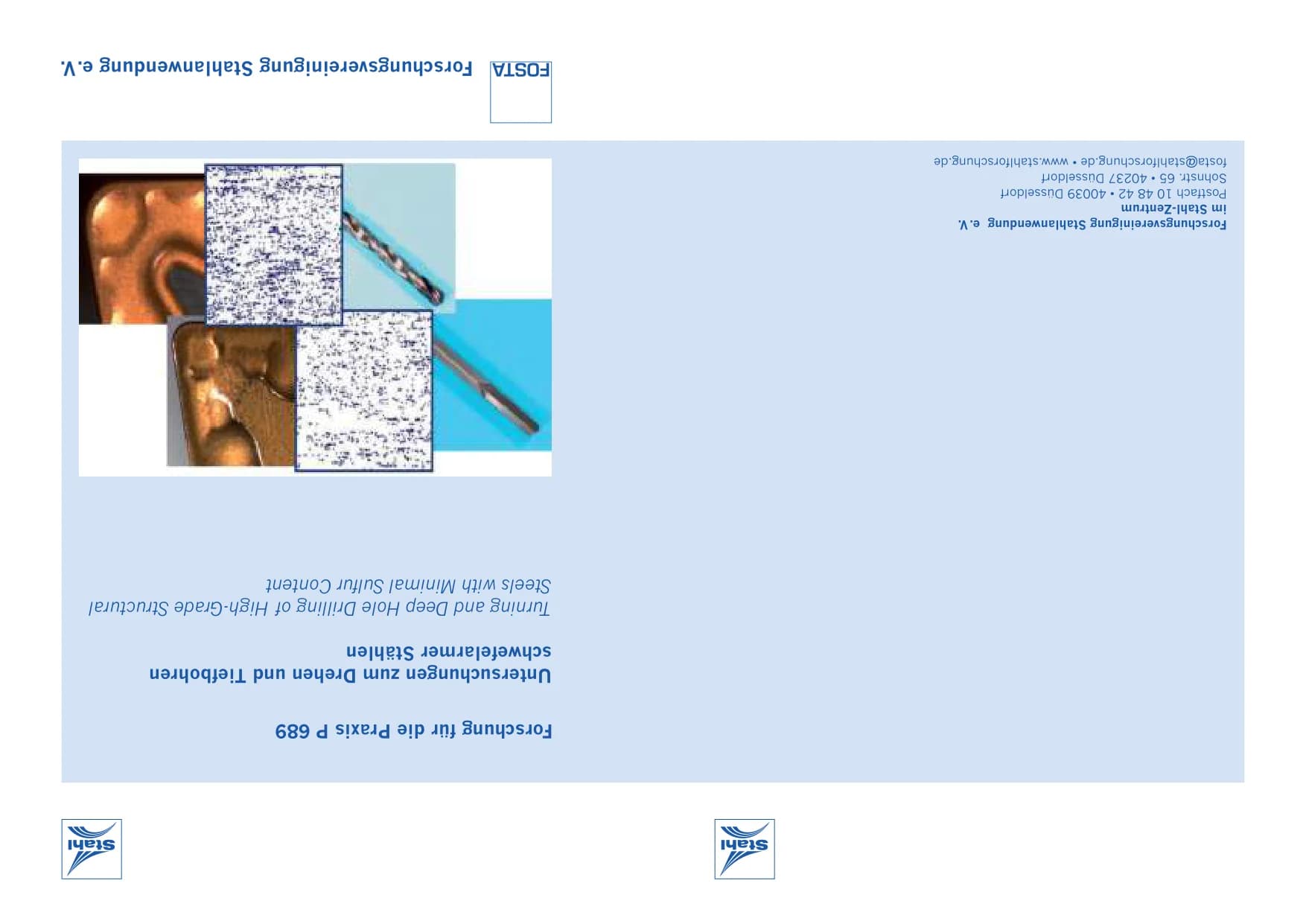
P 689 - Investigations on turning and deep drilling of low-sulphur steels The necessary properties of steel materials can be derived from the requirements in automotive, mechanical engineering and plant construction. If the highest mechanical requirements have to be met, it is advantageous to reduce the sulphur content of engineering steels, as the influence of the sulphur content on the reduction of fatigue strength and fracture toughness is known from numerous studies. In contrast, the machinability is positively influenced by high sulphur contents. Tool wear is reduced and chip breaking is more favourable. As part of this research project, the machining of lightly sulphur-alloyed and low-sulphur engineering steels was analysed in order to work out the influence of the sulphur content in detail. The manufacturing processes of turning and deep drilling with twist drills and single-lip drills were analysed. The influence of sulphur was determined with regard to the most important criteria of process behaviour. Both tool-related and workpiece-related parameters were analysed. The possibility of compensating for the influence of sulphur was investigated by varying the tool design, the cutting values and the cooling lubricant concept. The experimental investigations were substantiated by further tests, which were largely adapted to the boundary conditions of industrial production. The optimisation potential of machining low-sulphur steels was confirmed by using tools and cutting values from industrial processes. The results of the turning process show that the sulphur content has only a minor effect on tool wear. For numerous test points, comparable wear behaviour was observed when machining the normal sulphur-containing grade compared to the low-sulphur grade. This could be determined by recording the wear, but also the cutting force. The influence of sulphur on chip breaking is clear. When machining the low-sulphur steels, a process-favourable chip breakage could not be observed for all cutting value combinations. However, it is possible to compensate for the influence of the sulphur content by adapting the shape of the indexable insert and the feed rate. The results of the deep hole drilling tests show comparable effects of the sulphur content on turning with regard to tool wear and chip breaking. In deep hole drilling, the chip shape can be improved by adjusting the grinding and chip topography. In addition to the sulphur content, there are significant differences in process behaviour and hole quality due to the deep hole drilling concept. Twist drills are suitable for high feed rates that enable high productivity. Polished flutes and adapted cutting edge contours produce favourably shaped chips even when machining low-sulphur steels. The main advantage of the single-lip deep hole drilling tools lies in the good hole quality, which is characterised in particular by a low centre run-out and a low-defect surface. Overall, the results show that turning and deep hole drilling can also be designed efficiently for machining low-sulphur steels. As part of this study, the necessary process knowledge was determined to enable productive machining of low-sulphur steels. The research project was carried out at the Institute of Machining Technology, Technical University of Dortmund, Robert Bosch GmbH, Stuttgart, Deutsche Edelstahlwerke GmbH, Siegen and Witten sites, Swiss Steel AG, Emmenbrücke, and Saarstahl AG, Völklingen, with technical support and financial assistance from the Forschungsvereinigung Stahlanwendung e. V., Düsseldorf, with funds from the Stiftung Stahlanwendungsforschung, Essen. Authors: D. Biermann, K. Weinert, F. Felderhoff, K. Klenke, J. Krause, W. Hockauf, E. Wüstner, H. Roelofs Publication: 2009
available anytime
€30.00
excl. VAT