For stainless CrNi steels, the process variant of flux-free brazing using a laser beam was to be investigated. It was disputed whether this group of materials could be safely brazed using this method due to the …
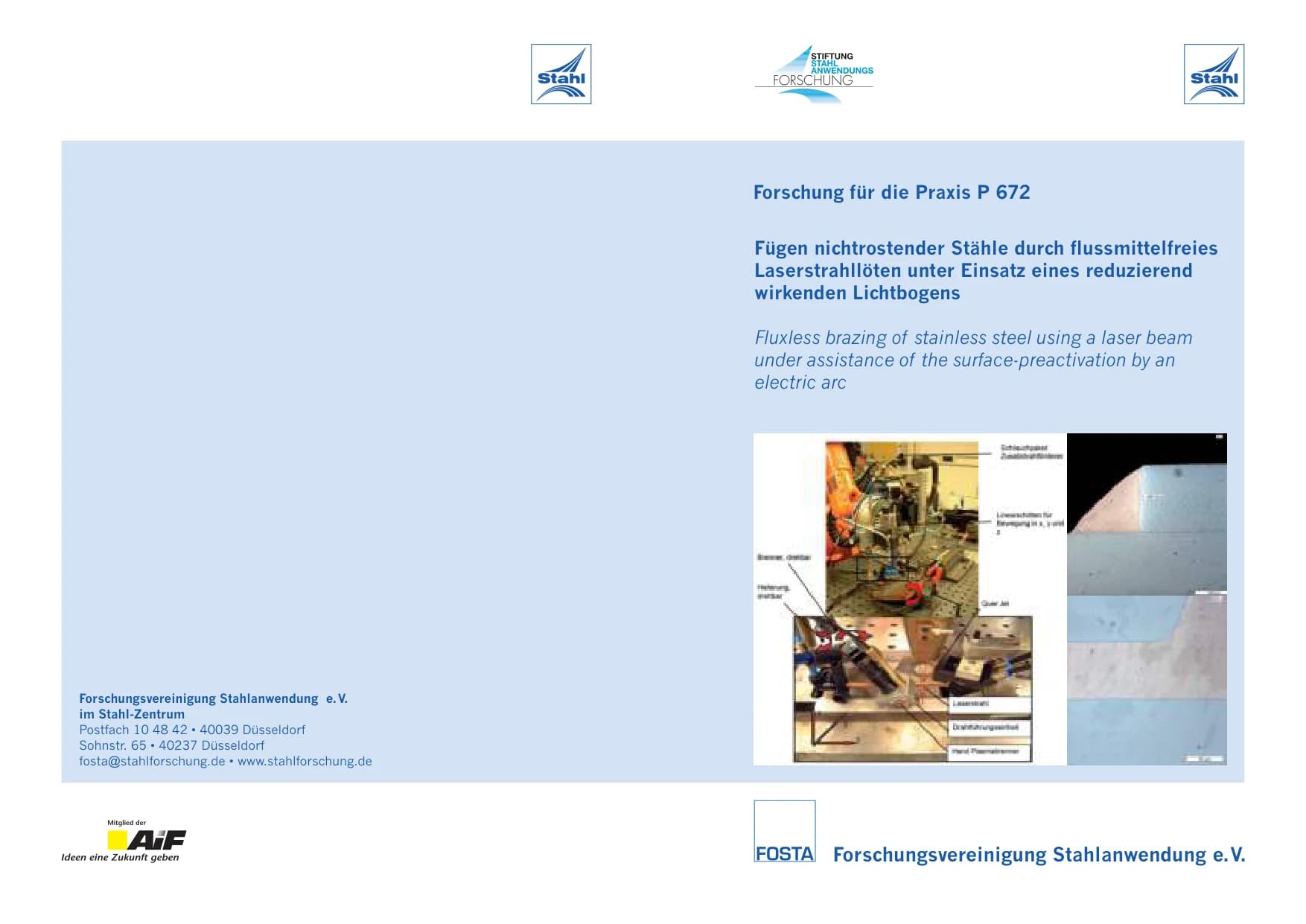
For stainless CrNi steels, the process variant of flux-free brazing using a laser beam was to be investigated. It was disputed whether this group of materials could be safely brazed using this method due to the naturally forming stable passive layer. An attempt was to be made to use a leading TIG or plasma arc to support surface preactivation. Preliminary tests have shown that this appears to improve solder wetting on the CrNi steel. If the use of laser beam brazing on CrNi sheets can be made more reliable, the typical technological advantages of laser beam technology, such as high process speed, low heat input, high reproducibility and automation capability, could also be utilised for this material group.
For this purpose, test series were carried out on CrNi sheets of different alloy types with a thickness of 0.5 mm to 2 mm. A 6 kW CO2 laser, a 500 W or a 3 kW Nd:YAG laser were used. A TIG or plasma arc preceding the laser beam was used to destroy the passive layer ("pre-activation"). Despite the wetting-promoting effect of the arc, no further progress was made due to partly contradictory physical mechanisms, so that the use of an arc for improved solder wetting was not pursued alone. At the same time, attempts were made in further test series to develop the basis for directly pre-activating the surfaces to be wetted using the energy of the laser beam. Using this principle, the brazed joints documented in the report could ultimately be produced without an additional activating arc, but only after careful adjustment of the system parameters within a specific and relatively narrow process window. In the most favourable case, the strength properties of the brazed joint corresponded to the strength of the base material. Solder cracking (penetration of the solder along the grain boundaries into the base material) was only partially detected and then only to a very shallow depth. The series of tests made it possible to identify and demonstrate in relative detail the influence of the individual process parameters on the formation of the brazed joint. This makes it possible to demonstrate the application possibilities, but also the narrow limits and weak points of this process variant. The results of this research work provide numerous indications that could support the use of laser brazing technology in terms of flux-free processing of high-alloy stainless CrNi steels or even improve its quality. Although the supporting effect of an arc could be demonstrated to improve wettability by the solder, the results of the investigation also show that direct utilisation of the laser beam instead of a separate arc for surface activation is possible under production conditions. The research project was carried out at the Schweißtechnische Lehr- und Versuchsanstalt SLV Duisburg, a branch of GSI mbH, Duisburg and the Pforzheim University of Applied Sciences, Department of Mechanical Engineering, Department of Production Technology, Pforzheim, with technical support and financial assistance from the Forschungsvereinigung Stahlanwendung e. V., Düsseldorf, with funds from the Stiftung Stahlanwendungsforschung, Essen.
Payment by card (Stripe) or invoice (DE, AT, CH). Download link by email: automatically after ordering by card, after order approval for invoice (valid for 30 days). Terms
Machine-translated title and description. The document itself is in German.
Digital download
Other parts and editions as well as neighbouring documents of the same series.

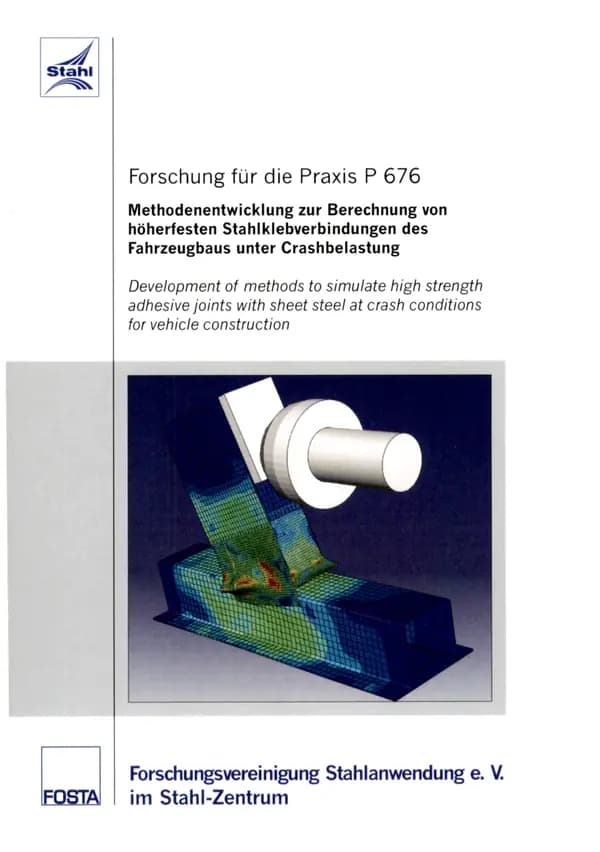
P 676 - Method development for the calculation of high-strength steel adhesive joints in vehicle construction under crash load Structural bonding technology with high-strength steel sheets is playing an increasingly important role in automotive engineering. Calculation and simulation methods for the design of bonded structures, especially under crash loading, are indispensable for new developments. In this research project, material models and simulation methods were developed and implemented that enable the numerical simulation of the stress and failure behaviour of bonded joints under crash load for the first time. Two approaches were taken: continuum mechanical models provide the basis for local consideration of the bonded joint, while simplified equivalent models facilitate prompt implementation in industrial applications. Both physically based formulations and combinations with empirical approaches for the speed dependence of plastic flow and failure are available as continuum mechanics-based approaches. The finite element modelling requires several elements over the adhesive layer thickness. For the equivalent modelling, special interface elements or simplified representations of the adhesive joint with a volume element over the adhesive layer thickness were selected. As the simplest approximation, a bi-linear equivalent model with a fracture mechanically motivated failure approach was used. The progress made in simulation technology during the project also enabled a deeper and better understanding of the tests to be carried out at high test speeds to determine the characteristic values. In some cases, improvements to the testing technology were already made during the project as a result of the simulation results. It was possible to understand the effects of inertia on the measurement signals. The research report is organised in such a way that it can be read in sections based on the headings. The various modelling approaches are described independently of each other. The presentation of the tests to determine the characteristic values and the modelling approaches is followed by the validating tests and simulations on the KSII specimen, the T-joint, the B-pillar and the door shaft reinforcement. The last main chapter contains various in-depth aspects of the calculation and testing of the KSII specimen and other basic tests, parameter identification, implementation and the critical time step. Authors: M. Brede Publication: 2008
available anytime
€70.00
excl. VAT

P 667 - Gas-shielded welded steel structures of low wall thickness from the automotive industry" in the cluster "Applicability of strength concepts for welded components subject to vibration loads Today, the nominal stress, structural stress and notch stress concepts are mainly used to estimate the service life of welded joints subjected to vibration. The aim of the AiF cluster "Applicability of strength concepts for welded components exposed to vibration" was to analyse the available strength concepts: - Investigate the available strength concepts with regard to application limits and reliability as well as consistency and compatibility, the - increasing the accuracy of service life estimates for welded components and simplifying the - simplifying the selection of the most appropriate design concept. Applications from the rail vehicle, automotive, mechanical engineering and shipbuilding industries were investigated in 6 projects in 5 research institutes, funded by 5 member organisations of the German Federation of Industrial Research Associations (AiF), Figure 1.1. Nine components were examined in detail. Frequent meetings of experts were held to coordinate and exchange experiences across the various sectors. Publication: 2015 Authors: DVS Prof. Dilger
available anytime
€30.00
excl. VAT

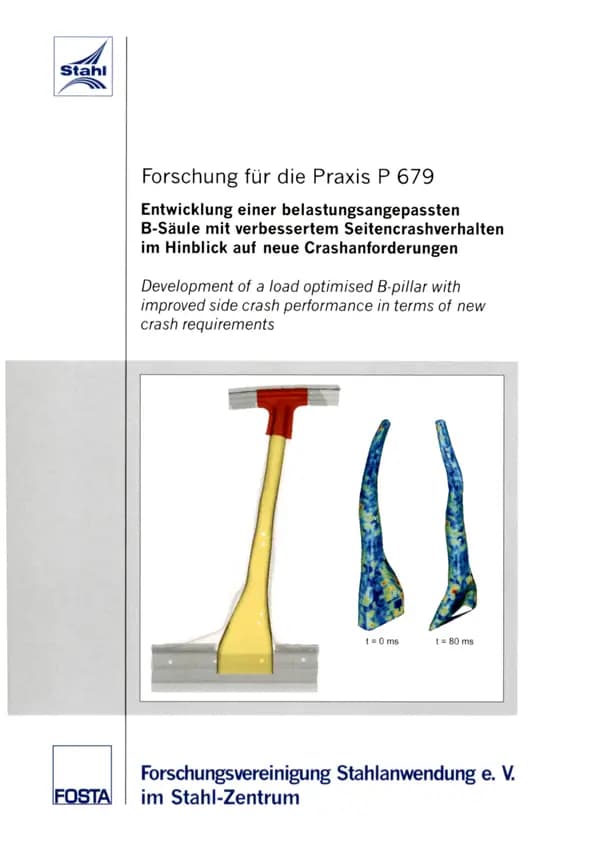
P 679 - Development of a load-adapted B-pillar with improved side crash behaviour with regard to new crash requirements The significance of the side impact of passenger cars for the risk of injury and accident severity has been proven in numerous studies. Due to changes in barrier heights in IIHS (Insurance Institute for Highway Safety) side crashes, the sill and floor pan are no longer essential elements for absorbing energy in a side crash, meaning that the B-pillar, among other things, will have to absorb a significantly greater proportion of the crash energy in future. In order to fulfil the increased requirements, the potential of a new design of the B-pillar in combination with innovative semi-finished products (final contour-adapted Tailor Rolled Tubes (TRT) and Tailor Welded Tubes (TWT)) in hydroforming has been investigated. The aim of the project was to reduce the required number of parts and weight while maintaining identical performance compared to a current series B-pillar and to determine a method for the numerical design of the new process chain. The Mercedes-Benz C-Class W203 was used as a reference vehicle. In order to compare the new design with the reference B-pillar, a specification sheet was developed based on the W203. In addition to the package, the connections and the joining processes, the specifications also defined possible materials for the new design. The determination of flow and forming limit curves made it possible to predict the material behaviour and failure in the simulation with the explicit solver of LS-DYNA. In order to save costs for a side crash, a component crash was developed that simulates the IIHS side crash very well. With the help of experiments in the IHU tool system of the atlas spaceframe project and the developed component test, a consistent modelling was developed that reproduces the real behaviour of the materials very well. This provided virtual models of the process chain and the component test, which were used to design the new concept. Failure-free manufacturability of the new designs could be proven numerically. However, this required a slight deviation from the specifications, so that the functional surface for connecting the upper door hinge was shifted by 10 mm in the plane. All other requirements of the specifications were met. The optimisation of the wall thickness distribution of the tailored tubes enabled an average weight reduction of 40% with identical performance to the series B-pillar. The cost-benefit analysis based on the ULSAB cost model further emphasised the great potential of the new process chain. In addition to the weight, the production costs were also reduced. The significant reduction in the number of components required from 9 in the series B-pillar to 2 in the new design more than compensated for the rising costs for the semi-finished products and the more cost-intensive joining by laser welding. The new process chain of near-net-shape tailored tubes and hydroforming can therefore be modelled numerically. The objective of determining a method for the numerical design of the process chain, taking into account the forming history and a predefined specification sheet, was achieved. With the help of this method, the potential of the process chain could be demonstrated. The use of higher-strength near-net-shape tailored tubes in combination with hydroforming in B-pillars enables a significant weight reduction with identical performance in the IIHS side crash at slightly lower costs. Authors: G. Hirt, M. Urban, H. Wallentowitz, R. Henn Publication: 2007
available anytime
€30.00
excl. VAT
Payment by card (Stripe) or invoice (DE, AT, CH). Download link by email: automatically after ordering by card, after order approval for invoice (valid for 30 days). Terms