Lightweight construction is becoming increasingly important for economic and ecological reasons, particularly in vehicle construction, in order to reduce the body weight and thus the fuel consumption of vehicles, while …
Lightweight construction is becoming increasingly important for economic and ecological reasons, particularly in vehicle construction, in order to reduce the body weight and thus the fuel consumption of vehicles, while at the same time maintaining high quality standards in terms of safety, ergonomics and comfort. Multi-cell sheet metal structures made of sheet steel are lightweight, flat lightweight composite structures that can be used in many areas of application to replace conventional, flat components made of solid sheet metal. In light commercial vehicle construction in particular, there is great potential for saving weight in the large sheet metal components used and - in view of the legal restrictions on the maximum weight of commercial vehicles - reducing the unladen weight and thus increasing the payload.
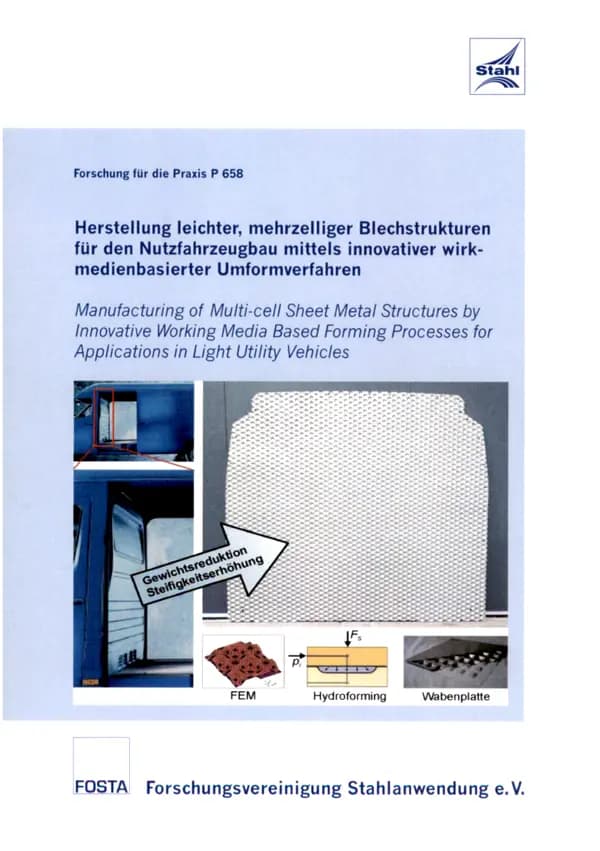
Due to their specific component properties, honeycomb panels made of sheet steel represent an economically and technologically attractive solution for flat, small-surface parts in vehicle construction. However, these composite sheets are only suitable to a limited extent for large-area applications, as they have to be joined with overlaps, which can lead to an undesirable increase in the number of parting lines and thus to higher production costs and an increased tendency to corrosion. As part of this research project, a production technology was developed that makes it possible to produce large-area cusp plates without parting lines with high component quality using forming processes based on active media. The realised forming tool allows the production of cusp plates with different widths at almost any length of a honeycomb plate shape. The cusp plates produced were then joined to form large-format composite sheets (honeycomb panels). The structural design of the cusp geometry and plate structure with regard to the specific requirements of the specifications of selected components was carried out using FE simulation and comparative forming tests with small tools. Cusp plates with a hexagonal cusp structure and two different cusp depths (4 and 8 mm) were produced. The sheet widths were up to 1,800 mm with a length of over 2,000 mm. Spot welding and bonding processes were used to join the cusp sheets into honeycomb panels. Water jet cutting proved successful for contour cutting of the bump plates. The experimental investigations showed a high degree of process robustness of the active media-based forming processes used. The components produced exhibited a high level of contour accuracy, which is a prerequisite for a good fit between two cusp plates during the joining process. In addition, the sheets showed high rigidity and a high degree of uniform plasticisation of the material in the formed areas. The FE-based and experimental investigations presented in the report address the following topics: - the design and manufacture of cusp plates by means of hydroforming (liquid moulding medium) and by hollow stamping (elastic moulding medium) - Joining technologies for bump plates - the resulting semi-finished product properties - the production of prototypes for two selected applications The application potential of small and large-format honeycomb sheets in the field of commercial vehicle construction has been demonstrated by the production of a van partition wall and a gearbox cover element and by means of investigations into their application behaviour. Compared to conventional solid sheet metal components, weight savings of 20% (partition wall) and 55% (transmission cover element) were achieved with the prototypes made from honeycomb panels. A supplementary economic evaluation of the semi-finished product and the "hydroforming - joining" process chain also shows the economic potential of this technology. The research project was carried out by the Institute of Forming Technology and Lightweight Construction, Technical University of Dortmund, in co-operation with borit Leichtbau-Technik GmbH, Daimler AG, EvoBus GmbH, ThyssenKrupp Steel AG and Volkswagen AG with technical support and financial support from the Forschungsvereinigung Stahlanwendung e. V., Düsseldorf, with funds from the Stiftung Stahlanwendungsforschung, Essen.
Payment by card (Stripe) or invoice (DE, AT, CH). Download link by email: automatically after ordering by card, after order approval for invoice (valid for 30 days). Terms
Machine-translated title and description. The document itself is in German.
Digital download
Other parts and editions as well as neighbouring documents of the same series.

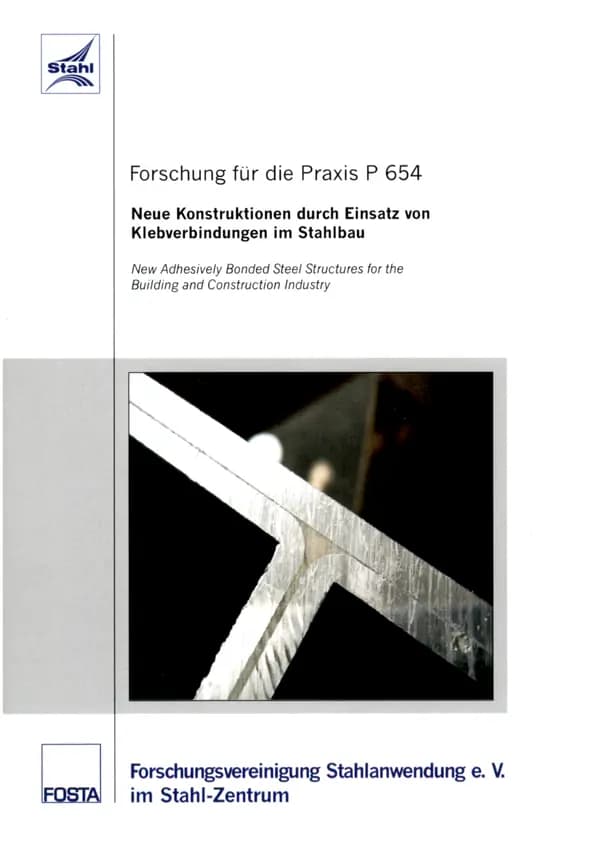
P 654 - New constructions through the use of adhesive bonds in steel construction Adhesive bonding still plays a subordinate role as an alternative to structural joining techniques in steel construction, despite the wide range of possible applications. In many cases, the relatively new technology of "adhesive bonding" in the construction industry can not only hold its own economically and technologically against existing established joining techniques, but also offers many advantages. Potential fields of application arise in particular where the technical and economic limits of conventional joining techniques have been reached. The research project presented here aims to contribute to the establishment of adhesive bonding in steel construction. As part of this research project, exemplary structures from bridge construction and façade construction were selected as fields of application for bonded joints: Bonded sandwich carriageway slabs for road bridges were developed and investigated as a representative of the area of "infrastructure structures". In addition to the adhesive-compatible design and dimensioning, comprehensive numerical and analytical calculations were carried out. The load-bearing behaviour and production processes of the bonded roadway slabs were also analysed experimentally using large-scale demonstrators and small samples. For bridge construction, this opens up the possibility of using these new, highly resilient bonded steel carriageways to overcome the limits that conventional orthotropic carriageway slabs have reached. In the field of steel façade construction, two potential applications of adhesive bonding technology were the subject of the investigations. The first application focussed on the adhesive reinforcement of hollow profiles in mullion-transom façades. As a second adhesive application in steel façade construction, a bonded alternative for fastening trapezoidal steel profiles in the façade area was investigated. The load-bearing capacity of bonded connections was demonstrated in tests and the system parameters were optimised on the basis of theoretical investigations with regard to increasing the load-bearing capacity. A representative range of commercially available products was available for the selection and characterisation of possible adhesive systems for use in structural steelwork. In addition to the mechanical properties, the processing and application behaviour of the adhesive systems, which are decisive for their possible use in steel construction, was also investigated. In particular, the preparation of the surfaces and the influence of corrosion protection measures were also analysed. In order to be able to fulfil the building inspection requirements placed on bonded structures, monitoring systems were developed as part of the project that allow continuous and cost-effective monitoring of the bonded joints. The production of bonded steel structures requires a certain amount of rethinking in the execution. Particular importance must be attached to the preparation of the bonded surfaces. The experience gained in this project shows that neither the existing mixing systems nor the options for fixing the joining partners are currently sufficient for the production of large components such as the bridge deck presented. Further production processes must be developed here must be developed, taking into account construction site or workshop production. Furthermore, it must be ensured that the work is only carried out by trained specialist personnel with accompanying production measures for control and quality assurance. It has been demonstrated that bonded components can be considered equivalent to other construction methods. It was shown that bonded constructions can be realised in steel construction and represent a durable form of construction if executed appropriately. In future, the potential of adhesive bonding in steel construction should be demonstrated by means of selected pilot projects, the aim of which must be to systematically reduce the existing reservations and obstacles regarding structural adhesive bonding. Authors: H. Pasternak, J. Meinz, M. Feldmann, B. Völling, B. Abeln, K. Dilger, S. Böhm, M. Ullmann, T. Ummenhofer, J. Medgenberg , P. L. Geiß, A. Wagner, F. J. Heise Publication: 2008
available anytime
€50.00
excl. VAT

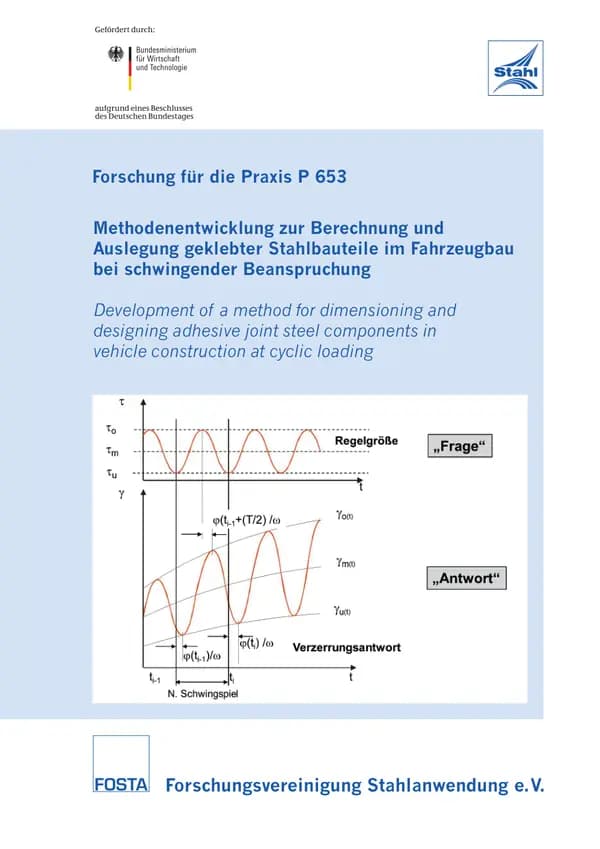
P 653 - Method development for the calculation and design of bonded steel components in vehicle construction under vibrating loads The structural bonding of steel sheets, which is now state of the art, is becoming increasingly important due to the introduction of new high-strength steel grades in vehicle construction, the desired lightweight construction and the demand for optimum material utilisation. In addition, adhesive bonding technology is ideal for realising mixed construction methods and reducing manufacturing and operating costs thanks to its high level of automation and other advantages. Adhesive bonding technology is therefore a technology of the future. The widespread use of adhesive bonding for highly stressed components and structures is only possible in those branches of industry that aim for either rapid development of their series products or individual production with a long service life if calculation and numerical simulation, as the essential development tool of modern industrial production, are possible and deliver reliable results. One of the main types of stress that leads to damage and failure in vehicle construction is the vibrational stress of individual components, i.e. component fatigue. The following three approaches were used in this research project to design bonded joints to be resistant to fatigue failure: Based on the structural stress concept for compact metallic materials and welded joints, the fatigue strength of a bonded component could be determined with good success from the results of Wöhler tests on bonded samples within the scatter range of the results. Due to the large scattering of results in the case of vibrational stressing of bonded joints and the associated long test and machine utilisation times, the time-temperature superposition principle originating from polymer mechanics was investigated on bonded joints as a shortcut and the shift factors determined in short-term tests were also successfully transferred to the fatigue strength of the joints. Finally, in the most extensive part of the project, the mechanical behaviour of samples subjected to vibrational stress was investigated experimentally with adhesive layer deformation measurements (so-called hysteresis measurements) at constant stress amplitudes, evaluated with mathematical models and formulated for implementation in FEM programs. A key result of these investigations was the relatively high creep tendency of the investigated viscoplastic epoxy resin adhesive, which leads to rapid failure of the joint when the tertiary creep stage is reached. The research project (IGF No. 141 ZN) was carried out at the Fraunhofer Institute for Manufacturing Technology and Applied Materials Research (IFAM), Bremen, Laboratory for Materials and Joining Technology (LWF), University of Paderborn, Institute for Materials Technology (IfW), Composites and Material Composites, University of Kassel, with financial support from the German Federation of Industrial Research Associations "Otto von Guericke" e. V. (AiF), Cologne, with funds from the Federal Ministry of Economics and Technology (BMWi), Berlin. Authors: O.D. Hennemann, M. Brede, C. Nagel, O. Hahn, J. Jendmy, D. Teutenberg, M. Schlimmer, K.M. Mihm Publication: 2012
available anytime
€60.00
excl. VAT

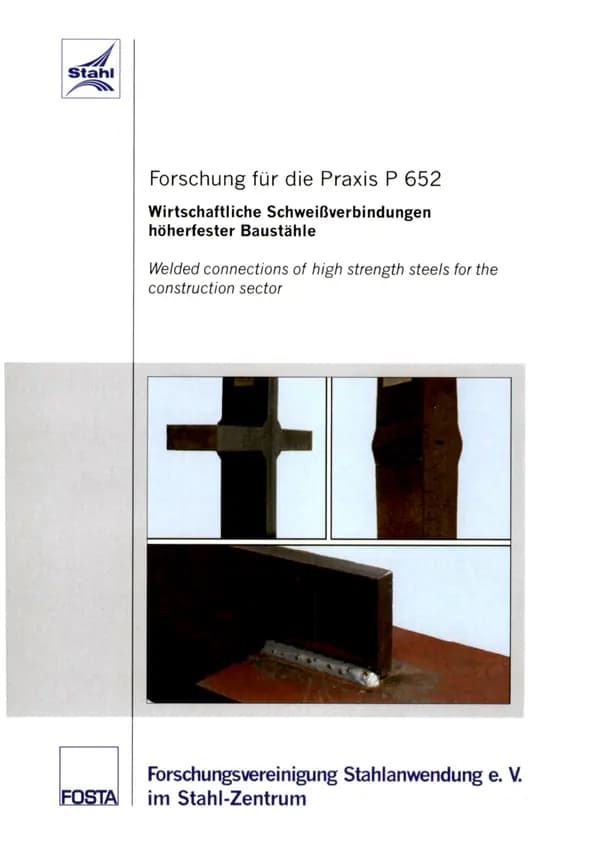
P 652 - Economical welded joints of high-strength structural steels Developments in steel construction are tending towards ever slimmer and lighter constructions made of structural steels with higher strength. The steel industry has developed steels for this purpose which, in addition to their higher strength, also have good welding properties and high toughness. However, the material saving potential of higher strength structural steels of strength classes S460 and S690 can only be insufficiently utilised in welded components due to the current standards. The aim of the research project was therefore to develop modern design, dimensioning and processing principles for welded joints of higher-strength structural steels in order to utilise higher-strength structural steels economically and at the same time conserve resources. To this end, extensive experimental and numerical investigations were carried out on the load-bearing capacity and brittle fracture resistance of non-through-welded plate, cross and butt joints made of high-strength structural steels of steel grades S460M/ML and S690Q/QL with plate thicknesses of 15, 20 and 50 mm. The focus was on investigating the influence of the combination of different strength ratios between base material and filler material (so-called mixed and mismatch joints) of MAG welded joints. A total of 326 tests were carried out to determine the load-bearing capacity at room temperature and 41 tests to determine the risk of brittle fracture at low temperatures (-40°C). Numerical welding simulations and residual stress measurements were used to determine the strength differences and residual stress states that occur locally during welding. These results support the evaluation of the load-bearing and fracture behaviour of the welded joints. On the basis of the investigations carried out, recommendations for the design of welded joints made of higher-strength structural steels with regard to load-bearing capacity and brittle fracture resistance could be derived, which, for example, lead to an increase in load-bearing capacity of 20% for steel grade S460M, while the existing normative load-bearing capacities could essentially be confirmed for steel grade S690Q. These recommendations are supplemented by information on requirements for proper production, e.g. with regard to the selection of suitable welding consumables and welding process parameters. The results of the research project thus contribute significantly to the optimised use of higher-strength structural steels in welded steel and plant engineering structures, in which, in addition to savings in material consumption, advantages can also be achieved through faster production as a result of reduced welding volume and lower assembly weights. The research results are being implemented as part of the revision of the design standards for steel structures. Authors: U. Kuhlmann, H. P. Günter, C. Rasche, F. Werner, J. Hildebrand, I. Wudtke, M. Vormwald, T. Beier, C. Versch, G. Köhler, H. Heinemann Publication: 2008
available anytime
€50.00
excl. VAT

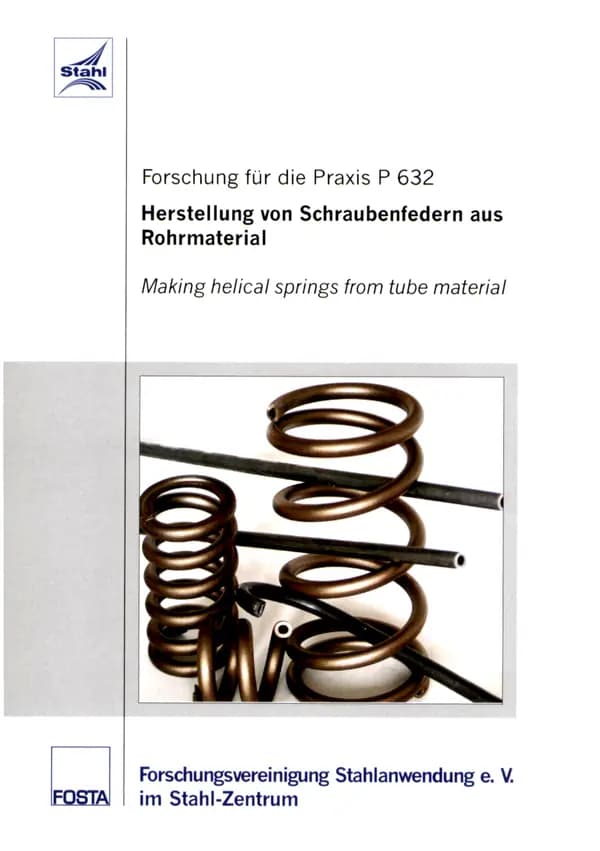
P 632 - Manufacture of coil springs from tubular material Coil springs are essentially subjected to torsion. The material near the wire axis remains largely unutilised. By using tubular material, it is possible to reduce the spring mass by 20 - 40 % while retaining the same spring function. The prerequisite for this substitution is the availability of high-quality tubular material with similar strength properties to spring steel wire. A seamless tube made of 70Mn7 steel was used in the research project. To create the continuous transformation diagrams, the required cooling curves were determined, hardness measurements were carried out and microsections were made to determine the microstructure. The pipe material was available in different dimensions and treatment states. The exact dimensions, surface roughness and mechanical characteristics were determined in the tensile test. Metallographic analyses were also carried out. Based on the results of the wire tempering tests, the temperature range for pipe tempering was narrowed down to tempering temperatures between 350 and 500°C. It was determined that the tube should be formed into a spring in the soft state and then tempered to the desired strength. From the results of roughness measurements, it could be clearly concluded that only drawing with an internal mould leads to an internal surface that is suitable for the production of a dynamically loaded Bourdon tube. In addition, the inside of one part of the tube was peeled between two drawing stages. The final tube dimension was 10 x 2.0 mm. To test the springs, two geometries (w = 8 and w = 5) were produced using two forming technologies: coiling and winding. During coiling, a slight cross-sectional deformation of the tube was observed due to the pressure of the feed rollers and the bending of the tube on the circular arc. The subsequent treatment consisted of hardening the spring, tempering, shot peening and tempering again. The end coils of some of the springs were ground. The heat treatment was carried out in such a way that a strength of Rm approx. 1700 MPa was achieved. The spring test involved determining the characteristic curve, relaxation behaviour and fatigue strength. The latter was intended to show that springs made of tubular material are generally also suitable for use under oscillating loads (influence of the inner surface). The load change tests were carried out with a stroke stress (corrected) of 650 MPa (?ku = 300 MPa, ?ko = 950 MPa). The best test results were achieved with springs with non-ground end coils made of internally peeled tube. Load cycles of up to 14 million were achieved without breakage. The springs made of non-peeled tube showed failures under 100,000 load cycles. The cause of breakage was due to the inadequate quality of the inner surface. In the springs with ground end coils, the end coils broke. Further necessary and promising research directions were identified: ⇒ the use of higher-strength material (high-strength spring steel), ⇒ further reduction of the wall thickness of the tube and thus even greater material savings, ⇒ improving the economic efficiency of pipe production. Authors: G. Lehmann, F. Hoffmann, H. J. Schorcht, S. Lutz Publication: 2007
available anytime
€20.00
excl. VAT
Payment by card (Stripe) or invoice (DE, AT, CH). Download link by email: automatically after ordering by card, after order approval for invoice (valid for 30 days). Terms