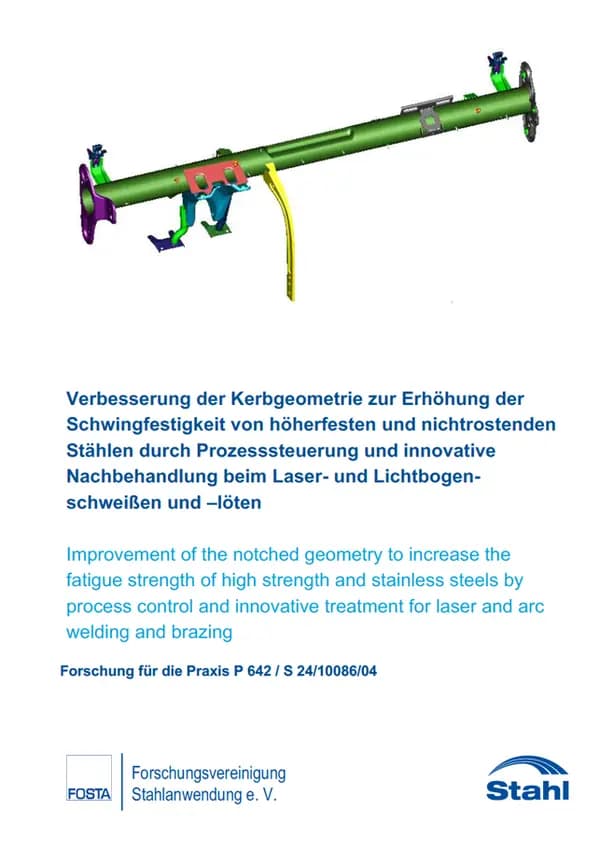
The aim of the project was to achieve higher fatigue strengths (ideally up to that of the base material) by improving the seam geometry of fillet welds at lap joints (sheet thickness s = 2 mm). For this purpose, the …
The aim of the project was to achieve higher fatigue strengths (ideally up to that of the base material) by improving the seam geometry of fillet welds at lap joints (sheet thickness s = 2 mm). For this purpose, the process control of already known and established joining processes (laser beam welding and brazing, MSG welding, MSG brazing, laser-MSG hybrid welding) for two steels, a high-strength ferritic-martensitic dual-phase steel (DPW600/ 1.0936) and a stainless austenitic steel (H400/1.4376), was first optimised. The influence of the energy intensity and its distribution during welding, the influence of the welding and brazing consumables and the shielding gas on the seam transition radius and seam rise were investigated.
Furthermore, an attempt was made to reduce the influence of the seam geometry on the MSG brazing processes by means of thermal post-treatment using the combined MIG-TIG process. In order to ensure the realisation of the results in industrial production, the transferability of the processes to a demonstrator component was also to be tested. For an initial assessment of the fatigue strength, Wöhler tests were first carried out on flat samples with overlap seams for both materials. In the next step, gas welding tests (variable load amplitude) were carried out on flat specimens with lap seams. The welding processes used for both materials were laser-MSG hybrid welding, laser beam welding and MIGWIG brazing. The latter represents an improvement on GMAW brazing in terms of the seam geometry due to the thermal post-treatment by the TIG process and was used for the DP-W600 using the filler material AlBz5Ni2 and for the H400 using the filler material CuAl8, in accordance with the results of the Wöhler tests. In addition, the corresponding Wöhler tests were also carried out for these variants for reasons of comparability. The feasibility of optimising the joining process was verified on a real component at the end of the project. For this purpose, instrument panel carriers with a welded steering column attachment were manufactured at an industrial partner of the group of supervisors in accordance with the knowledge gained in the project.
Payment by card (Stripe) or invoice (DE, AT, CH). Download link by email: automatically after ordering by card, after order approval for invoice (valid for 30 days). Terms
Machine-translated title and description. The document itself is in German.
Digital download
Other parts and editions as well as neighbouring documents of the same series.

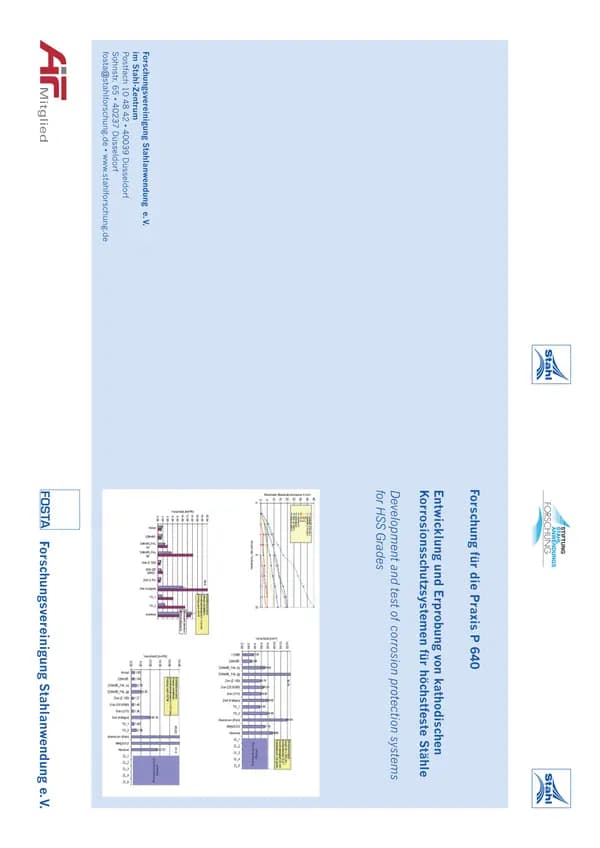
P 640 - Development and testing of cathodic corrosion protection systems for ultra-high-strength steels In addition to reliability and quality, vehicle safety and cost-effectiveness are decisive criteria for car manufacturers. Corrosion protection plays a key role here, as it increases the service life and service life. The advantages, disadvantages and areas of application of different corrosion protection measures in the automotive sector were compared. With the provision of high-strength steel grades, materials are available which, due to their mechanical properties, have a high potential for lightweight construction and very good energy absorption capacity. In conjunction with the possibility of hot forming, they are therefore predestined for the production of complicated, stress-compliant moulds in the crash-relevant bodywork area. The various conventional corrosion protection systems for press-hardened high-strength steels are described, characterised and compared. At present, there is no production-ready solution for the subsequent corrosion protection of components that have already been hot-formed. For this reason, a corrosion protection system based on the conventional hot-dip galvanising process was developed and applied. The development was based on an extensive investigation of the softening behaviour of the ultra-high-strength substrate 22MnB5. The newly developed product was compared with various conventional corrosion protection systems. The evaluation was carried out with regard to surface and coating properties, coating adhesion, corrosion behaviour, tribological properties and weldability. In addition to the tests on flat samples, component tests were also carried out. A section of a B-pillar was used as a component. Scanning electron microscopy and optical microscopy were used for evaluation. The investigations were carried out in close interdisciplinary co-operation between steel manufacturers, manufacturers/processors of coating systems, the automotive industry and research institutes. The research project was carried out at the VDEh-Betriebsforschungsinstitut GmbH, Düsseldorf and the Ingolstadt University of Applied Sciences Materials Technology Laboratory for Surface Technology with technical support and financial assistance from the Forschungsvereinigung Stahlanwendung e. V., Düsseldorf, with funds from the Stiftung Stahlanwendungsforschung, Essen. Authors: J. Kurzynski, C. Strobl, V. Merklinger, R. Salomon Publication: 2013
available anytime
€30.00
excl. VAT

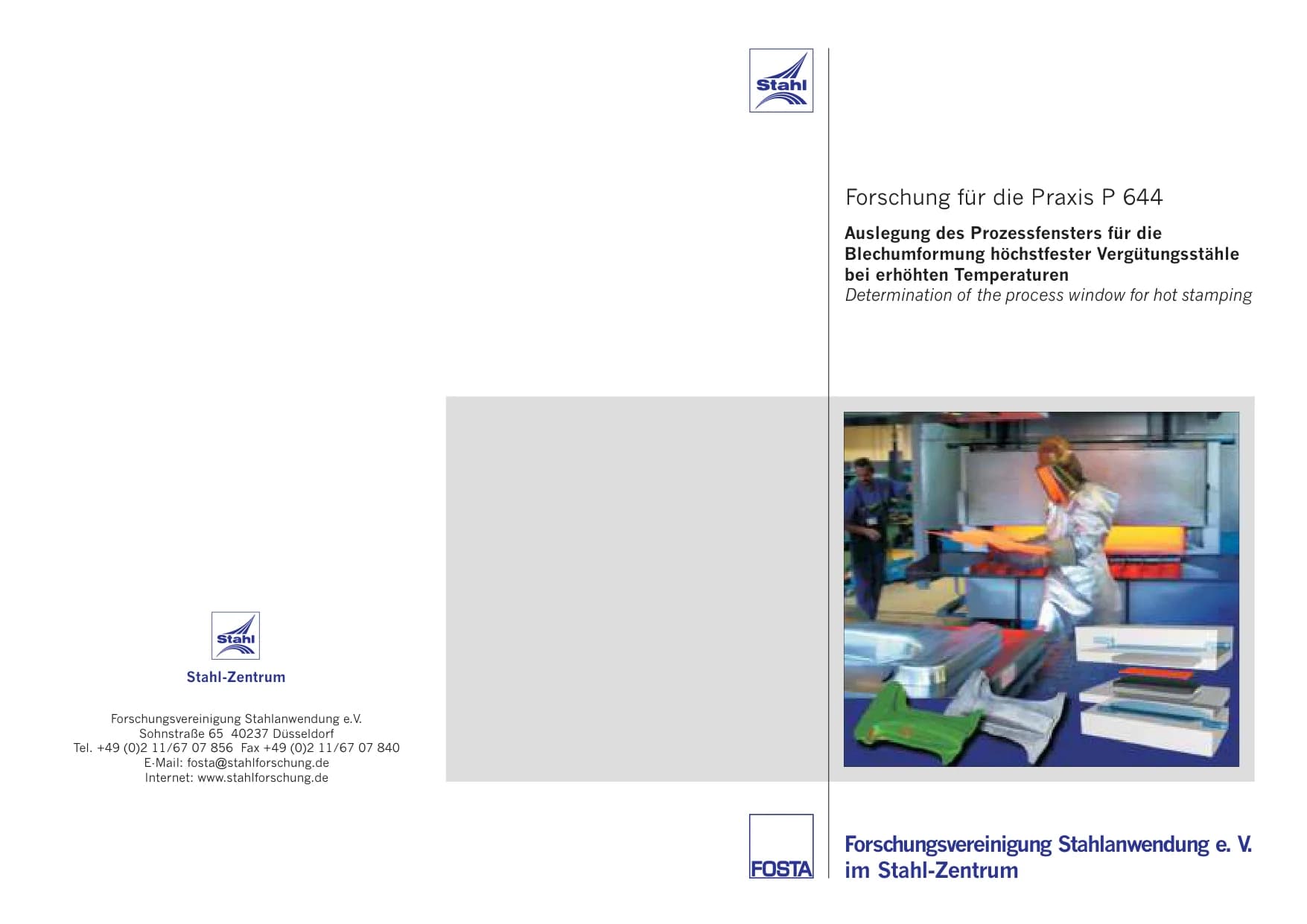
P 644 - Design of a process window for sheet metal forming of ultra-high-strength heat-treatable steels at elevated temperatures Reducing weight while at the same time meeting increasing safety requirements is a key issue in automotive engineering. This has led to a wide variety of solutions from the automotive and supplier industry. In recent years, press hardening technology has proven to be a good option for the production of crash-relevant body components. This involves a combination of hot forming and hardening, which are carried out simultaneously in a single process step. As part of the research project "Design of the process window for sheet metal forming of ultra-high-strength heat-treatable steels at elevated temperatures", the objective was to contribute to a better understanding of the process and to a more robust process design. For the investigations, the press hardening process was divided into the four process steps of austenitising, transfer, forming and hardening. The process window for austenitising was examined with regard to an upper and a lower limit for the austenitising time. It was found that the material exhibited similar hardness values regardless of the annealing time. Even a faster heating rate, which was realised by conductive sample heating, had no influence on the hardness values. A test set-up was developed specifically to determine the cooling rates typical of the process during hardening, with which the cooling can be determined by metallic contact on both sides. The resulting cooling rates as a function of the contact pressure could thus be determined. This contact condition was also modelled in finite element simulations and the heat transfer coefficient occurring in each case was detected by comparing the results from the experiment and the finite element simulation. Hot tensile tests were carried out to record the thermo-mechanical parameters of the steel 22MnB5 (1.5528) generally used for press hardening. With the aid of the Gleeble universal testing machine, which is equipped with a conductive heating unit, the typical time-temperature curve for press hardening was observed. The influence of temperature, strain rate, cooling rate and batch or sheet thickness was determined. DaimlerChrysler AG provided the mould for pressing a B-pillar as a demonstrator component. The influence of the hold-down distance and the holding time on the moulding result was determined both during the pressing process and afterwards by means of thermographic images, hardness and sheet thickness measurements. The demonstrator component was modelled with the finite element software LS Dyna using the process and material data previously determined in the experiments. The failure mode of the component and the temperature distribution could thus be reproduced well. Authors: M. Geiger, M. Merklein, C. Hoff, K. Roll, D. Lorenz Publication: 2006
available anytime
€30.00
excl. VAT

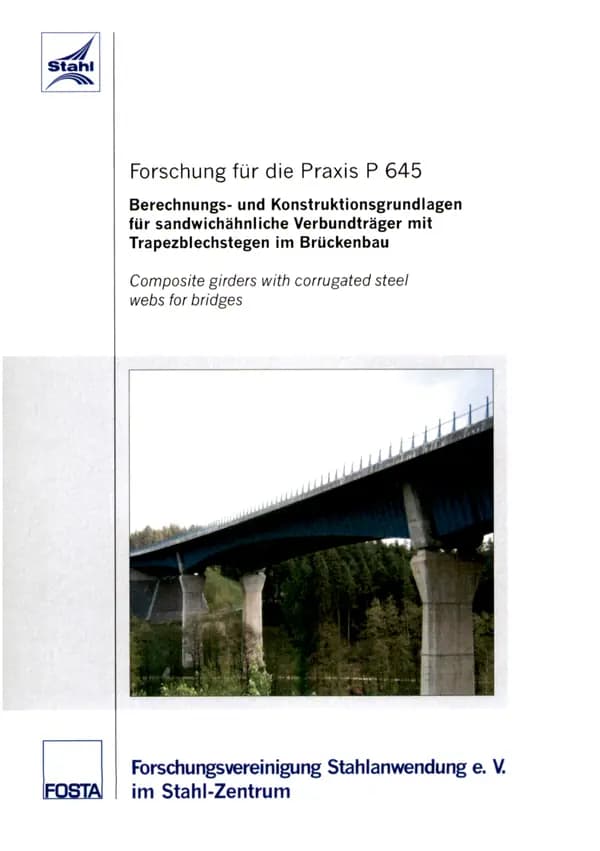
P 645 - Calculation and design principles for sandwich-like composite girders with trapezoidal sheet metal webs in bridge construction The use of trapezoidal sheet webs in composite bridge construction, which has so far only been practised on one pilot structure in Germany, offers structural and economic advantages over existing bridge construction methods due to the characteristic properties of trapezoidal sheet metal, such as a reduction in dead weight, increased buckling resistance and high transverse bending stiffness. However, there is insufficient experience and, above all, regulations available to fully utilise the advantages and enable an economical design. The construction of the first pilot bridge in Germany in particular has highlighted critical points here. In view of the advantages of the composite girder with trapezoidal sheet webs, the aim of the research project presented was to establish this construction method in bridge building and to promote the competitiveness of composite bridge building compared to other construction methods. The design of the connection between the trapezoidal sheet metal and the concrete chords has been unsatisfactory in some of the projects completed to date. In order to increase cost-effectiveness, there is therefore a need to optimise a composite joint solution that is efficient in practical construction terms. Initial tests on push-out structures with a trapezoidal sheet web and concrete or shear stud dowels under longitudinal shear loading showed ductile behaviour in which the web takes on a significant proportion of the load-bearing capacity and the fasteners further increase the load-bearing capacity. It was possible to derive a design concept for the concrete dowel fastener. Tests on the transverse bending load-bearing capacity showed good-natured behaviour and considerable load-bearing capacities. It was possible to derive a planar framework model in which the existing three-dimensional load transfer on the safe side is neglected for practical purposes and its effect is approximately captured by the design. The ability to record and calculate the load-bearing and deformation behaviour in a simple manner is an essential prerequisite for the potential of this construction method. Based on tests and parameter studies, an approximation method based on a modification of the shear area was developed for calculating the deformations with the aid of bar statics. In addition to these approximation solutions for the serviceability limit state, approximation formulae were also specified for the ultimate limit state, which enable the shear force distribution between the individual composite partners to be calculated. If the reinforced concrete composite girders with trapezoidal sheet webs are manufactured with a steel chord, as is normally the case, production limits are encountered that are specified by rules for welding in cold-formed areas. According to the existing standards, corresponding minimum bending radii min (r/t) must be adhered to in order to avoid brittle component failure depending on the sheet thickness t. These limit values are still based on steel grades of the older generation and do not take into account the excellent toughness properties of modern bridge construction steels. Experimental and numerical investigations were therefore carried out as part of the project, which clearly show that, in addition to the changes in the properties of the base material, no detrimental effects in the form of loss of toughness caused by strain ageing or coarse grain formation due to recrystallisation phenomena are to be expected when welding in cold-formed areas if the welded joints are carried out correctly. A restriction of the conditions cannot be justified for the investigated steel grades S355J2, S355N and S460M, for the sheet thickness t = 30mm and a degree of deformation of up to 10% elongation. In steel bridge construction, a complete cancellation of the conditions for welding in cold-formed steel is therefore recommended for degrees of deformation up to 10% elongation and the resulting minimum bending radii of r/t ≥ 5 for all sheet thicknesses and steel grades of strength class S355 and S460. This leads to significant savings in production costs, particularly for reinforced concrete composite beams with trapezoidal sheet webs, due to the elimination of costly heat treatments. As part of the investigations into the local application of force in the trapezoidal sheet web, it was shown that the transverse load-bearing capacity can be significantly increased even for a low profiling of the web plate with folding angles from α ≥ 15° due to the reduced stability risk of the web plate. The evaluation of the beam behaviour showed that, in contrast to the short load application lengths usually investigated to date for structural engineering applications, global buckling over the web plate height can also occur for long load application lengths, which are typical for today's displacement bearings in bridge construction, in addition to local buckling within the beads. By comparing existing design concepts with the experimental and numerical database, it could be shown that Kähönen's design proposal for the case of local buckling is also suitable for long load application lengths. To avoid global buckling, a minimum rib width was defined that excludes global buckling due to geometric parameters. It can be assumed that the considered convolution geometries are sufficient with regard to practical application. As a harmonised addition and improvement to the model, a factor for taking the folding angle into account is also proposed. Authors: B. Novák, F. Reichert, J. Röhm, U. Kuhlmann, P. Günther, B. Braun, J. Raichle, Publication: 2008
available anytime
€60.00
excl. VAT
Payment by card (Stripe) or invoice (DE, AT, CH). Download link by email: automatically after ordering by card, after order approval for invoice (valid for 30 days). Terms