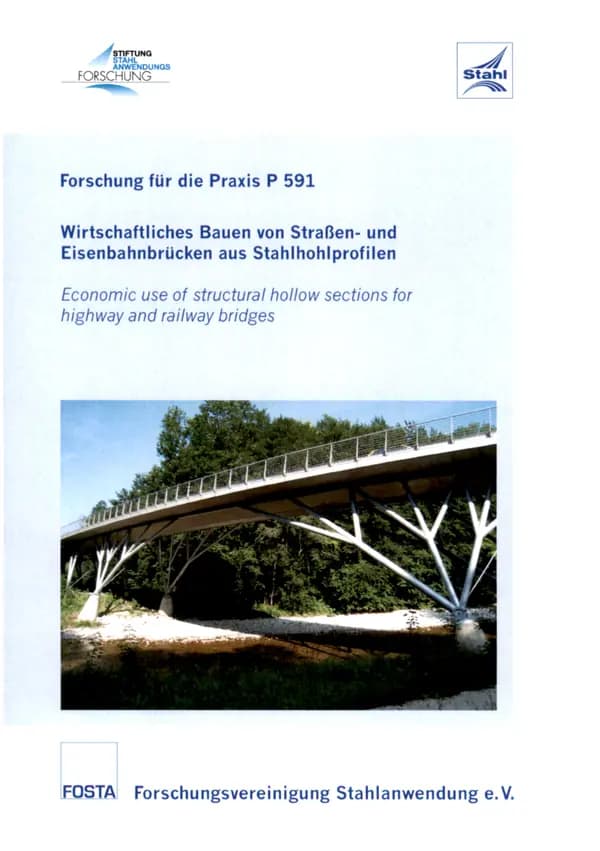
As part of the research project, extensive investigations were carried out on K-nodes made of cast steel and on connections of hot-formed hollow sections with a circular cross-section to components made of cast steel. …
As part of the research project, extensive investigations were carried out on K-nodes made of cast steel and on connections of hot-formed hollow sections with a circular cross-section to components made of cast steel. The focus here is on the fatigue behaviour of components with dimensions typical in bridge construction. Fatigue tests under tension and bending were carried out to investigate the butt-welded hollow section connections. A total of three series of tests were carried out with diameters ranging from 193.7 to 508 mm, wall thicknesses between 20 and 50 mm and with steel grades S355 and S460. The evaluation of the fatigue tests on butt joints with different design variants were analysed using Wöhler diagrams.
In detail, experimental investigations were carried out to provide information about possible casting defects, the material properties of the cast steel used, the influence of the weld seam formation on the fatigue strength and the crack propagation behaviour. The research report presents a numerical model with boundary elements (boundary element method), which can be used to calculate stress intensity factors at the crack front for assumed casting defects and to simulate crack propagation behaviour. For the calculation of the applied internal forces, the nodes were integrated into the model of a typical truss bridge. Parameter studies were then carried out to generalise these results. The influence of the material properties and the node geometry and load caused by the bridge type on the maximum permissible initial size of casting defects was analysed. Based on the results, practical design and dimensioning recommendations are given for connections with thick-walled hollow sections. One focus is on the use of cast steel in load-bearing structures, non-destructive testing and quality assurance measures. The aim is to eliminate errors in the application and avoid unnecessary costs. All the results obtained are prepared and presented in such a way that they can be included in the current guidelines (EC3, CIDECT, IIW). In addition, a table clearly summarises the most important results. In order to optimise the use of hollow sections in bridge construction, the designer and planner must be able to estimate which type of node - welded or cast steel - has the greatest economic advantage, depending on the technical requirements and also the manufacturing costs. For this reason, both technical and economic aspects are taken into account in order to select the most suitable manufacturing variant. in each case.
Payment by card (Stripe) or invoice (DE, AT, CH). Download link by email: automatically after ordering by card, after order approval for invoice (valid for 30 days). Terms
Machine-translated title and description. The document itself is in German.
Digital download
Other parts and editions as well as neighbouring documents of the same series.

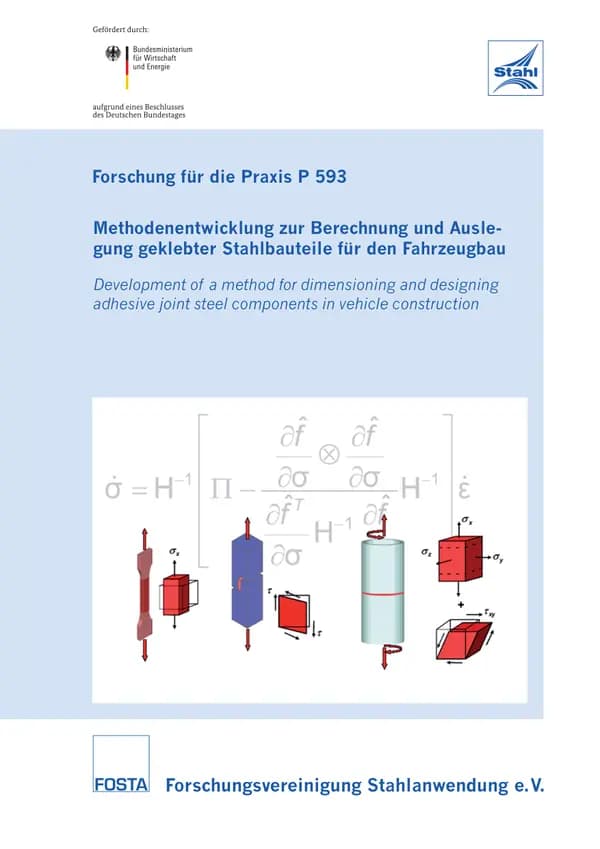
P 593 - Method development for the calculation and design of bonded steel components for vehicle construction The aim of the research project was to develop a method with which the stiffness and, in particular, the strength of individual bonded joints and entire bonded structures can be calculated or estimated using the finite element method (FEM) computer programmes used in the automotive industry. The starting point was material testing and strength theory based on continuum and fracture mechanics, which were consistently applied to the special features of the thin adhesive layer in a joint. The division of the experimental and theoretical investigations between the participating research centres led to the definition of suitable samples and test procedures to determine the mechanical behaviour of the adhesive or adhesive layer and the characteristic values derived from this for the numerical calculations of the stress state and the failure of an adhesive bond. On this basis, the mechanical modelling, the mathematical formulation of an adhesive-compatible material model and its implementation in FEM programs followed. To validate the experimental and numerical methods, structural deformations and joint failures were calculated numerically on component-like bonded joints and sample components and tested experimentally using field measurement technology. In comparison to the objectives of the research proposal, the experimental basic and component tests under quasi-static tensile loading, the theoretical foundations for mathematical modelling and the implementation in an FEM programme have been completed. In addition to the great progress that has been achieved with the research project, the results achieved so far also show that refinements and modifications still need to be made for individual steps in order to ultimately be able to provide the industry with a universally applicable calculation programme for bonded structures. The results, which are presented in detail in the research report, show in comparison with the existing literature or with industrial applications that a broad experimental and theoretical basis has been created for modern adhesive bonding technology and that a significant and far-reaching contribution has been made in the field of the calculation of bonded joints and a high level of knowledge and development has been achieved. Authors: O-D. Hennemann, M. Brede, O. Hesebeck, O. Hahn, J. Jendrny, C. Handing, M. Schlimmer, J. Bornemann Publication: 2015
available anytime
€50.00
excl. VAT

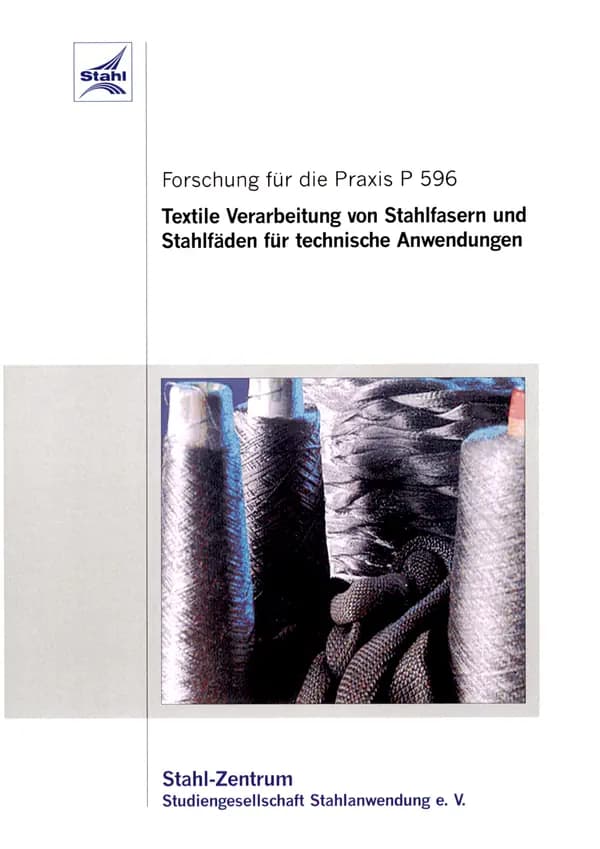
P 596 - Textile processing of steel fibres and steel threads for technical applications The demand for processing techniques and technical textiles with numerous possibilities for combining materials and functional properties remains very high. The task of this study was to present the current state of the art and to assess the potential for extended applications using steel fibres and steel threads. The investigations began with a complete survey of domestic and foreign (European) manufacturers of metal fibres, wires, ropes, fabrics, knitted fabrics, nets and nonwovens. As part of a survey, these manufacturers were asked to provide their product sheets in order to create a market overview. At the same time, an overview of commercially available linear and flat textile products was compiled, which makes the broad spectrum of textile technology options for fibre and thread processing transparent. By comparing these textile possibilities with the products that are already available on the market, the white areas were then identified in which steel fibres and steel threads have not yet received any attention, but nevertheless have high innovation potential in any kind of combination. The study clearly shows that the combination of steel fibres and threads with other textile fibre materials offers a multitude of previously unexploited possibilities for new developments and their application. Particular application potential for steel is seen in spacer fabrics, knitted and crocheted fabrics, knitted and crocheted fabrics, sewn fabrics, directly orientated structures (warp knitted fabrics, knitted fabrics), 3D shaping and nonwoven bonding by sewing. There also appear to be many previously unutilised possibilities in textile weaving technology when using steel. The paper contains a variety of suggestions and approaches for processing companies, the user industry and textile research institutes for the development of innovative textile products with new functional properties through the use of steel fibres and steel threads. STUDIENGESELLSCHAFT STAHLANWENDUNG e.V. Publication: 2002 Authors: Prof. Dr.-lng. habil. Dr h.c. P. Offermann, Dr M. Mägel
available anytime
€30.00
excl. VAT

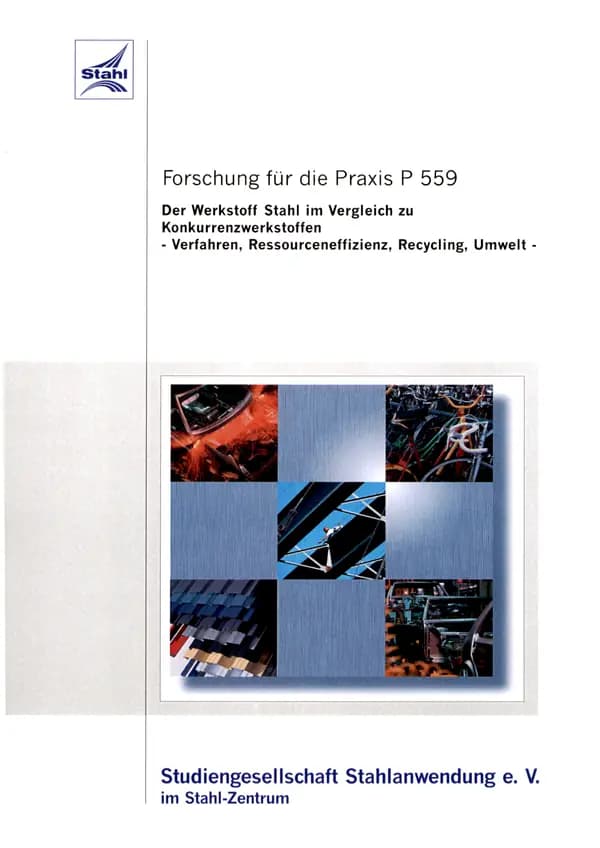
P 559 - The material steel in comparison to competing materials - processes, resource efficiency, recycling, environment The study "The material steel in comparison: Processes, resource efficiency, recycling, environment" was carried out on behalf of the Studiengesellschaft Stahlanwendung e.V. by the Wuppertal Institut für Klima, Umwelt, Energie GmbH in co-operation with the project office MR-ten from 8/2001 to 6/2002. This study shows ecological product comparisons for three different areas of steel applications: Building support frames, bicycle frames and car bodies. For the supporting frames and bicycle frames, product comparisons were carried out on the basis of aluminium, wood, concrete and carbon fibre reinforced plastic (CFRP). For the car body, an investigation was carried out into developments from the standard body to the ULSAB-AVC body (UltraLight Steel Auto Body - Advanced Vehicle Concepts). All analyses were carried out on the basis of a selection of relevant environmental indicators in accordance with the key environmental indicators defined by the European Environmental Agency (EEA). The indicators analysed are TMR (Total Material Requirement - a resource efficiency indicator); water consumption; CED (Cumulative Energy Expenditure); GWP 100 (Global Warming Potential - an indicator of the anthropogenic greenhouse effect). The focus of the study is on the comparison of the selected exemplary reference objects (products) and not on the comparison of materials. When comparing the supporting frames made of steel, reinforced concrete and timber (including corresponding ceiling constructions), no clearly ecologically favourable variants can be identified. When comparing the variants, the indicator values sometimes point in opposite directions or do not show a clear trend in the overall analysis. When analysing the bicycle frames, three different variants were considered: Steel frame, aluminium frame, CFRP frame. The comparison shows that the steel frame has by far the most favourable results for all indicators. This is followed at some distance by the aluminium frame and the CFRP frame. The result of the comparison between the aluminium and CFRP frames is not clear. The comparison of the bodies shows that, due to the reduced use of steel in the ULSAB-AVC body, body production is associated with lower environmental impacts across the life cycle with regard to the indicators analysed. than the traditional comparative body. The increased manufacturing costs for the ULSAB-AVC body, primarily the high power input for laser welding, reduce these savings without, however, compensating for them. Due to the lower weight of the ULSAB-AVC body and the resulting reduction in fuel consumption, the indicator values are reduced even more significantly during the utilisation phase. The indicators were selected in such a way that they reflect different environmental impacts and allow for reliable and decision-supporting statements. It can be assumed that this also applies to a large number of other products. It should be noted when analysing the individual indicators: With regard to possible combinations of different indicators, TMR should be combined with GWP, or if no suitable GWP data is available, TMR should be combined with KEA. In this way, both the predominantly climate-relevant energetic material conversions and the non-energetic inputs and the associated extraction processes (ores, etc.) can be mapped. By taking water consumption into account, a further area can be covered. The simultaneous consideration of CED and GWP, on the other hand, leads to an extensive duplication in the assessment of energy use. Authors: K. Herzog, C. Liedtke, M. Ritthof, H. Wallbaum, T. Merten Publication: 2003
available anytime
€30.00
excl. VAT
Payment by card (Stripe) or invoice (DE, AT, CH). Download link by email: automatically after ordering by card, after order approval for invoice (valid for 30 days). Terms